
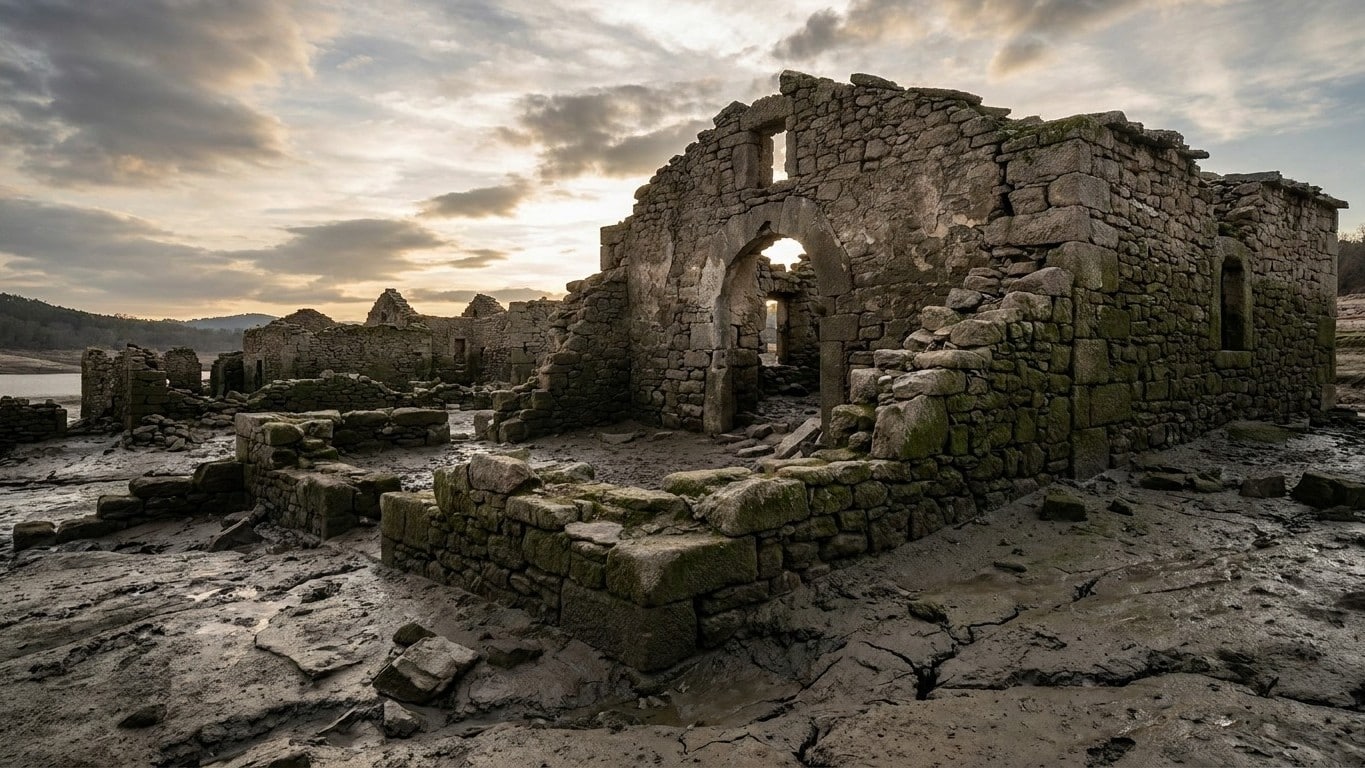
In April 2024, photos swarmed across social networks like an apparition. Stone walls rose from a bed of cracked silt, a century-old bridge, naked foundations eaten away by the mud but still standing. It isn’t Jordan nor a distant archaeological site. It’s Savoie, just a few kilometers from one of Europe’s busiest ski resorts. Beneath Lake Chevril lies the old Tignes, a Savoyard village submerged in 1952 by 235 million cubic meters of water, and which stubbornly refuses to disappear completely.
Key takeaways
- A six-day ultimatum to leave the site: on April 27, 1952, 400 mountaineers were forcibly expropriated
- Even the deceased were not spared from eviction: the cemetery was emptied brick by brick
- Every ten years, old Tignes resurfaces, drawing tens of thousands of visitors in search of memory
A village sacrificed on the altar of national reconstruction
In 1952, the construction of an 180-meter-tall hydroelectric dam swallowed the old village of Tignes and its 400 years of history under 235 million cubic meters of water. To grasp what that means concretely: it is the equivalent of 94,000 Olympic swimming pools. It was the highest arched dam in Europe at the time of its construction, designed by engineer André Coyne in a Savoy valley that, geographically, seemed tailor-made for this project.
Work on the Chevril dam began after the war in 1947, as France’s energy consumption started to rise. The context was brutal: the country was exhausted from the conflict, its factories barely functioning, coal in short supply. The Tignes dam was not a whim of an engineer. It was a matter of state necessity, decided at the expense of 400 mountain residents who had asked for nothing.
The old village comprised 150 traditional Savoyard houses, some dating back to the 16th century. The church of Saint-Jacques, a jewel of Savoyard baroque art built in 1679, boasted frescoes and altarpieces of exceptional artistic value. Before flooding, the services of the Monuments historiques could save some precious elements, including the Baroque altarpiece and several statues, today displayed in the new church of Tignes-le-Lac. The rest was dynamited, then swallowed.
A forced eviction, brick by brick
The 400 inhabitants of the time tried by all means, lawsuits and acts of sabotage included, to derail the project. The commune even went so far as to sue EDF for compensation large enough to be acceptable. Nothing worked. On 21 April 1952, the prefect of Savoie published a notice to the inhabitants: any who had not definitively left the site by 27 April 1952 would not receive any eviction indemnity. A stark ultimatum, leaving no room for ambiguity.
CRS riot police were mobilized to compel the departure of the last Tignards after the dam gates opened. A bulldozer cleared the path to the cemetery, followed by gravediggers tasked with relocating the dead. Even the deceased were expropriated. The last Mass in the church of Saint-Jacques was celebrated on Easter Sunday, 13 April 1952, under the surveillance of the CRS. Five days later, the village ceased to exist.
The church would be replicated at the entrance of the newly built station, higher up. A faithful copy, constructed farther away, as if a replica could erase the pain of the original destroyed. The current village of Tignes was rebuilt by a handful of Tignes locals in 1956 with the aid of state subsidies, near the natural lake of Tignes, giving birth to one of France’s highest resorts. A new village, without memory etched in its walls. The other, the real one, waited at the bottom of the water.
The decennial draining, between technical inspection and collective rite
Since its opening in 1953, the Tignes dam underwent a complete decennial draining of its reservoir, with the ruins of the submerged village resurfacing to perform a general inspection of the equipment and its arch. These moments had something of a rite as much as a technical operation. Every ten years, for a few weeks, the old Tignes reemerged into the air. Not intact, covered in mud and silence, but there nonetheless.
The March 2000 draining allowed many Tignards, including the few who originated from the old Tignes, to organize a Mass in the ruins of the submerged church. A ceremony out of time, in a space officially dead for half a century. During the last draining in 2014, the ruins of the old Tignes reappeared for several weeks, drawing more than 30,000 visitors. Thirty thousand people to see walls covered in mud. This figure says everything about the power of such a place: people come not for the beauty of the spectacle, but because something buried rises to the surface, both literally and figuratively.
What visitors discover is not a postcard backdrop. There remain only a few walls, but there is a substantial layer of mud, at least a meter deep. In short, the bottom of the lake is a vast muddy expanse with a few ruins protruding and a small lake that remains between the dam and the old village. Not spectacular in a tourist sense. Moving, for those who know what lies there.
Technology against memory: a paradox of the era
EDF now employs underwater robots to avoid draining the lake during inspections. This technological choice, as rational as it is, deprives the descendants of Tignes of a rare ritual: walking through the streets of their ancestors, a pause between two impoundments. It seems there will be no more decennial draining, as inspections are now performed thanks to underwater robots, limiting service interruptions. The last inspection drain occurred in April 2014.
In April 2024, a partial drain for maintenance reproduced the phenomenon: the lake was partly emptied and certain ruins, having resisted water and mud, resurfaced. Partial, not total. Sufficient to rekindle emotion on social networks, but without the full plunge into the past that decennial drainage once allowed. This is the paradox of this site: the more technology advances, the less chance the village has of resurfacing.
The old Tignes is not an isolated case. To allow the construction of France’s hydroelectric reservoirs, it was necessary to drown 44 inhabited valleys. Artificial lakes swallowed many villages, primarily in the Alps, the Massif Central, and the Jura. Tignes remains the most publicized case, but it is not isolated. Several French communes have undertaken procedures to classify or protect memory, in conjunction with departmental archives and the General Inventory of Cultural Heritage. A late but real recognition for territories long relegated to the status of collateral damage of progress. The old Tignes, for its part, did not wait for administrative decisions to endure: seventy years under water, and its walls still stand.
Sources: glisseavecplaisir.blogspot.com | francetastique.info
