
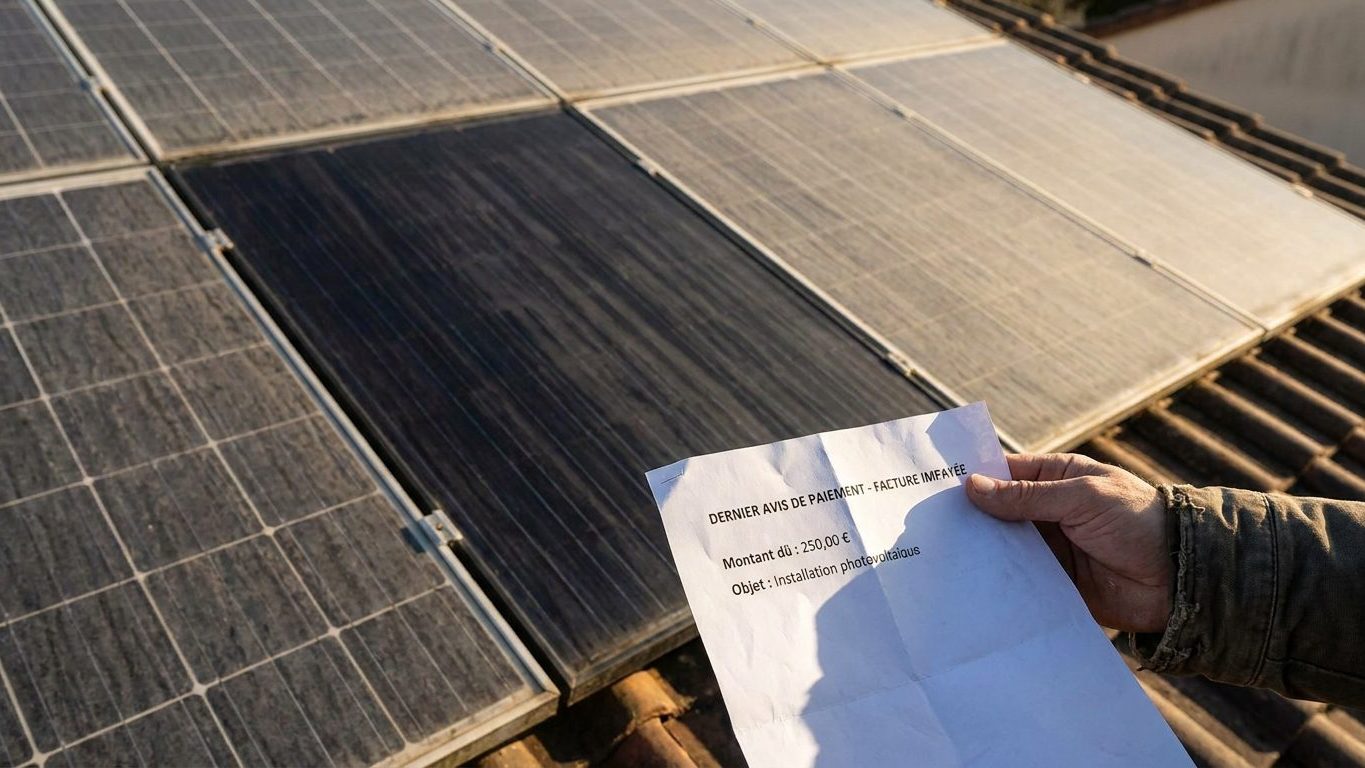
A salesperson calls on a Saturday afternoon. He talks about savings, resale of electricity, and a loan that “pays for itself” thanks to solar production. Years later, the seller has vanished, the installation no longer produces, and the monthly payment still lands in the bank account.
The scenario has become banal. A private individual receives a visit from a salesperson at home, who sells a photovoltaic installation presented as self-financed by energy savings. The purchase order is signed the same day, at the same time as a tied loan taken out with a partner financial institution. No time to think at night, no second opinion from a competing tradesperson. Just a signature, slipped between the coffee and the cooled coffee.
- The residential inverter typically fails between 10 and 12 years, well before the end of the loan which can run for 15 to 20 years.
- Canceling the sales contract does not automatically erase the tied loan; the bank remains a creditor of the borrowed capital.
- Checking the decennial warranty, the RGE certification, and the company’s age before signing prevents 90% of future problems.
- The decennial warranty only covers solar panels if they contribute to the building’s structural integrity or watertightness.
A return that never aligns with the business calculation
A few months later, the installation works poorly, or the installer disappears, placed into liquidation. The connection drags, the production study proves overly optimistic, the roof frame sometimes was never adequately checked before installation. Many consumers approached at home for solar panels are promised energy savings, rapid profitability, government grants, all financed by a loan presented as a formality; then the first difficulties appear: delays, connection flaws, breakdowns, non-existent after-sales service.
The weak point, almost always, is the inverter. This component that converts the panels’ direct current into usable household electricity is also the most fragile of the entire installation. In the field, a residential string inverter generally lasts about ten years, often 10 to 12 years, the determining factor being thermal management and component quality rather than the number of kWh produced. Well before the loan is paid off, the installation’s keystone component has a good chance of failing.
And there, no one answers the phone anymore. In the meantime, the monthly loan withdrawals continue, as if nothing were wrong. The contrast is stark: on one side a roof that produces nothing, on the other an automatic debit, month after month, for years.
Why the loan outlives the seller
Many borrowers believe that a company in liquidation erases their debt. That is false. The consumer believes there is a simple remedy: cancel the sale contract tainted by formal irregularities and free themselves from the loan. The legal reality is more demanding: canceling the main contract does indeed cancel the tied loan, but it leaves, in principle, the obligation to repay the bank the borrowed capital.
The tied loan is backed by a specific sales contract. Its disappearance is not enough on its own to annul the loan.
The fault, when it exists, lies elsewhere. The real lever is in the lender’s fault for releasing the funds without verifying the formal validity of the purchase order, and the Court of Cassation’s first civil chamber has built, case after case, a precise mechanism that shifts the burden of the capital to the negligent bank when the installer is insolvent. Concretely: when the bank had erred by disbursing the borrowed capital to the seller, it could not rely on repayment following the cancellation of the tied loan, jurisprudence noting that the lender should not release funds without verifying the completion certificate and the compliance of the purchase order.
Courts have already ruled in this sense. The Rouen Court of Appeal deemed insufficient the pre-printed brand mention followed by “or equivalent,” noting the absence of the exact brand of the panels, and confirmed the nullity after observing several irregularities in the purchase order. An administrative detail, at first glance. It was enough to topple the entire contractual edifice.
The nuance matters. Poor execution of the works or excessive electricity consumption falls under the seller, not the bank; a November 2025 ruling rejects the argument that the damage was “solely attributable to the installer seller,” distinguishing this damage from that arising from the impossibility of recovering the price from the liquidated seller, which indeed stems from the lender’s fault. Two damages, two logics, and no automatic link between a breakdown and the loan’s cancellation.
What really protects, before signing
Three simple verifications change everything. The first: the installer’s decennial warranty. It is valid for ten years from the completion of the work, and this remains true even if the installer no longer exists, which allows it to be invoked even after a bankruptcy. Still, it must be checked before work begins, not after the incident.
The second verification concerns the company’s age. A company created only a few months earlier, without verifiable client references or a traceable physical address, should trigger immediate concern.
The third rule is the easiest to apply: never sign during the salesperson’s visit. Require the RGE certification, mandatory for reduced VAT, and verify the certificate on the official site before signing, as well as the installer’s decennial insurance. Comparing at least two quotes over several days also helps spot production studies that are overly optimistic.
A final guideline worth knowing: the decennial warranty does not cover everything. It only applies if the panels contribute to the building’s solidity or watertightness; equipment for producing electricity that is not linked to the structure may be excluded. This technical distinction explains why so many cases hit a legal wall once a failure occurs and the installer cannot be found.
Sources: salagnon-avocat-nantes.fr | kohenavocats.fr
