
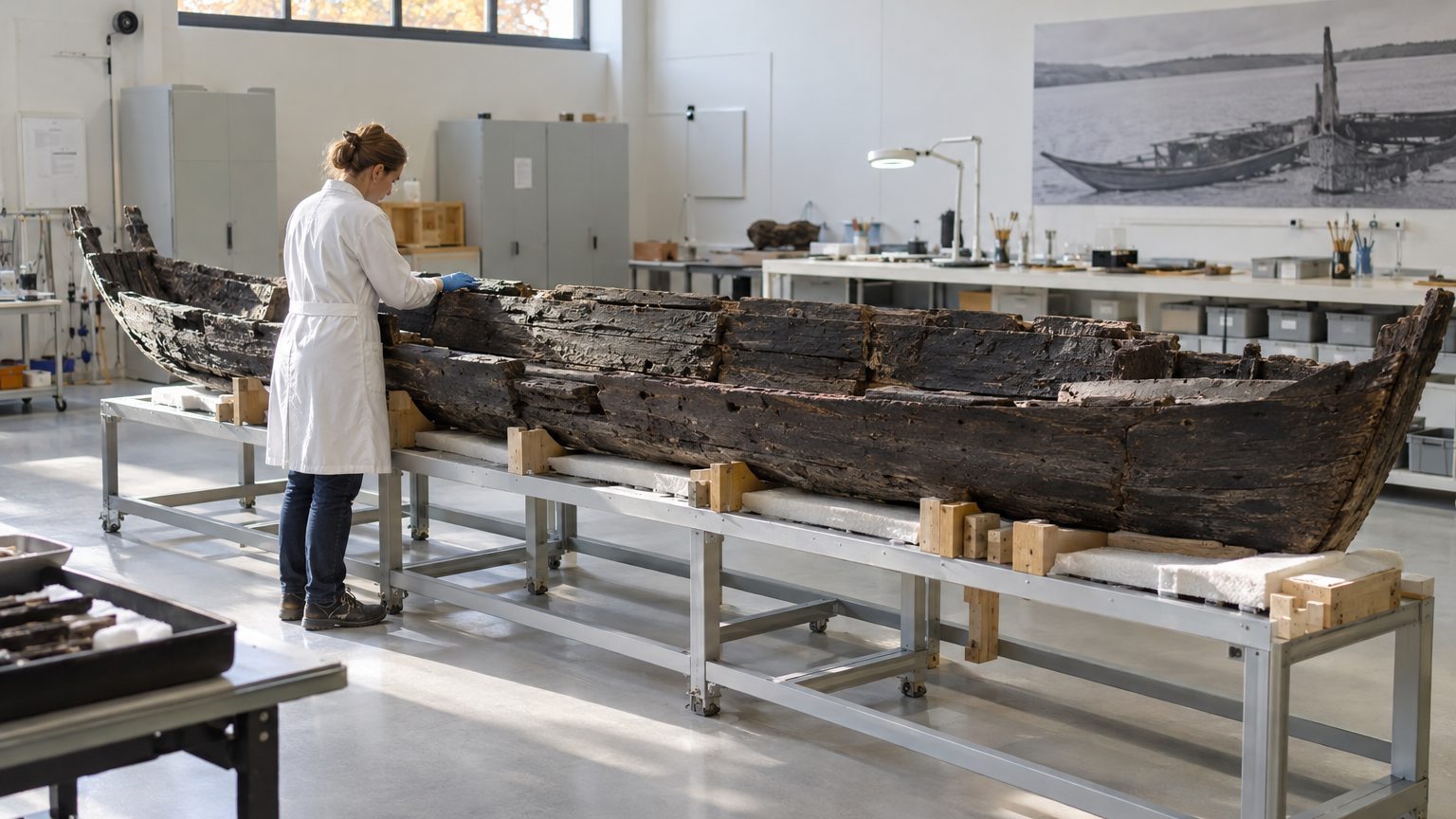
In 2003, archaeologists from Inrap uncovered 16 boats on the site of an underground parking facility, at the edge of Lyon’s Saint-Georges district, on the right bank of the Saône. Among them, a second-century CE barge, originally measuring 28 meters in length. To save it, it had to be dismantled into nearly 1,000 pieces.
The excavations were preventive, mandated by the state.
- Sixteen vessels were unearthed in 2003 beneath a Lyon parking lot.
- The preserved Roman barge measures 17 meters of the original 28.
- Dismantling required nearly 1,000 pieces and 2,100 nails removed one by one.
- The timber was consolidated with PEG and then lyophilized in Grenoble, at Arc-Nucléart.
Sixteen vessels beneath the same park
The details of these 16 wrecks are laid out in a monograph published in 2010 in Archaeonautica (volume 16, CNRS éditions), directed by Éric Rieth. It lists five large Roman barges and a bac or lighter, two medieval pirogues, seven live-fish boats from the early 16th century, and a boat dated to 1746. The excavation was carried out by Inrap under the direction of Grégoire Ayala, with Marc Guyon for the study of Gallo-Roman craft.
The site thus narrates more than fifteen centuries of river life, from ancient commerce to later usages. The vivier boats, as their name implies, were likely used to keep live fish. One of them, a pirogue-vivier, has in fact been restored and entrusted to the Gadagne Museum in Lyon, which Inrap announced in November 2020. The largest piece remained the Roman barge, nicknamed “Lyon Saint-Georges 4” (LSG 4).
A 28-meter barge, of which 17 were recovered
Of the original 28 meters, the excavators recovered only 17 meters of hull. Researchers believe it was a flat-bottom vessel, 4.85 meters wide and 1.35 meters high, sailing the Rhône-Saône river system. The archaeologists think it was used for trade on the Rhône.
Once dug up, it was not displayed immediately. The barge spent about ten years in a water body, under provisional conservation, before returning to the shore on 28 January 2014. It was sent to Grenoble, where Arc-Nucléart’s workshop, specialized in waterlogged archaeological wood, took charge.
The barge belongs to the Metropolis of Lyon, and the restoration was overseen jointly by an Inrap archaeologist and a restorer from Arc-Nucléart. Lyon Parc Auto, a mixed-economy company that operates parking facilities, financed the operation, according to the Federation of Local Public Enterprise Companies. The parking lot thus ended up paying for the wrecks it had uncovered.
1,000 pieces, 2,100 nails, a year of soaking
Wood that has remained underwater for eighteen centuries does not simply dry in the sun. It would warp, crack, or collapse. Before anything, the team placed the barge in a 200-square-meter workshop where temperature and humidity are continuously controlled.
The dismantling then began, piece by piece, each accurately labeled to guarantee reassembly. The puzzle consisted of nearly 1,000 elements. And 2,100 nails had to be removed one by one, because iron posed a real problem: when oxidized in the presence of moisture, it forms pyrite, a sulfur compound that produces sulfuric acid capable of eating away at the wood.
The iron was gone; what remained was the wood to be consolidated.
The pieces were first freed from metallic compounds by gentle brushing, then impregnated for a year with a consolidant, polyethylene glycol (PEG), which gradually replaces the water in the fibers. They were then lyophilized: frozen at -30 °C for several weeks, then dried under vacuum, so that ice transitions directly to vapor. The process limits distortions. For the most damaged part, the restorers chose another path, impregnated with resin and then hardened by gamma radiation, according to the Nucléart method.
Arc-Nucléart, a laboratory affiliated with the CEA, presents itself as one of the few in the world capable of carrying out impregnation on this scale. Inrap and the laboratory announced the completion of the treatment in September 2016. The press release even spoke, in its title, of a “fifteen-meter boat,” while the body of the text clearly states that 17 meters were preserved out of 28.
The Fourvière Museum, planned destination
The barge is destined for Lyon-Fourvière’s Gallo-Roman Museum, now called Lugdunum. The constraints are heavy: according to the project led by the Rhône Department, the boat can only be housed on the ground floor, in a room with a controlled atmosphere, which would require first moving the museum’s current reserve. Following restoration, the wreck would have to be dismantled again and preserved under a controlled atmosphere on a purpose-built support.
As for the timeline, announcements have varied over the years: the 2016 press coverage spoke of about two years, a researcher’s page mentioned an exhibition in early 2021, and I found no confirmation of a public display to date. Before going up to Fourvière to see it, it is best to check directly with the Lugdunum Museum.
Another agreement was signed on 11 October 2016 at the Fourvière Museum between Inrap and Lyon Parc Auto, for new research on the LSG 4 barge.
Sources: archeofluviale.e-monsite.com | cea.fr
