
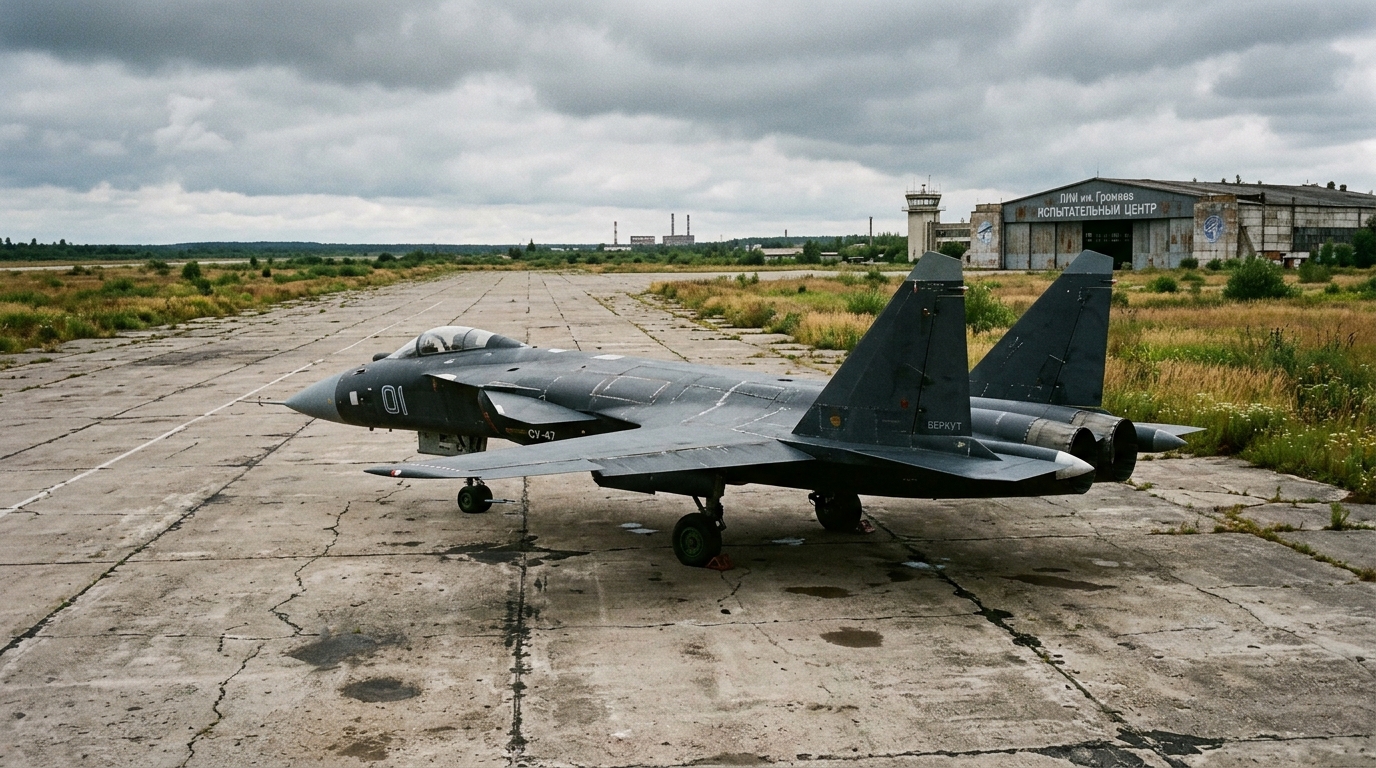
On one side, there are aircraft rolled out in series, flying by the hundreds and writing the history of military aviation with a string of commercial records. On the other, there are those that remain unique, almost secret, quietly shaping the decades that follow. The Su-47 Berkut belongs to the second category, the realm of ghost airplanes whose influence extends far beyond their solitary fate. Built by Sukhoi in the late 1990s, this forward-swept-wing aircraft never left prototype status. Only a single airframe saw life, only one took to the skies, and yet its innovations eventually fed into the program that produced the Su-57, Russia’s first fifth-generation fighter. How could a lone aircraft leave such a lasting imprint? This is the story of a bold and perilous technological gamble.
- The Su-47 Berkut, first flight in 1997 at Zhukovsky, remained a unique example featuring forward-swept wings that granted excellent low-speed maneuverability.
- Its abandonment stems from the aircraft’s intrinsic instability, the complexity of flight at supersonic speeds, and the development cost in a Russia economically fragile at the time.
- Its innovations (composite structures, electronic flight control of an unstable aircraft, internal weapons bay) were reused on the Su-35BM and later on the Su-57, contributing to Sukhoi’s selection as the lead designer for the PAK FA program in 2002.
- An inverted wing that defies all classical aerodynamic laws
- Why this unique aircraft never left the prototype stage
- The Su-47 is dead, but its technologies survived in the PAK FA
- What the Berkut teaches us about the future of Russian combat aviation
An inverted wing that defies all classical aerodynamic laws
At first glance, the Su-47 might look like a design misstep. Its wings, instead of extending backward as on nearly all modern fighters, point forward. This configuration, known as an inverted sweep, is not a mere aesthetic eccentricity. It serves a precise aerodynamic logic: to deliver exceptional handling at low speeds and high angles of attack, those moments when a fighter must literally pitch up to surprise an adversary in close-quarters combat. The prototype, identified by the white side number 01, performed its first flight at Zhukovsky in September 1997, before being officially renamed Su-47 in 2002.
To fulfill this promise, Russian engineers had to rely heavily on composite materials, capable of withstanding the structural stresses generated by this wing configuration without buckling under aerodynamic load. The Berkut did not emerge from nowhere: it drew extensively on avionics technologies developed for the Su-27 modernization program, from which it borrowed visible elements such as the canopy design, the landing gear, and the nearly vertical fins. A lineage that reminds us that even the boldest, most futuristic projects often grow out of solid and proven foundations.
Why this unique aircraft never left the prototype stage
The historical context in which this project sprang to life was far from ideal. The collapse of the USSR in 1991 simply halted many Russian aviation programs due to budget constraints and a lack of a clear strategic vision. That Sukhoi managed to keep its technology demonstrator alive in such an atmosphere of uncertainty is almost an industrial feat in itself. But perseverance wasn’t enough to turn the experiment into a production aircraft: the sole airframe remained a costly and complex testbed rather than an operational fighter.
Several factors explain the abandonment. The inverted-forward wing, while promising subsonic advantages, made supersonic handling considerably more challenging, a domain where modern fighters must excel. More importantly, the aircraft proved intrinsically unstable, requiring an extraordinarily sophisticated electronic flight-control system to remain controllable. These technical constraints, combined with a development cost difficult to justify in an economically fragile Russia, sealed the Berkut’s fate: it would stay unique, never proliferating.
The Su-47 is dead, but its technologies survived in the PAK FA
Here the story takes an unexpected turn. Even though the emblematic wing of the Su-47 was abandoned, the aircraft did not vanish without a trace. Quite the contrary: several advanced technologies tested on this prototype were directly adopted by the 4.5th generation fighter Su-35BM, and then by the 5th generation PAK FA T-50 prototype, which has since become the Su-57. The paradox is striking: the most visually distinctive aircraft in recent Russian history ended up feeding the country’s most strategic program, designed to rival Western stealth fighters.
The Su-57 ultimately carries a conventional wing, a traditional forward sweep rather than an inverted one. The real contribution of the Berkut does not lie in its silhouette, but in the experience gained: mastering the construction and control of large composite structures, learning to electronically stabilize an aircraft deliberately rendered unstable to gain agility, and above all integrating an internal weapons bay to preserve stealth. These capabilities are now essential for any fighter conceived around radar invisibility, with the Su-57 using composites for about a quarter of its structure. In May 2002, this accumulation of know-how directly led to Sukhoi being chosen as the lead designer of the PAK FA program, proof that the Berkut’s commercial failure masked a discreet technological triumph.
What the Berkut teaches us about the future of Russian combat aviation
For a long time, the sole example languished at Zhukovsky, but it reappeared in a striking fashion at MAKS 2019, the air show held at Zhukovsky International Airport near Moscow. The aircraft, towed for the occasion, was no longer airworthy, yet its mere presence reminded everyone how this fighter remains a singular piece in Russia’s aerospace imagination. A relic displayed like a relic, almost a totem, symbolizing a era when technical audacity sometimes outweighed industrial profitability.
What the Berkut’s story ultimately shows is how a military program can be deemed a commercial failure while constituting a major strategic success. The Su-47 was never intended to engage in combat, but to explore, test, and pioneer technical solutions that other aircraft would later leverage. This logic of a test bed, rather than a finished product, seems to characterize a certain Russian approach to aerospace development, where experimentation sometimes takes precedence over immediate production.
In the end, the Su-47 Berkut embodies the fascinating idea that an aircraft can disappear while remaining deeply present, concealed within the technological core of its successor. Its forward-oriented wings belong to history itself, but its invisible legacy continues to fly aboard the Su-57. The question remains whether, in the decades ahead, another uniquely styled prototype will dare to defy established aerodynamic conventions, even if it, too, remains solitary in its kind.
