
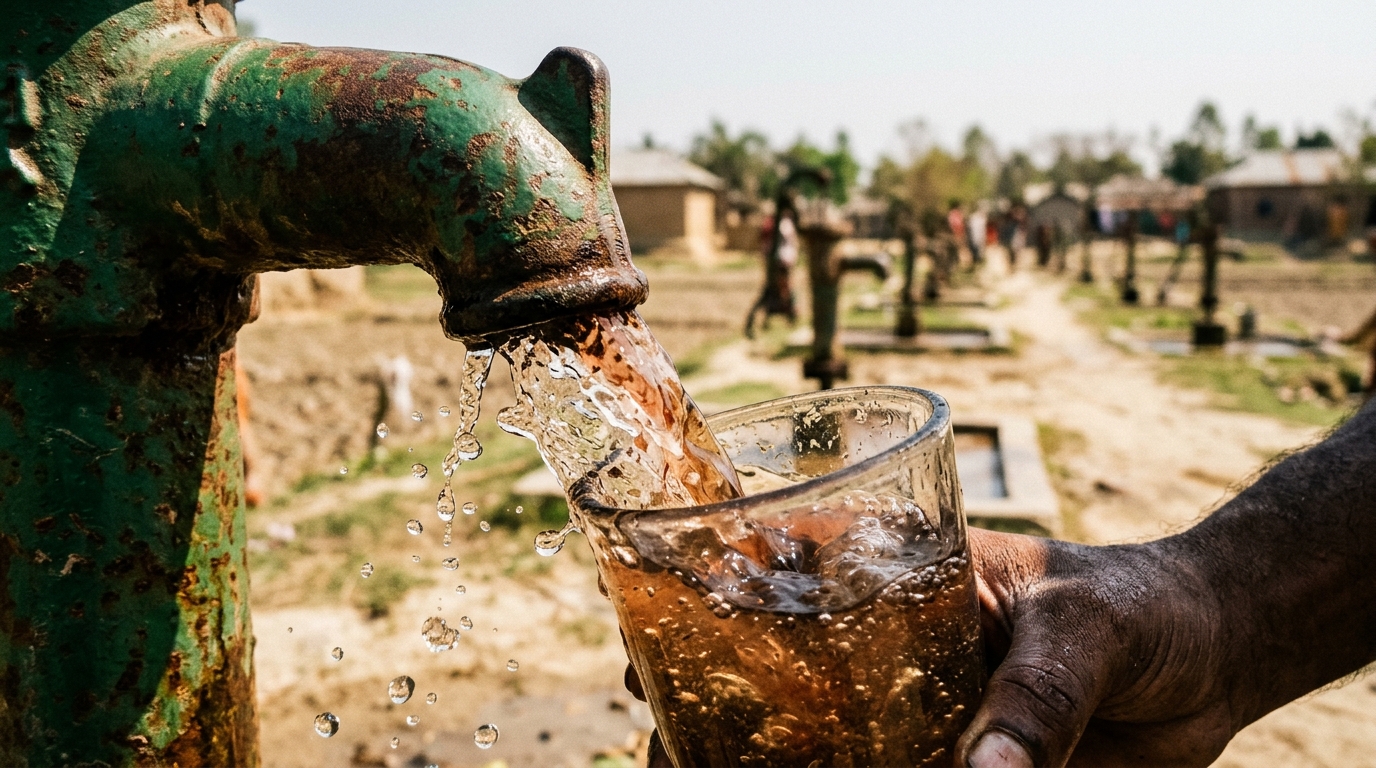
Imagine a country that, within a few decades, managed to cut infant mortality in half with a single measure: digging wells. A public health feat celebrated worldwide. And yet this same solution would later turn against tens of millions of people, exposing them unknowingly to one of the most insidious poisons that exists. Welcome to the little-known story of Bangladesh’s wells, where a resounding victory over cholera ended up becoming one of the greatest mass poisonings ever recorded.
- During the 1970s-1980s, millions of wells were drilled in Bangladesh to combat cholera, without initial tests screening for arsenic.
- About 75 million people were exposed to underground water naturally high in arsenic, a poisoning described by the WHO as the largest in history.
- Wells drilled beyond 150 meters offer safer water, but the majority of existing boreholes do not exceed 50 meters, leaving around 20 million Bangladeshis still exposed today.
- A miracle solution that hid an invisible poison
- Arsenic, this killer no test revealed
- Dozens of millions of villagers poisoned without knowing
- When a health victory becomes a silent disaster
A miracle solution that hid an invisible poison
In the 1970s and 1980s, Bangladesh faced a chilling reality: the surface waters, rivers and ponds from which villagers drew water were responsible every year for deadly diarrheal diseases and repeated cholera outbreaks. In response to this scourge, the Bangladeshi government partnered with UNICEF, the World Bank and the United Nations to launch a program of unprecedented scale: driving tubed wells that could draw water directly from underground aquifers, far from the bacterial contamination that gnaws at surface waters.
The result exceeded all expectations. About ten million wells were sunk across the country, drawing water from depths between 10 and 40 meters. In forty years, infant mortality was halved, largely thanks to this water now deemed safer. On paper, everything seemed perfect: waterborne diseases receded, children survived more, and Bangladesh became almost a model to follow in public health. No one at the time could imagine that the very subsurface would become the enemy.
Arsenic, this killer no test revealed
What engineers and health authorities had not anticipated is that the Brahmaputra basin, the great river that flows through Bangladesh, sits atop a groundwater layer naturally rich in arsenic. An invisible element, without odor or taste, capable of quietly accumulating in the body for years before causing skin lesions, cancers or irreversible cardiovascular damage.
The tragedy is that during the massive installation of wells in the late 1970s, the tests conducted were limited to looking for bacteria, iron and chlorine. Arsenic, it simply wasn’t tested for. UNICEF itself now acknowledges this flaw in the initial control protocol. The result: millions of wells deemed perfectly safe were actually distributing slowly toxic water, without anyone realizing it for many years.
Dozens of millions of villagers poisoned without knowing
It would take until 1993, more than fifteen years after the drilling program began, for the Bangladeshi government to officially confirm the scale of the problem. A considerable delay, during which generations of villagers continued to drink, cook and irrigate with contaminated water, convinced they had finally gained access to a safe resource.
The figures are staggering. It is now estimated that around 75 million people, spread across 59 of the country’s 64 districts, are exposed to arsenic-laden water above safe thresholds. A Human Rights Watch report even notes that around 20 million Bangladeshis continue today to drink contaminated water from government wells, a figure that has remained roughly stable despite years of awareness campaigns. The World Health Organization has not hesitated to describe this situation as the largest poisoning of a population in history.
When a health victory becomes a silent disaster
The paradox is striking: the solution intended to save lives ended up threatening far more. Studies have shown that wells reaching at least 150 meters typically access deeper, safer aquifers, since arsenic is mainly concentrated in the more superficial geological layers. The problem is that the vast majority of existing boreholes stop around 50 meters, far too shallow to escape contamination.
Reboring several million wells to a suitable depth represents a colossal undertaking, technically and financially, for a country already grappling with numerous other challenges. In the meantime, entire villages continue to live with this invisible sword of Damocles, water that looks clean, smells neutral, and appears harmless, yet slowly poisons entire bodies, generation after generation.
This story reminds us of a truth too often forgotten: a technical solution, even one designed with the best intentions and validated by the world’s leading institutions, can yield unpredictable consequences when it disrupts a natural balance that is poorly understood. Bangladesh defeated cholera by digging beneath its feet, but it awakened—without realizing it—a sleeping poison in its subsoil for millennia. The question extends far beyond this country’s borders: how many other solutions touted today as decisive advances are likewise hiding risks we are not yet able to measure?
