
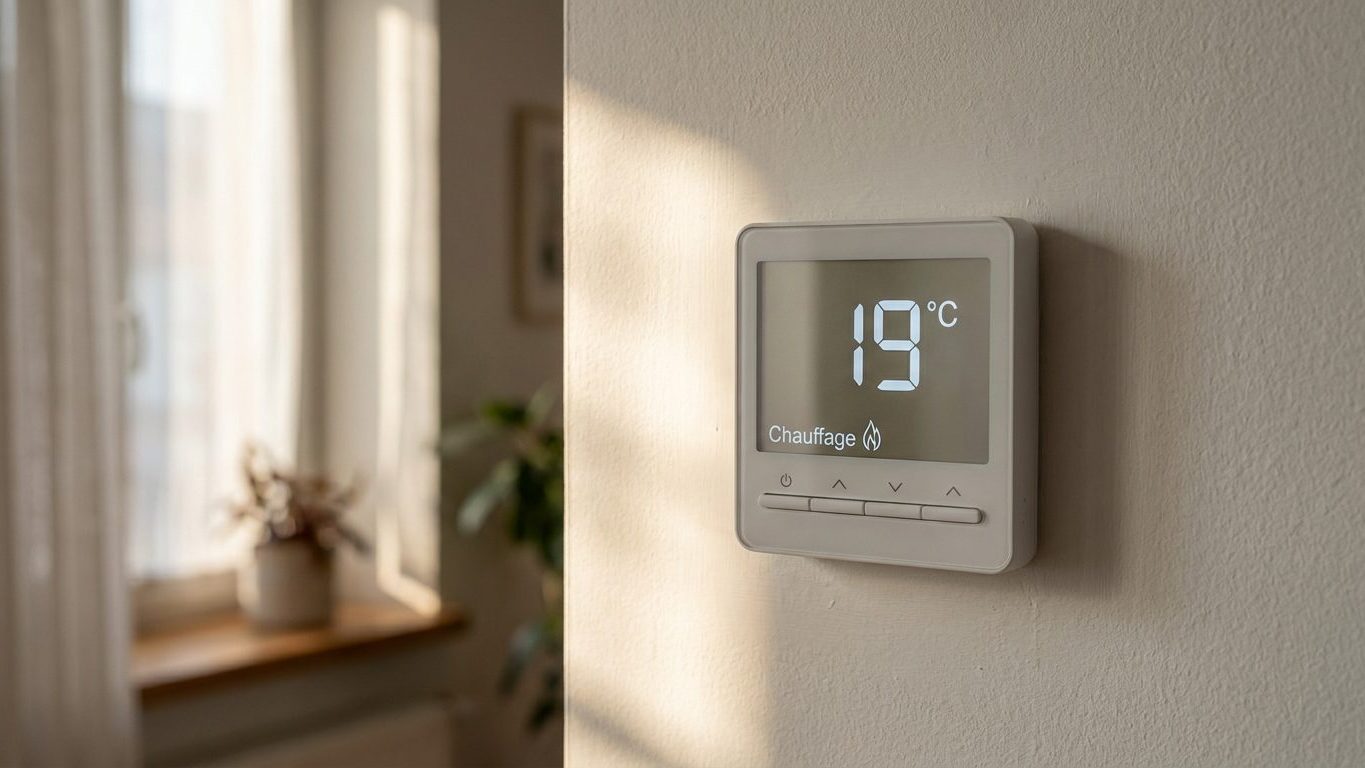
This week, thousands of households switch their heating back on after the summer. Many are about to follow, without realizing it, what they believe to be a simple rule of common sense: keep heating at a maximum of 19°C. This instruction is not a moral guideline but a legal obligation written into French law for more than fifty years.
And this rule has never been repealed.
- A 1979 decree legally caps the average heating temperature at 19°C in French homes
- This rule targets an average over the entire dwelling, not a ceiling per room
- Elderly people, young children, and patients cared for at home may benefit from an average of 22°C
- A fine of 1,500 euros is provided for non-compliance, but there is practically no enforcement
A text born out of the urgency of the oil shock
The energy-saving law established the principle in the mid-1970s: limit the heat emitted by buildings to reduce France’s dependence on imported fuel oil. This measure was introduced within the framework of the Energy Savings Law of October 22, 1974, amid an energy crisis. A few years later, a decree specified the threshold and embedded it in the Building and Housing Code. Decree No. 79-907 of October 22, 1979, echoed by Article R.131-20 of the Building and Housing Code, limits the average heating temperature in spaces used for living, education, offices, or reception of the public to 19°C. This regulatory text was adopted in response to the oil shocks of the 1970s.
Parliamentarians repeatedly called for the abrogation of this decree from the early 2000s onward, arguing it had become outdated once the price of oil dropped. A deputy even questioned the government about the impracticality of maintaining a decree born of a petrol shortage and no longer applied in practice, requesting its repeal. Each time, the response was the same: there would be no changes to the text. The Government did not intend to modify the existing regulation on heating temperature limits for housing and the tertiary sector, which account for a significant share of national energy consumption.
What the rule really says (and what it does not say)
The text does not set a per-room ceiling, but an average across the entire dwelling. Concretely, a living room heated to 21°C, five bedrooms at 17°C, and a garage at 12°C would perfectly comply with the regulatory obligation. It is an average for the entire dwelling: if the living room reaches 21°C, the five bedrooms 17°C, and the garage 12°C, the regulatory obligation is met.
The law never targets a single room.
Certain groups are covered by a different regime: dwellings housing the elderly, very young children, or patients cared for at home can be heated to a higher average. The average heating temperature can be raised to 22°C in homes where medical care is provided to non-hospitalized individuals or where elderly people or young children reside. A single room, however, must never exceed 24°C, including exemptions. The heating temperature of an individual room must, likewise, not exceed 24°C. These exceptions are set out in a 1977 order, almost contemporaneous with the initial decree.
A theoretical fine, an almost non-existent enforcement
Non-compliance with this ceiling would, in theory, constitute a fifth-class misdemeanor, carrying a fine of up to €1,500, an amount that can be doubled on a second offense. The sum can rise to €3,000 for repeated violations. Penalties are provided for by Article R241-29-1 of the same code in case of non-compliance with the dwelling’s average temperature.
Yet, no officer will actually go and measure temperatures in private homes.
The government itself acknowledged this during the autumn 2022 energy sobriety campaign. There was never any plan to conduct room-by-room checks to ensure the temperature is being respected. In the private sector, this kind of verification simply does not exist in practice.
What one degree really changes (and why walls matter more than the thermometer)
Physics, of course, does not argue. In a well-insulated dwelling, the walls aren’t cold and that temperature feels comfortable. When insulation is poor and losses create cold drafts, occupants tend to push the heating higher, leading to greater consumption. A room at 19°C in a well-insulated home often feels more comfortable than a room at 21°C with a cold wall, because the body perceives radiation from the walls almost as much as the temperature shown by the thermostat.
As early as 2004, a deputy questioned the government about social housing heated to around 17°C, far below the legal threshold, where many elderly residents lived. Many tenants, particularly seniors in social housing, complained of temperatures often around 17°C, underheated for several years. Twenty years later, social landlords still ignore the existence of the 22°C derogation provided by the same 1977 order. Many property owners and social landlords are unaware of this right and refuse to heat their homes above 19°C. The reference text, for its part, remains exactly the one drafted in the wake of the oil shock, unchanged for forty-seven years.
Sources: sortiraparis.com | village-justice.com
