
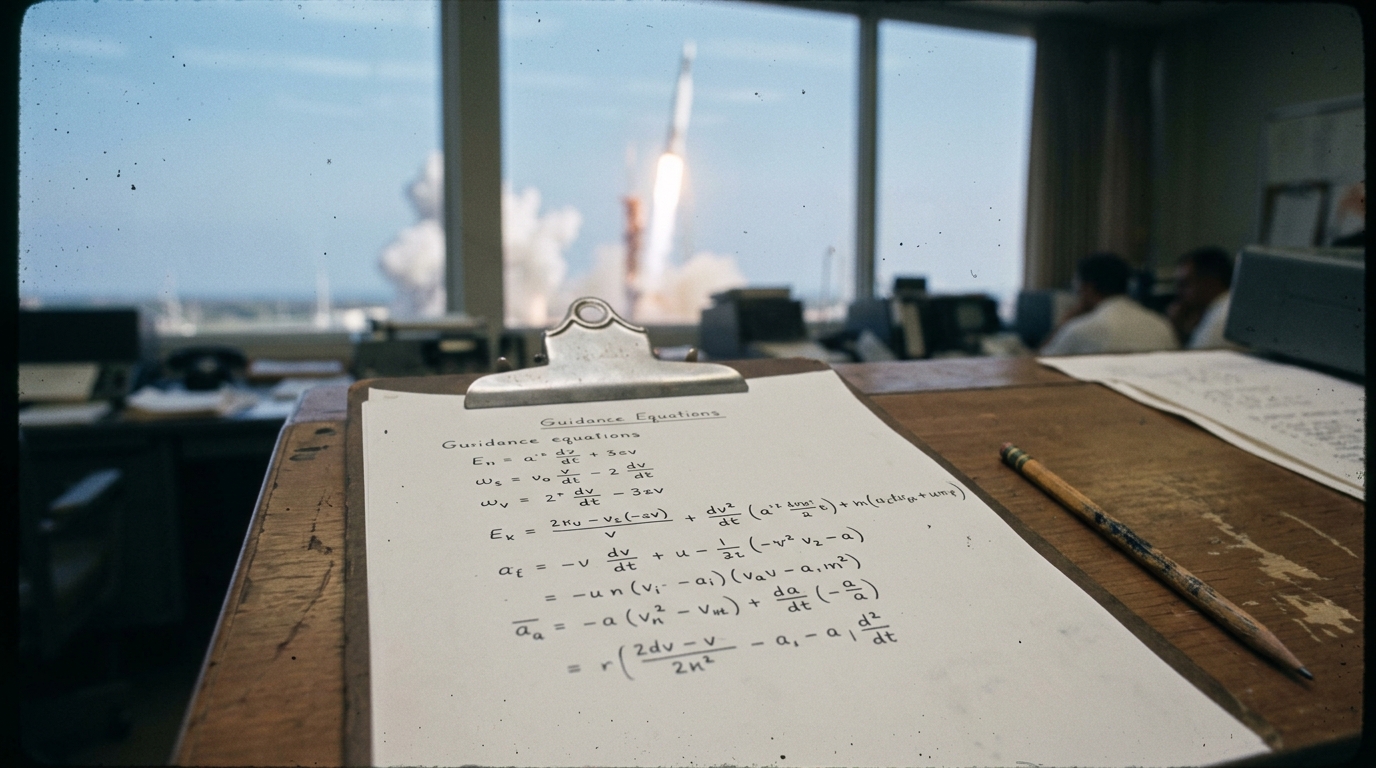
There are space disasters that can be attributed to bad luck, to an unpredictable solar storm, or to an unforeseeable mechanical failure. And then there are those born from a detail so tiny it becomes almost comical, if the final bill weren’t so steep. The story of Mariner 1 belongs to this second category. In this autumn when people like to revisit the grand sagas of space exploration, this 1962 fiasco deserves attention, for it perfectly illustrates this troubling idea: sometimes it isn’t the storms that sink ships, but a simple oversight on a spreadsheet.
- On July 22, 1962, the Atlas-Agena rocket carrying Mariner 1 had to be destroyed in flight roughly 293 seconds after liftoff due to an erratic trajectory.
- The root cause lay in the omission of a smoothing bar in the transcription of a guidance equation, rendering the software incapable of distinguishing a real deviation from radar noise.
- One month later, on August 27, 1962, the twin probe Mariner 2 launched successfully and became the first American mission to fly by another planet, skimming Venus in December.
- The launch that turns into a silent nightmare
- A missing cue, a trajectory that derails
- The radical decision that saves the mission and costs a fortune
- What Mariner 1 changed forever in aerospace
Le décollage qui tourne au cauchemar silencieux
On July 22, 1962, an Atlas-Agena rocket rises from Launch Complex 12 at Cape Canaveral. At its apex sits the Mariner 1 probe, the product of years of work, charged with achieving an unprecedented feat for the United States: the first close flyby of another planet. The target is Venus, this scorching, enigmatic neighbor about which only fragments of its atmosphere were known. The NASA engineers had equipped the spacecraft with instruments designed to probe that gaseous envelope, hoping to finally pierce some of its mysteries.
The initial seconds of the flight appear normal. But very quickly something goes wrong. The rocket begins to drift subtly off its intended path, as if unsure which way to go. On the ground, the control teams watch with rising unease as these deviations accumulate. No one yet suspects that the probe is following instructions that are completely erroneous, dictated by a guidance system that has become unable to distinguish a genuine deviation from mere radar noise.
Un signe manquant, une trajectoire qui déraille
The investigation that followed the catastrophe would reveal a cause as dizzying as it is seemingly trivial. Everything stems from a hand-written guidance equation, later transcribed into the computer program responsible for piloting the rocket. In this transcription, one detail was forgotten: a smoothing bar, that little horizontal stroke placed above a mathematical symbol to indicate that a value should be averaged over time, rather than used as a raw, instantaneous datum.
This missing dash might seem inconsequential, but it sets off a cascade of effects. Without this smoothing function, the guidance software begins treating every tiny fluctuation detected by the radar as a real and urgent deviation from the planned trajectory. The result: the rocket receives control orders that are erratic, wildly disproportionate to its actual position. To make matters worse, a fault in the onboard transmission system, the so-called Atlas airborne beacon, causes speed signals to be lost, depriving ground controllers of reliable information at the moment they need it most.
La décision radicale qui sauve la mise et coûte une fortune
About 293 seconds after liftoff, the situation becomes untenable. The rocket, buffeted by incoherent corrections, threatens to wander far beyond its permitted flight zone, with a real danger of reentry over populated areas. The flight-safety officer, charged with managing such catastrophe scenarios, makes the only possible decision: he orders self-destruction. In an instant, Mariner 1 explodes in the sky above the Atlantic, leaving the ground crew to witness years of work vanish in a cloud of smoke.
The price tag matches the scale of the disaster: approximately $18.5 million disappeared, a staggering sum for the era. The science-fiction writer Arthur C. Clarke, famed for his quips, would later sum up the affair in his 1968 work The Promise of Space, describing the incident as the most expensive hinge in history. A wry British-turn of phrase that left a lasting stamp on the space-minded public memory.
Ce que Mariner 1 a changé pour toujours dans l’aérospatiale
Undeterred, NASA teams quickly returned to work. The transcription error was identified, corrected, and barely a month later, on August 27, 1962, the twin probe Mariner 2 launched as planned. This time everything went as intended: the probe skimmed Venus in December of that year, becoming the first American mission to brush past another planet. A resounding comeback achieved in record time.
Since then, the Mariner 1 episode has become a genuine case study, taught in software engineering courses around the world. It reminds us that no error is too small to overlook, especially when it hides in the code that drives machines launched at thousands of kilometers per hour. Revisions, cross-checks, and meticulous transcription of mathematical formulas have become indispensable steps in designing critical systems, whether they voyage toward Venus or pilot today’s commercial airliners.
Ultimately, the tale of Mariner 1 is not merely about a spectacular and costly failure. It is a lesson in humility for engineers, for developers, for anyone who now handles lines of code capable of affecting our lives far more subtly than a rocket launch. A missing dash, a misplaced comma, a missing parenthesis: six decades on, the question remains astoundingly relevant. How many of our current systems, however sophisticated, still hinge on a detail as fragile and invisible?
