
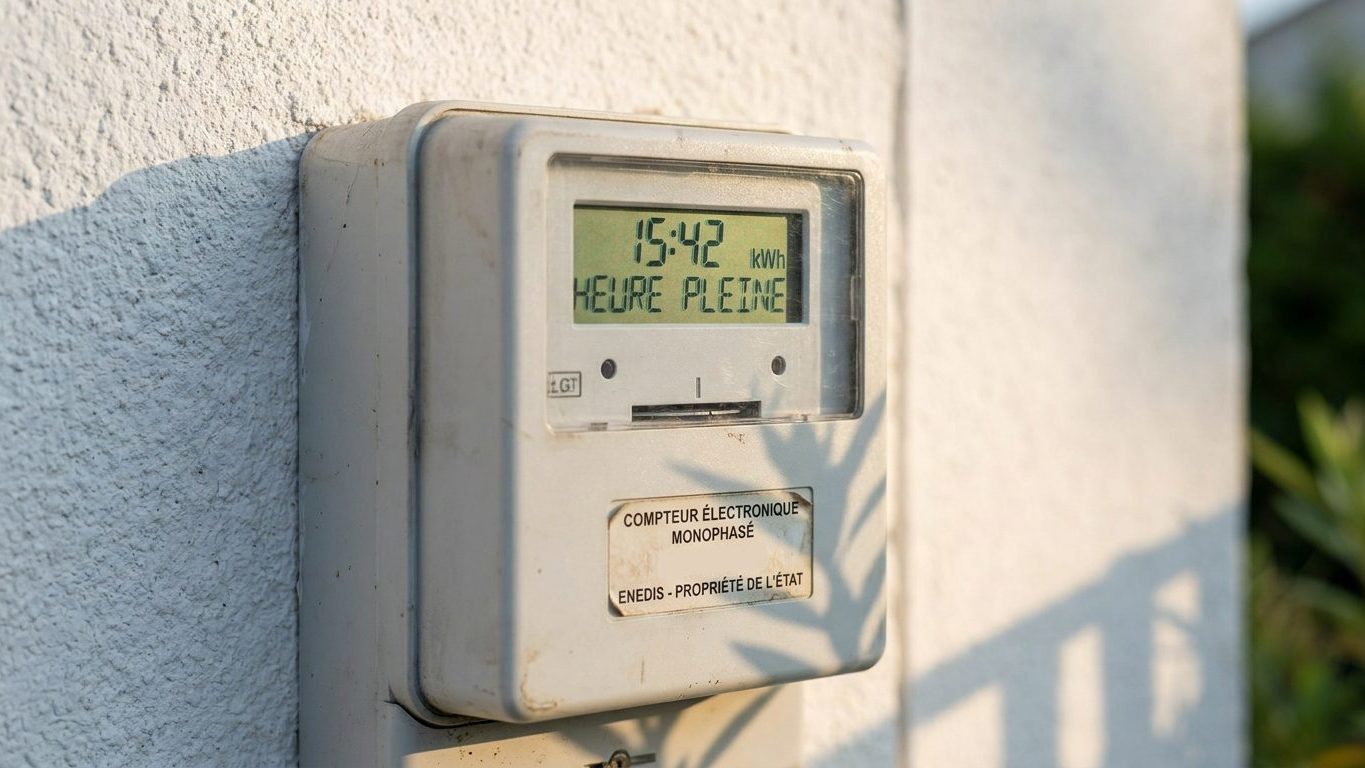
Since November 1, 2025, Enedis is carrying out a profound reform of a system that the French believed to be fixed since the 1960s: off-peak hours are no longer automatically nocturnal. In line with the provisions of the tariff for the use of public electricity networks (TURPE 7) defined by the Energy Regulatory Commission in March 2025, Enedis is rolling out the reform of peak/off-peak hours. Practically, a portion of these advantageous tariff windows shifts toward the middle of the day, and devices programmed to run at night risk switching to the peak tariff without anyone making any changes.
The historic system rested on a simple logic. The Off-Peak / Peak Hours arrangement has existed since the 1960s and allows customers to benefit from a reduced price per kilowatt-hour during periods of low demand, historically at night. The system had been designed for a specific reason: to absorb the production from the French nuclear fleet, which cannot be stopped suddenly when consumption falls after sunset.
- The off-peak hours migrate partially from night to the afternoon to align consumption with solar production peaks.
- Water heaters, washing machines and electric vehicles programmed to run at night will switch to the peak tariff without automatic notification.
- The total number of off-peak hours remains the same, but their distribution will change progressively until October 2027 depending on the housing.
The solar power has inverted the problem off-peak hours were meant to solve
The electricity grid’s physics have shifted. The issue is no longer the night; it is the middle of the day. The Energy Regulatory Commission advised Enedis to shift off-peak hour windows to align with solar production peaks, placing some off-peak hours in the daytime during spring and summer, when photovoltaic production reaches its national maximum. The direct market consequence: prices on the wholesale markets can dip below zero.
A concrete example illustrates the phenomenon. This summer, electricity prices turned negative, sliding to as low as minus 36.15 euros per megawatt-hour in late July, when photovoltaic plants are operating at full capacity and the surplus must be exported at very low or even negative prices. Paying to get rid of an electricity surplus is the paradox the French grid now faces during sunny daytime hours.
Shifting off-peak hours directly addresses this imbalance. The reform aims to move part of demand toward the afternoon, when photovoltaic production is at its peak and prices at their lowest, which should help balance the system and reduce the occurrence of negative prices. In plain terms, we no longer push households toward a night that has become less strategic; we lure them toward the afternoon, where excess electricity is abundant.
The water heater and the washing machine do not automatically follow
This technical shift has a very concrete effect in homes. The reform, decisioned by the CRE, aims to encourage smarter consumption, in step with the moments when electricity is most available and cheapest. But household equipment remains set to the old hours unless it is updated.
The water heater is the first to be affected. Connected to the day/night switch on the electrical panel, the water heater receives a signal from Enedis during off-peak hours and begins heating water during those windows to store it for later use. If the appliance is not connected to the new signal, it continues to heat at the same hours as before, without knowing that the situation has changed.
The same goes for other programmable uses. This change aims to smooth electricity consumption by encouraging people to run their water heater, their tumble dryer, or recharge their electric vehicle during off-peak periods that are no longer tied to the evening or morning rushes. A washing machine started at 2 a.m. out of habit, a nighttime EV recharge; these settings, inherited from a logic that dates back decades, can now operate during peak hours without triggering any alert on the meter.
There is no automatic notice inside the home. That is the blind spot of the reform.
Check your meter before the bill climbs
The good news is that the number of off-peak hours per day does not change. Consumers who have subscribed to a peak/off-peak offer keep their eight off-peak hours per day, including at least five consecutive hours at night. Only their distribution evolves, with a portion migrating to the afternoon depending on the season.
The timetable for the shift stretches over several months. This reform concerns 14.5 million customers with an off-peak / peak offer, of whom 3.5 million already enjoy time slots compatible with the new rules; for the remaining 11 million, off-peak hours will gradually evolve between November 2025 and October 2027. In other words, the issue is not settled: the transition continues home by home, meter by meter, until 2027.
To know where you stand, one simple check suffices. Look at your bill, your supplier’s customer space, or directly the Linky meter menu, where the time slots assigned to the delivery point are displayed. Each residence has its own slots, locally set by Enedis, which explains why two neighbors can suddenly find themselves with different hours.
This reform is not insignificant in its symbolic scope. It is the most significant overhaul since the introduction of off-peak hours in the 1970s-1980s, which aimed to optimize the use of electricity, such as for water heaters. Fifty years after it was designed to absorb nuclear output at night, the same tariff tool changes function to absorb a daytime solar influx, proving that the French electrical grid must now adapt to two very different production rhythms.
Sources: divertissonsnous.com | bourseinside.fr
