
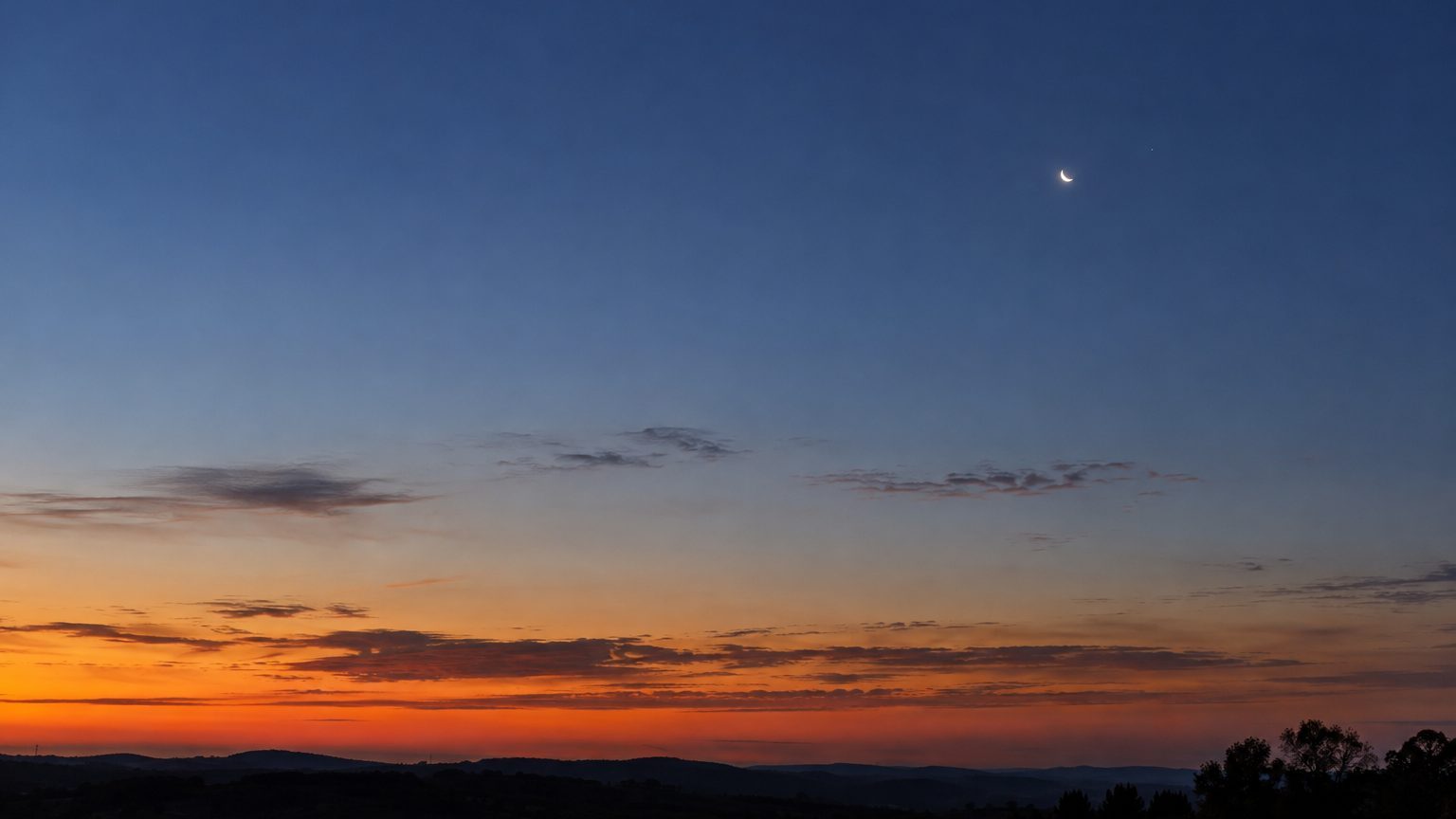
On October 24, 2026, Venus will pass between Earth and the Sun, at a distance a little over 40 million kilometers from us. EarthSky places the exact moment at 4:00 UTC, roughly 6:00 a.m. in Paris, well before sunrise (ephemerides differ by a few minutes). The planet that had been shining in the evening sky since the summer will then tilt into the morning sky, a passage astronomers call an inferior conjunction.
From October 12, Venus will set before the Sun.
- Venus will pass into inferior conjunction on October 24, 2026 at 4 h UTC, shifting from the evening sky to the dawn sky
- The planet will never be as bright as in the weeks preceding its disappearance, with a magnitude of -4.8
- No transit will be visible: Venus will pass 6.5° from the Sun, far too far to leave a dark dot on the star
A planet that laps Earth every 19.5 months
Venus races along its orbit at about 35 km/s, compared with Earth’s 30 km/s. Its path is shorter as it orbits closer to the Sun. It thus gains a lap on us roughly every 19.5 months. The previous inferior conjunction occurred on March 23, 2025.
Since October 3, Venus has appeared to retrograde among the stars, an apparent motion caused by perspective due to the overtake. This apparent retrograde motion will end on November 14. No real backward motion, of course: the planet continues to travel in the same direction around the Sun.
On October 24, the Earth-Venus distance will be about 0.28 astronomical unit, a little over 40 million km. That’s more than 100 times the Earth–Moon distance, and a little more than 2 minutes of light travel time.
This figure comes from a calculation, not from a published value we would have reviewed: Earth will be about 0.994 AU from the Sun at the end of October, Venus about 0.72 AU, yielding a separation of 0.27–0.28 AU. Expect a margin of about 1 million km. As for Venus’ angular offset from the Sun, 6.5° at the center of the conjunction according to the Astrofiles calendar, it only marginally lengthens this distance.
No transit, but a planet at the peak of its brightness
No dark spot will cross the Sun this time.
Venus will pass about 6.5° from the Sun, i.e., roughly twelve times its apparent diameter, and on the southern side. A perfect alignment would trigger a transit, and the next one won’t occur until December 10–11, 2117. On October 24, the illuminated side will be almost entirely turned away from Earth, resulting in a disk of nearly 1 arcminute in diameter, about thirty times smaller than the Moon.
To the naked eye, it’s a lost cause. EarthSky reserves any attempts, whether with a telescope or in photography, for experienced solar observers, with the caution required near the Sun.
Paradoxically: Venus is never as bright as in the weeks surrounding its disappearance. Close to us, it presents a large disk, and even if only a crescent is illuminated, this combination yields a magnitude of -4.8. On the morning side, its maximum brightness is expected on November 27, at -4.9. Astronomers refer to it as the greatest brilliance, a geometric maximum tied to the illuminated apparent surface.
The last evening glows, then the return to dawn
This week, Venus still clings to the sunset, very low on the southwestern horizon. Its angular distance from the Sun drops from 31° in early October to 13° by late October, according to astronomer Alexander Merz on the Sterngucker site. The close approach with Mercury, from October 5 to 7 at about 5° of separation, was already very difficult to see from the Northern Hemisphere.
Through the telescope, its apparent diameter is increasing (up to about 1 arcminute) and its crescent is growing thinner, and these remain observable until the end. On the day of the conjunction, it will be in new phase, like the Moon at New Moon.
For evening-sky watchers, Saturn offers consolation: after reaching opposition on October 4, it is brighter and visible longer than at any other time of the year. The switch to winter time occurs on October 25, the day after the conjunction. The Hunter’s Moon of October 26 will take over.
The return, however, will begin in the early days of November.
From early November, you’ll have to search for Venus very low above the eastern horizon, before sunrise. By mid-November, it will be much easier to spot as it moves away from the Sun. Its greatest Western elongation is set for January 3, 2027.
Morning Star: One planet, two schedules
The Morning Star is nothing of a star: it is a planet. The Ancients believed it to be double, Phosphoros, the bringer of morning light, and Hesperos, the evening star.
Venus will remain in the morning sky until its superior conjunction on August 11, 2027, when it will pass behind the Sun. It will not return to the evening sky until afterward, with a larger Eastern elongation on March 22, 2028. Between two inferior conjunctions, an average of 583.9 days elapse.
Sources: astrophotofacile.canalblog.com | mon.astrocenter.fr
