
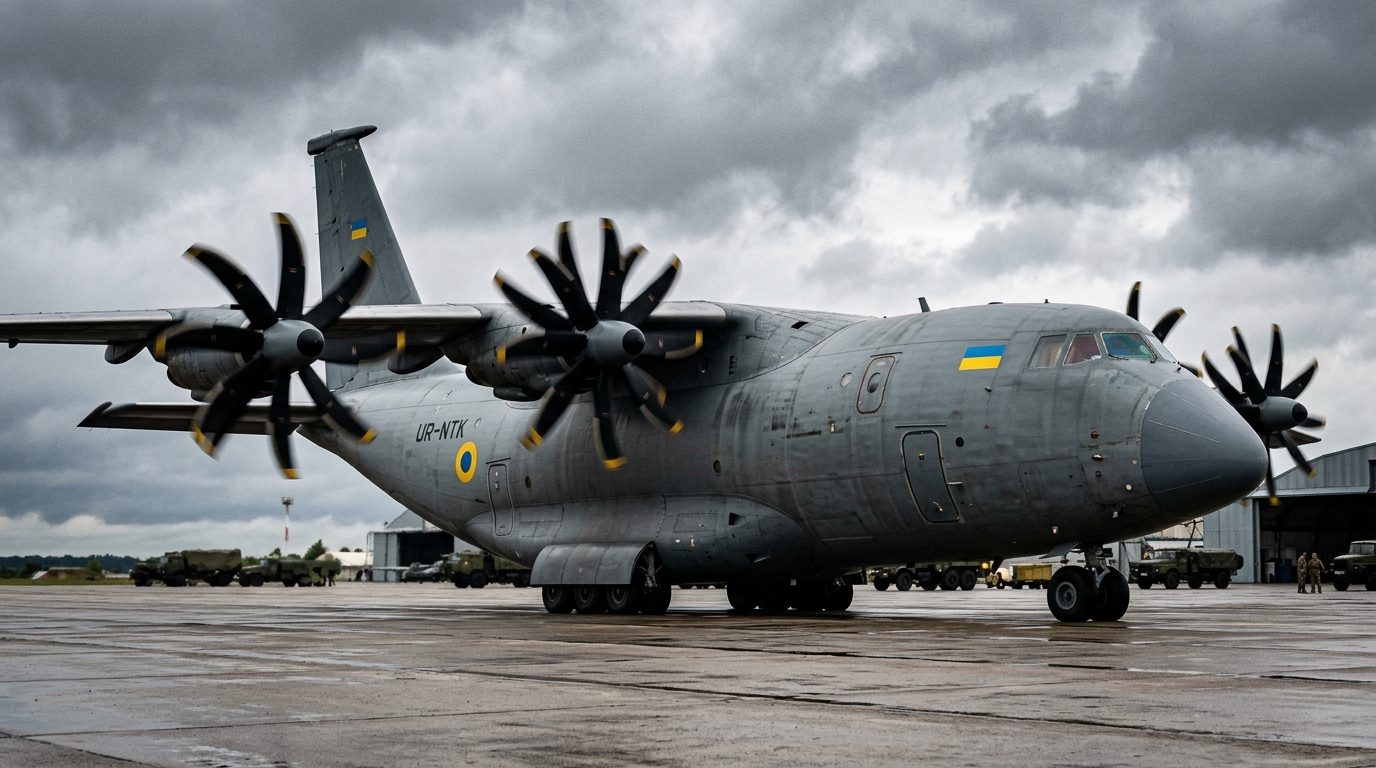
A military transport aircraft capable of carrying armored vehicles on rough airstrips, powered by engines so unconventional that no other aircraft in the world would dare adopt them before it. In two facts, that is all there was to the Antonov An-70’s fascination when it first took to the sky. Yet this plane, which should have replaced an entire generation of Soviet military transports, never achieved the industrial glory promised to it. Its story, forged by technical audacity and by missed destinies, ultimately says more about post-Soviet geopolitical tensions than about aviation itself. This is a look back at an extraordinary program born in Kiev, which gradually transformed into a symbol of a shared dream shattered between two nations.
- The An-70 conducted its maiden flight on December 16, 1994 in Kiev, becoming the first aircraft in the world to be powered exclusively by contra-rotating propfan engines
- A crash in February 1995, caused by human error, took the lives of all seven crew members and weakened the program from its outset
- The official withdrawal by Russia in April 2006, which had ordered 164 units, ended any hopes of mass production of the aircraft
- A giant with contra-rotating propellers that was to revolutionize military transport
- Four engines, eight blades: the bold technical gamble of the Antonov An-70
- The USSR collapses, the project becomes a political issue between Kiev and Moscow
- Crash, economic troubles: why the An-70 never truly took off
- An aircraft that encapsulates thirty years of Russo-Ukrainian tensions
A giant with contra-rotating propellers that was to revolutionize military transport
In the late 1980s, the Antonov design office, based in Ukraine, tackled a major challenge: to design the successor to the An-12, a military transport aircraft increasingly edged by age. The goal was clear—the aircraft needed to haul heavy loads, including armored vehicles, and to land on rugged fields far from paved runways. Thus was born the Antonov An-70, envisioned as a true technological break with its predecessors.
The prototype rolled out of the workshops on January 20, 1994, a milestone in itself for Ukraine’s newly independent aerospace industry. But it was December 16, 1994, in Kiev, when the aircraft made its first flight, a moment many still regard as the symbolic apex of the program. On that day, the An-70 became the first aircraft in the world to fly powered solely by propfan engines, a feat that should have opened the door to an entire new family of aircraft.
Four engines, eight blades: the bold technical gamble of the Antonov An-70
What immediately sets the An-70 apart from its rivals are its four Progress D-27 engines, equipped with contra-rotating propellers. In practical terms, each engine drives two propellers turning in opposite directions, a configuration that blends the speed of a turbojet with the fuel efficiency of a conventional propeller. The result is striking: the aircraft consumes considerably less fuel than its rivals while delivering comparable, or even superior, performance in short takeoff and payload handling.
This technical choice, as audacious as it was, carried risks. Propfan engines were still an experimental technology at the time, tested on very few aircraft worldwide. Antonov thus positioned itself as a pioneer, betting on a solution that Western manufacturers had largely abandoned a few years earlier, largely due to falling fuel prices. And this is precisely where the An-70’s paradox lies: its engines, often criticized as a risk factor, ended up proving to be one of the program’s major technical successes.
The USSR collapses, the project becomes a political problem between Kiev and Moscow
The An-70 program was originally designed to equip the Soviet military aviation as a whole. But the dissolution of the USSR, occurring just as the prototype took shape, radically changed the situation. The aircraft thus became a joint project between two newly sovereign states, Russia and Ukraine, each now responsible for funding and validating separately a program that had been conceived as a single unit.
This co-management, intended to share costs and expertise, quickly turned into a source of stalemate. Russia had initially ordered 164 units, a volume that would have been enough to launch a profitable production run. But its commitment proved intermittent over the years, continually slowing industrial cadences. In April 2006, Moscow formally announced its withdrawal from the program, citing rising costs, effectively ending any hope of a large-scale order that could have saved the aircraft.
Crash, economic difficulties: why the An-70 never truly took off
On February 10, 1995, barely two months after its inaugural flight, the first An-70 prototype was struck midair by an Antonov An-72 that was assisting testing over Borodianka, Ukraine. The crash, as brutal as it was unexpected, killed all seven crew members of the An-70, while the accompanying aircraft managed an emergency landing with no casualties. An Ukrainian commission would later conclude that human error, through the crew’s flight maneuvers, was the primary factor in the collision.
This tragedy dealt a heavy blow to the program, already strained by the economic hardships plaguing post-Soviet Ukraine. The second prototype didn’t roll out of the factory until December 24, 1996, and it would take until April 24, 1997 for its first flight, nearly two and a half years after the initial accident. A second aircraft would also suffer a forced landing in January 2001, adding to a program that had clearly been battered. With no durable Russian orders, the Antonov bureau had to push development with its own funds, an untenable situation for sustaining a genuine industrial production line. In the end, only two or three airframes would emerge, far from the hundreds initially envisioned.
An aircraft that encapsulates thirty years of Russo-Ukrainian tensions
Despite repeated promises of industrial revival in Ukraine in the following decades, the An-70 program never reclaimed the momentum it had at the time of its inaugural flight. Today it stands as a textbook case, frequently cited in aviation circles as the quintessential example of a technologically mature aircraft that was politically doomed. Neither its propfan engines nor its short-takeoff performance ever posed a problem; it was the rupture of the Russo-Ukrainian partnership that sealed its fate.
In hindsight, the An-70 appears almost as a precursor to the tensions that would intensify between the two countries in the decades to come. A program born in the euphoria of post-Soviet cooperation, but which ultimately did not survive the political, economic, and then military fractures that would permanently place Kiev and Moscow at odds.
Ultimately, the story of the Antonov An-70 illustrates how a technological innovation, even one brilliantly conceived, never suffices on its own to guarantee the success of an aerospace program. Its contra-rotating propellers opened a path that other manufacturers would explore later, but its industrial fate was decided elsewhere—in the hushed rooms of political negotiations between two capitals that had become rivals. It is hard not to wonder how many other promising projects have been sacrificed on the altar of tensions far removed from purely technical questions.
