
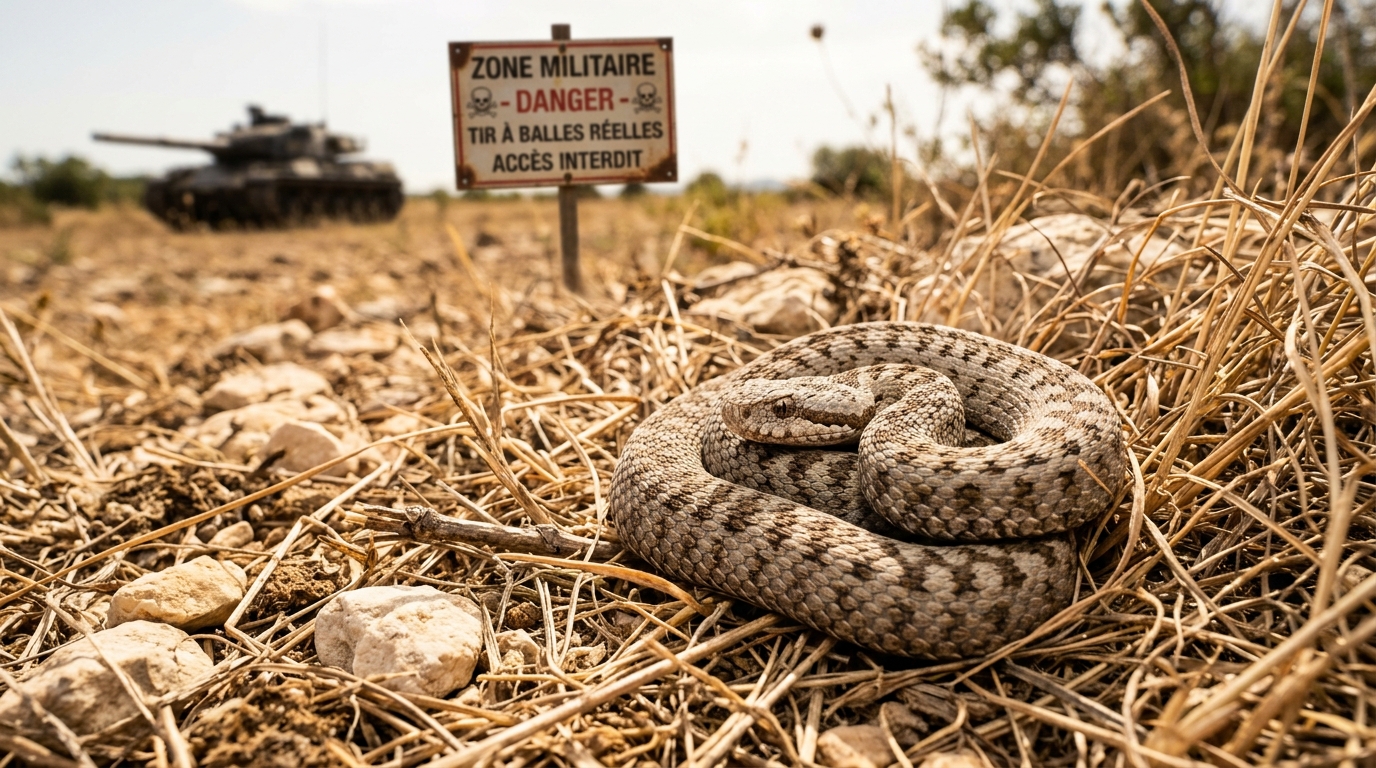
There are places where human presence is so tightly controlled that it paradoxically ends up becoming a boon for nature. This is precisely what has been unfolding for more than fifty years on the Canjuers plateau, in the north of the Var department. Where one might expect to find an ecological desert swept by artillery fire, one instead discovers a refuge where one of Europe’s most threatened snakes survives. A story that upends our certainties about what it truly means to protect a species.
- The Canjuers military camp, created in 1970 and off-limits to the public ever since, hosts one of the twelve remaining French populations of Orsini’s viper, one of Europe’s most threatened snakes.
- The site harbors the ten snake species recorded in Provence, four ungulates, the wolf and the lynx, as well as around a hundred breeding bird species, making it a major biodiversity reservoir in the Var.
- This involuntary protection, born from military constraints rather than a conservation strategy, coexists with an intense activity of 2,500 permanent personnel and up to 10,000 trainees per year.
- A snake that no one expected to disappear quietly anymore
- Why explosions protect better than a natural park
- Europe’s most discreet viper fights for its survival on this plateau
- What Canjuers reveals about the true nature of animal protection
A snake that no one expected to disappear quietly anymore
Orsini’s viper has never grabbed the headlines. This small, unobtrusive serpent, found in several mountain ranges of Southern Europe, gradually vanished from numerous territories without anyone really noticing. Unlike iconic species whose decline mobilizes public opinion, this viper declined sharply within near-total indifference, a victim of habitat fragmentation, the closure of habitats, and the gradual disappearance of the open environments it cherishes.
Today, there are only twelve known populations of this species recorded across France. A figure that can be dizzying when one considers how every lost population represents an irreplaceable portion of the species’ genetic heritage. And it is precisely here that the Canjuers plateau enters the scene, because it hosts one of these twelve survival pockets, in conditions that no one could have anticipated at the outset.
Why explosions protect better than a natural park
Created in 1970, the Canjuers military camp spans 35,000 hectares, making it the largest firing range in Western Europe. Across this vast area, only 14 hectares are occupied by buildings: the rest remains a natural space where humans enter only within a highly controlled framework. Public access has been forbidden since the site’s creation, a rule that has never wavered for more than fifty years.
The paradox is striking: it is the cannon fire and the accompanying noise that, by discouraging any recreational human presence, have effectively created a sanctuary. Where a traditional nature park must manage tourist pressure, hiking trails, and hunting, Canjuers has never had to contend with these constraints. Some sectors, used as direct firing zones, are completely closed to any movement, both human and animal, further strengthening this involuntary sanctuarization. The site’s managers themselves acknowledge: this protection was never sought originally; it is the product of military chance rather than a conservation strategy.
Europe’s most discreet viper fights for its survival on this plateau
What Canjuers reveals goes far beyond the Orsini’s viper alone. The plateau actually hosts the ten snake species recorded in Provence, a remarkable figure that attests to exceptional herpetological richness for such a small region. Along with these, there are four ungulate species — wild boar, deer, roe deer, and chamois — as well as two large emblematic predators: the wolf and the lynx, whose simultaneous presence on the same territory remains rare in metropolitan France.
The picture doesn’t end there. About a hundred breeding bird species have been counted on this same site, placing Canjuers among the Var department’s largest biodiversity reservoirs. An irony for a terrain whose primary vocation was never conservation but military training. Ironically, this plateau used to host much more peaceful activities: before militarization, the region produced lavender, as well as 150 tons of honey and 20 tons of beeswax every year. These agricultural activities disappeared with the arrival of the army, giving way to a completely different balance, wilder and, unwittingly, more protective.
What Canjuers reveals about the true nature of animal protection
The Canjuers example forces us to rethink our intuitions about species conservation. We often imagine that an effective protected area requires restricted access and proactively ecological management implemented by naturalists or specialized managers. Here, it is a purely military constraint — the restriction of civilian-access routes and the strict ban on entering the firing polygon — that produced this result, without any intention of preservation ever being stated from the outset.
Yet the site continues its double life: today it hosts about 2,500 permanent personnel and up to 10,000 trainees per year, who come to train within the French forces and their allies. This intense activity, seemingly incompatible with conserving a snake as discreet as Orsini’s viper, has coexist with it for decades. An unlikely coexistence that illustrates how the closure of a territory, even for reasons wholly unrelated to ecology, can be enough to save what intensive farming and urbanization have erased elsewhere.
Canjuers thus reminds us of a truth that is too often forgotten: the best protection for wildlife is not always the one that bears that label. Sometimes, it is enough simply to leave a territory quiet, whatever the stated reason for that quiet. A question remains worth considering: how many other spaces, closed for reasons unrelated to ecology, shelter today—unknown to anyone—the last refuges of species we had believed to be already lost?
