
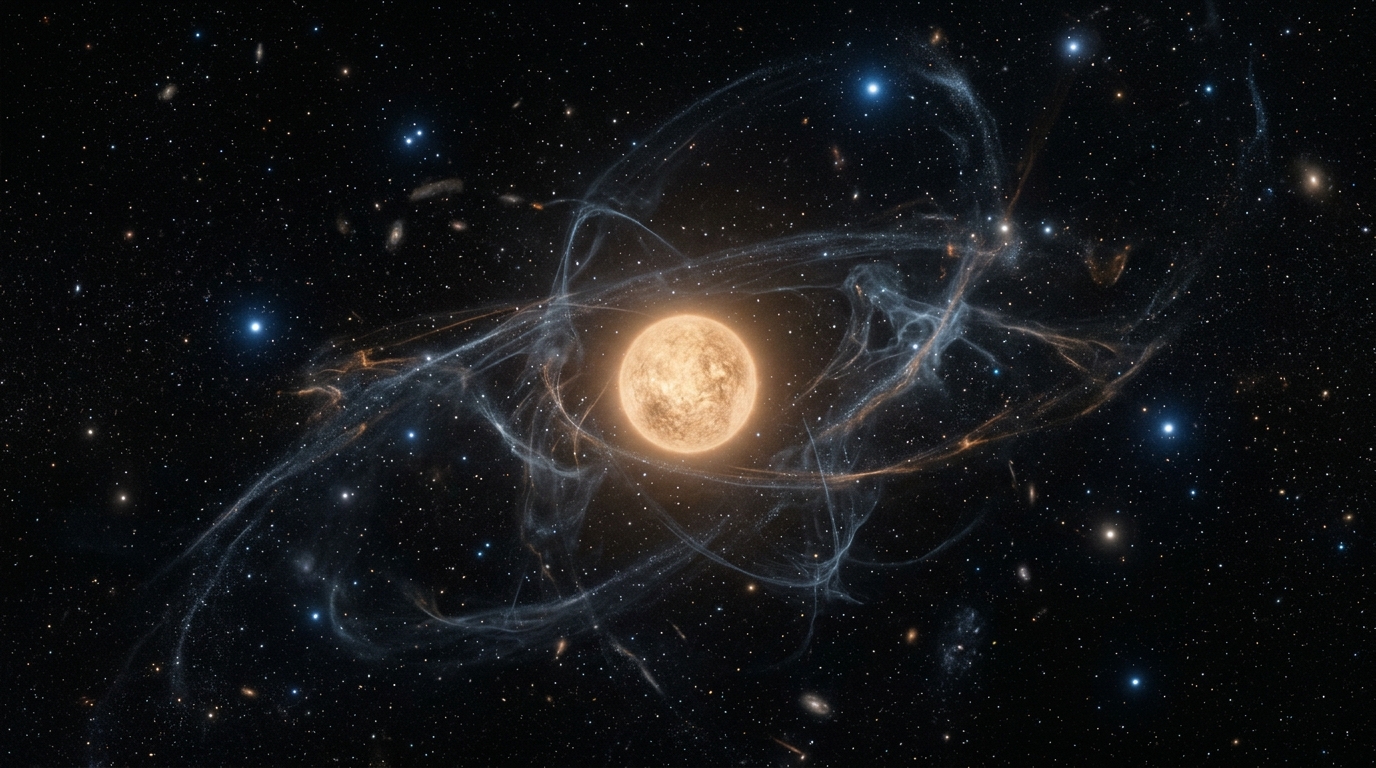
A star older than time itself: this is the puzzle that shook astrophysicists. Just 190 light-years from Earth, HD 140283 exhibited an impossible age: 14.5 billion years, while the Universe itself is only 13.8 billion. An anomaly that alerted the entire scientific community.
- HD 140283, the Methuselah star located 190 light-years away, was dated at about 14.5 billion years by the Hubble Space Telescope using its parallax.
- This dating carries an uncertainty of 800 million years, making its real age compatible with the Universe’s 13.77 billion years.
- The star would originate from a dwarf galaxy swallowed by the Milky Way, bearing the chemical fingerprints of the Universe’s earliest moments.
- The Methuselah star that defies the laws of the cosmos
- Hubble probes the heart of a stellar relic
- 800 million years: the margin that preserves physics
- What HD 140283 reveals about the Universe’s earliest moments
Imagine discovering, in the back of your attic, an object whose date of manufacture predates the house that shelters it. That’s roughly what astronomers experienced when studying a modest star in our galactic neighborhood. Far from the shooting stars we often admire on clear autumn nights, HD 140283 does not shine with brightness, but with the time warp it inspires. Its nickname, the Methuselah Star, in reference to the biblical figure famed for extraordinary longevity, is indeed well deserved.
The Methuselah Star that Defies the Laws of the Cosmos
HD 140283 is not unknown to astronomers. This subgiant belonging to the Milky Way has been cataloged for more than a century, primarily because it travels across the sky at an extraordinary pace: about 1.3 million kilometers per hour. A motion that quickly intrigued observers, since stars with such proper motion often betray a particular origin, or even a chaotic trajectory inherited from a turbulent past.
It was in the early 2000s that the problem truly emerged. An initial estimate assigned the star an age of around 16 billion years. A figure that, on paper, made no sense: how could a star be older than the Universe in which it formed? This apparent contradiction, worthy of a temporal paradox, immediately placed HD 140283 in the scientific spotlight.
Hubble Probes the Heart of a Stellar Relic
To settle this debate, instruments capable of measuring the star’s distance with razor-sharp precision were required, a condition essential to deducing its true age. The Hubble Space Telescope took on this delicate mission. Using its Fine Guidance Sensor, a device designed to stabilize observations with remarkable finesse, a team led by astronomer Howard Bond could recompute the parallax of HD 140283 with a level of rigor unprecedented to that date.
This method rests on a fairly intuitive principle: by watching the slight apparent shift of a star as the Earth moves around the Sun, one can deduce its exact distance, somewhat like how closing one eye and then the other helps gauge the distance to an object. Eleven sets of observations, recorded over several years, thus allowed the data to be drastically refined. Result: the star’s age was revised downward to around 14.5 billion years. A follow-up study published some time later even refined this figure to about 14.27 billion years. A notable improvement, but it did not completely solve the cosmological puzzle.
800 Million Years: The Margin That Preserves Physics
Here lies the crux of the matter. The age of the observable Universe, calculated from the cosmic microwave background radiation, is estimated at 13.77 billion years, with a tiny uncertainty of only ~0.06 billion years. On paper, HD 140283 would thus appear to be older than the cosmos that formed it, which would be like saying a child was born before its own mother.
This is where the essential nuance comes in, often overlooked in quick summaries of this story. The dating of HD 140283 by Hubble itself carries an error margin of 800 million years. In other words, its true age could just as well be around 13.7 billion years, a value perfectly compatible with the Universe’s age. The contradiction, dramatic in appearance, dissolves as soon as the statistical uncertainties inherent in this kind of astronomical measurement are taken into account. HD 140283 remains compatible with the age of the Universe thanks to this famous margin of error, which does not diminish the star’s fascinating nature but reassures the coherence of our cosmological models.
What HD 140283 Reveals About the Universe’s First Moments
Beyond the simple question of age, HD 140283 also intrigues with its likely origins. According to the favored hypothesis among astronomers, this star did not form in the Milky Way as we know it today. It would rather have originated in a dwarf galaxy, captured and gradually absorbed by our galaxy over its history, before joining the galactic halo where it now resides. A bit like an immigrant from a distant land, HD 140283 would thus carry the chemical fingerprints of an environment radically different, formed in the very earliest moments of the Universe, at a time when heavy elements were still extremely rare.
To refine these measurements further and definitively lift the veil on such ancient stars, Europe launched the Gaia satellite at the end of 2013. Its mission is precisely to map distances and motions of more than a billion stars in our galaxy with unrivaled precision. With this tool, astronomers now have far finer data to distinguish genuine cosmological anomalies from mere measurement uncertainties—a crucial challenge when trying to reconstruct the first chapters of the Universe’s history.
The story of HD 140283 ultimately offers a valuable lesson in scientific inquiry: a surprising, even troubling datum does not necessarily mean that our fundamental theories are wrong. It invites us to scrutinize the margins of error, to refine instruments, and to accept that uncertainty is an integral part of any measurement, even the most rigorous. Waiting for even more precise data, this venerable Milky Way elder continues to travel across the sky at a breathtaking speed, a silent witness to an era we have only glimpsed so far.
