
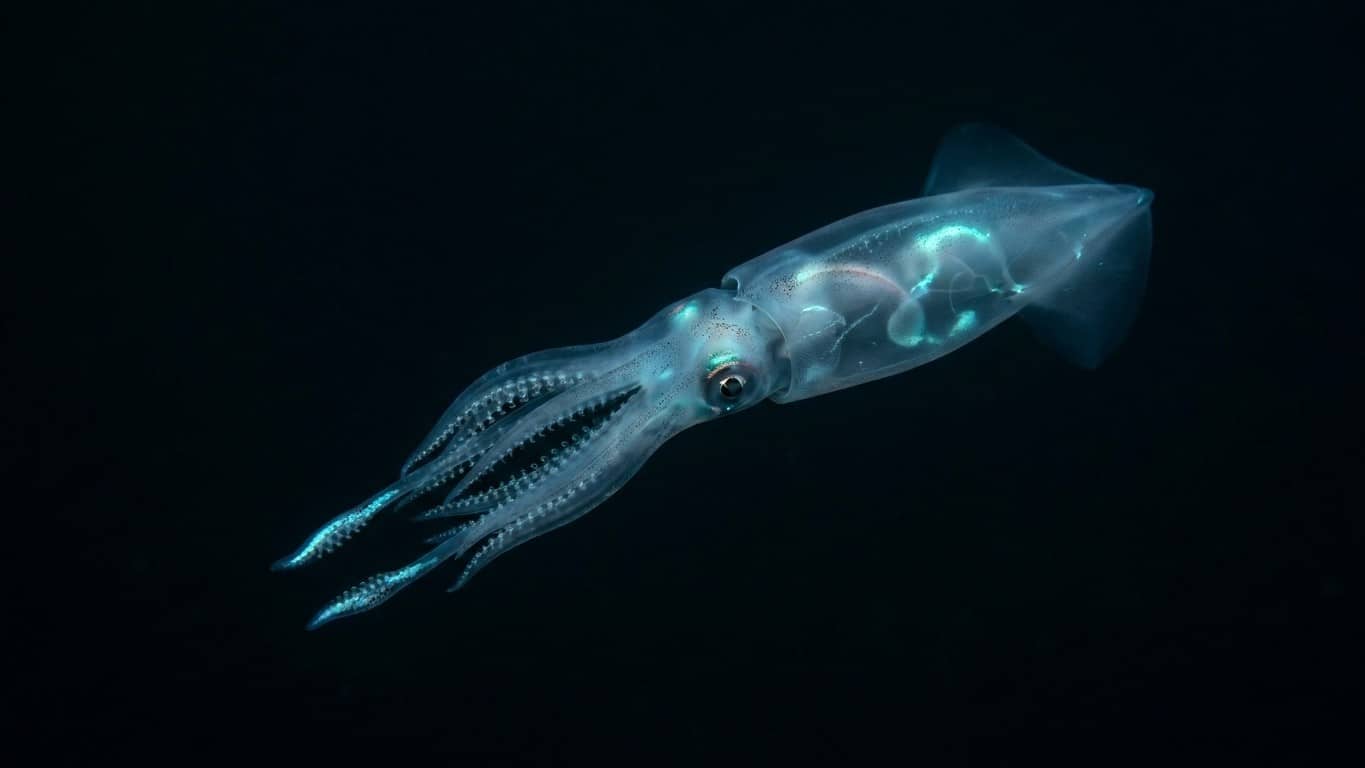
March 9, 2025, 600 meters below the surface of the South Atlantic, a submarine robot crossed paths with a ghost. A translucent being, barely larger than a school ruler, gliding through the darkness of the frigid waters near the South Sandwich Islands. A hundred years after its identification and official naming, the colossal squid (Mesonychoteuthis hamiltoni) had just been observed alive in its natural habitat for the very first time. A century of waiting. For 30 centimeters of transparent creature.
Key takeaways
- A century after its identification, a living creature is filmed for the first time
- 27-centimeter giant eyes and swiveling hooks: a biology still largely unknown
- A translucent juvenile today, but perhaps a 500 kg monster tomorrow
A Century of Absolute Silence
The colossal squid had been identified for the first time in 1925, based on remains found in the stomachs of sperm whales. Until now, all knowledge about the species came from dead specimens or individuals accidentally captured by fishermen. That’s little. It’s almost nothing for an animal thought to be the heaviest invertebrate on the planet.
Officially identified a century ago, it is regarded as the largest known invertebrate, surpassing even the famed giant squid. In adulthood, it can reach 14 meters in length and weigh up to 500 kilograms. To put that in perspective: that’s the weight of about one and a half Smart cars. And yet colossal squids are observed so rarely that we know so little about them, and it is impossible to know how many there are.
According to researcher Kat Bolstad, “for a hundred years, we mostly encountered them in the form of remains in the stomachs of whales and seabirds, and as predators of ligneous species harvested.” The reason they probably hadn’t been filmed until now lies in their large, sensitive eyes, which push them to avoid research equipment, often very bright and noisy. Eyes that, paradoxically, constitute their most spectacular feature: the colossal squid possesses the largest eyes of any studied animal, measuring about 27 cm in diameter, roughly the size of a football.
The Discovery No One Really Expected That Night
The 35-day mission that captured these images was a flagship expedition of the Ocean Census, a collaboration between the Schmidt Ocean Institute, the Nippon Foundation-Nekton Ocean Census, and GoSouth, a joint project between the University of Plymouth, the GEOMAR Helmholtz Centre for Ocean Research, and the British Antarctic Survey. The objective was to search for new marine species. Not necessarily this one.
At the time, researchers did not even know it was a colossal squid. It was only later, after analyzing the footage, that they realized the animal’s significance. The chief scientist Michelle Taylor, from the University of Essex, explained: “We filmed it because it was beautiful and unusual, then we descended to the seafloor to continue the planned exploration.” The history of science is full of moments when the greatest discovery of the year slips in between ordinary tasks.
The remotely operated vehicle SuBastian captured the footage. The video shows a juvenile colossal squid of about 30 centimeters in length, with a translucent body and distinctive hooks on its arms. Those hooks, in particular, played a decisive role: the colossal squid has swiveling hooks on its tentacles, a detail that allowed the scientists to authenticate their discovery. The researchers waited to verify the species identification with independent scientists before releasing the footage.
A Translucent Baby Heralding a Monster
Thirty centimeters today. Seven meters perhaps one day. Its transparency still betrays its young age, as colossal squids become progressively opaque as they grow. This glassy body, almost unreal in the footage, is only a fleeting stage in a metamorphosis that science has never been able to observe from end to end. Scientists know little about the reproductive cycle of the colossal squid, largely because only females have been found.
Unlike the better-known and more widespread giant squid, the colossal squid is bulkier, with a wider head and shorter but stronger tentacles. It is not the longest of the cephalopods, but the most “sturdy,” a distinction that matters when stalking prey in total darkness at depths around 1,000 meters. The colossal squid is known to inhabit hard-to-reach zones, at depths between 500 and 2,200 meters. It lives in total darkness, far from any natural light, which makes its observation almost impossible.
The reaction of the scientists who viewed the footage summarizes the magnitude of the moment better than anything else. Dr. Kat Bolstad, of Auckland University of Technology, one of the independent experts who verified the images, said: “It’s thrilling to see the first in situ images of a juvenile colossal, and moving to think that they have no idea that humans exist.”
What This Image Changes (and What It Does Not Change)
A video does not create biology. The images from the SuBastian ROV finally open a direct window into the living behavior of the animal, but they do not resolve the mysteries that have accumulated since 1925. We still do not know how the species reproduces in the wild, what its true lifespan is, or how many individuals inhabit Antarctic waters. The largest specimen ever captured, in 2007, weighed 495 kg and is today on display at the Museum of New Zealand Te Papa Tongarewa in Wellington. A museum exhibit for an animal that, for its part, has never really revealed itself.
What changes, however, is the method. On a prior expedition in the Southern Ocean near Antarctica, the team filmed a glass squid from the ice-cold depths (Galiteuthis glacialis), another species never observed alive in its natural habitat. Two world-firsts on consecutive expeditions. Michelle Taylor, the expedition’s chief scientist and a professor at the University of Essex, told ABC News: “This is a once-in-a-lifetime moment; discoveries like this don’t happen often.” High-resolution ROV technologies and long-duration missions into parts of the ocean previously shunned by researchers seem to be deeply transforming what the ocean is willing to show us. After a century of silence, the colossal squid may have simply waited for someone to come to it at the right place, with the right tool, and without making too much noise.
Sources : gayaone.com | nouvelordremondial.cc
