
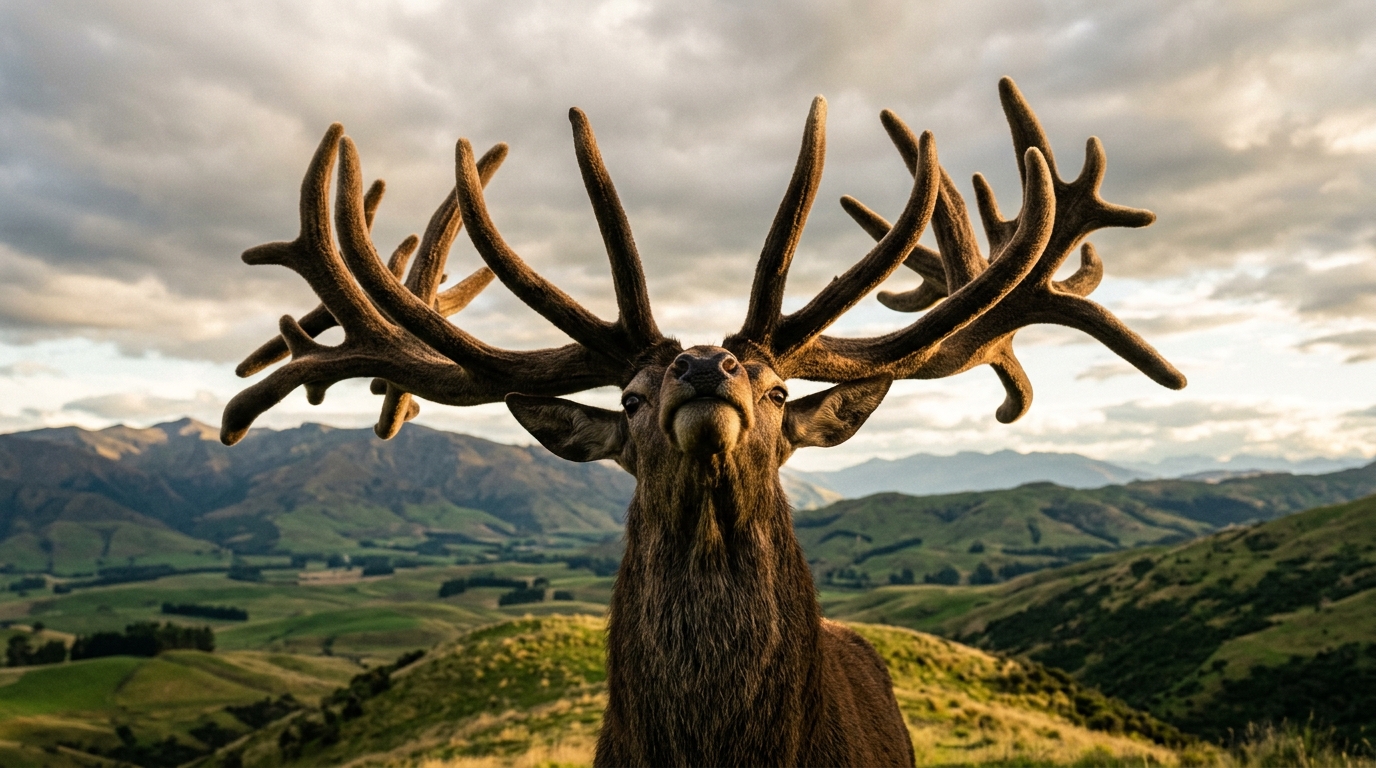
People often imagine that ever-larger deer antlers are meant to impress a hunting jury or to adorn the walls of a country house, but the New Zealand reality tells a very different story. For decades the oceanic archipelago has carried out a methodical genetic selection program for its farmed deer, with a precise objective: to produce antlers that are increasingly branched, heavier, and denser. None of these animals will end up mounted in a hunter’s drawing room. Their fate lies elsewhere, in a Korean wellness market that quietly absorbs, around 800 tonnes of deer velvet each year. This discreet trade, almost invisible from Europe, reveals an agricultural industry as rational as it is little known.
- New Zealand genetically selects its deer to produce velvet antlers, becoming the world’s leading producer with 700–800 tonnes per season.
- South Korea absorbs 60–80% of this output, used in traditional medicine and dietary supplements for a market exceeding NZ$100 million per year.
- This intensive selection for heavier antlers comes at a cost to animal welfare, some deer risking neck fractures.
- Deer Selected for Their Antlers, Not for Their Trophy Heads
- Deer Velvet, an Ingredient Worth More Than Its Meat
- South Korea, an Invisible Yet Insatiable Market
- What This Trade Reveals About Modern Selective Breeding
Deer Selected for Their Antlers, Not for Their Trophy Heads
In New Zealand farms, selection does not target the size of the game or its wild looks. It aims at a very specific trait: the branching and density of the antlers, passed down through generations via carefully planned crossbreeding akin to optimizing any agricultural output. The result, over decades, has been spectacular: deer bearing antlers ever more developed, far beyond what nature would spontaneously yield. This race for greater branching does carry consequences for animal welfare. A New Zealand breeder has testified that some individuals now carry antlers so heavy that the risk of neck fracture becomes real, an unintended side effect of this intensive selection.
This breeding work ultimately positioned New Zealand as a global player. According to data cited by Wikipedia, the country is now regarded as the world’s leading producer of velvet antlers, well ahead of Australia, China, Russia, the United States, and Canada. An achievement all the more remarkable given that this sector remains largely unfamiliar to Western publics, even as it underpins a substantial portion of New Zealand agriculture for decades.
Deer Velvet, an Ingredient Worth More Than Its Meat
The term deer velvet refers to the soft, still-covered antlers harvested before calcification, typically around 60 days after growth begins. This harvest window is crucial: too early, the velvet hasn’t reached its useful maturity; too late, it hardens and loses the properties sought by buyers. Once cut, the velvet is rapidly frozen, then dried under a strict protocol controlling temperature and humidity, a prerequisite to preserve quality and to meet sanitary requirements for export markets.
This ingredient is not a marketing novelty. Its use in traditional Chinese and Korean medicine would date back roughly two thousand years, with the earliest documented trace being a silk scroll found in a Han dynasty tomb in Hunan province. Today, it is marketed in a more contemporary form: as dietary supplements aimed at overworked executives or recovering athletes, sold with promises of energy and concentration. New Zealand’s total production oscillates between 700 and 800 tonnes per season, for a market estimated at more than NZ$100 million per year, a figure that underscores a supply chain far from trivial.
South Korea, an Invisible Yet Insatiable Market
It is South Korea that buys the bulk of this production, absorbing between 60 and 80% of New Zealand’s velvet export, whether ground, or sliced thinly. Exports to this market began in the late 1970s, initially with uneven quality, before the industry gradually organized around strict standards. According to Deer Industry NZ, New Zealand has since established itself as the reference source for frozen velvet, integrated into highly regulated product lines scientifically validated by local health authorities.
Renowned Korean companies such as KGC, HY, or Yuhan Care prominently feature the New Zealand origin in their marketing as a sign of purity and sanitary safety. A symbolic turning point occurred in late 2024 when Kwangdong Pharmaceutical launched the first deer velvet product with a health claim validated by Korea’s MFDS. This same lab had previously obtained a health claim related to prostate support and fatigue for a similar product. From the period up to September 2025, Korean imports of frozen velvet continued to rise, driven almost exclusively by New Zealand. It is also worth noting that a portion of velvet sold to China is actually processed there before being re-exported to South Korea, which remains, in the end, the final destination for the vast majority of this production.
What This Trade Reveals About Modern Selective Breeding
This story goes far beyond a simple agricultural narrative. It demonstrates how a niche market, located on the other side of the globe, can profoundly shape the breeding practices of an entire country. New Zealand did not select its deer by chance or by hunting tradition: it responded, methodically, to a precise economic demand, even if it pushed animal genetics to their physiological limits. The testimony of an breeder mentioning the risk of neck fractures in some animals reminds us that this productive optimization comes at a cost to the welfare of the animals involved.
This New Zealand case thus sits within a broader reflection on contemporary selective farming, where the performance sought by a distant market ends up literally remapping the morphology of a species. Deer velvet, a little-known product in the West, becomes the symbol of a globalized agriculture capable of turning a wild animal into a genuine industrial supply chain, calibrated to the millimeter to meet the needs of consumers located on the far side of the planet.
Ultimately, these ever more branched antlers do not tell a story of hunting or prestige, but of a discreet and tightly run agro-food chain, oriented toward Korean health and well-being. The question remains how far this genetic race can push without further endangering the animals that literally bear all the weight on their heads.
