
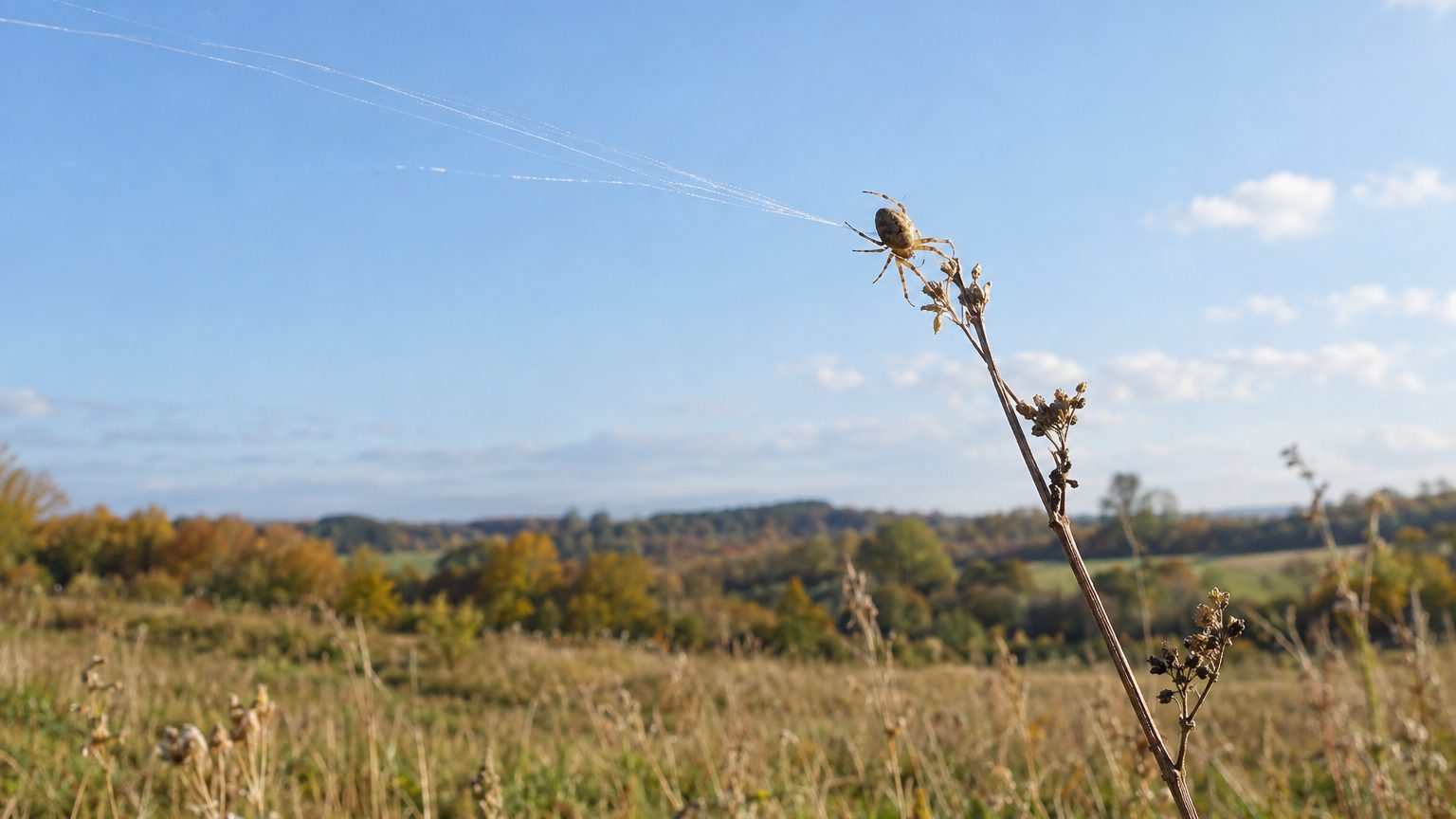
In meadows, on embankments, and along fences, the crisp October mornings become threaded with white filaments known as the Virgin’s threads. The warm afternoons of late summer then set them in motion, across swaths and swaths. At the end of every filament, a traveling spider waits.
The wind doesn’t explain everything.
In 2018, Bristol University biologists Erica Morley and Daniel Robert demonstrated that electric fields in the atmosphere—comparable in strength to those present in the air—can trigger ballooning and provide lift even in the absence of any air movement. Their study, published in Current Biology on July 5, 2018, exposed linyphiid spiders to laboratory electric fields equivalent to atmospheric conditions. When the field was on, the spider ascended; when it was off, it descended. No airflow was involved in the manipulation.
- Atmospheric electric fields create an electrostatic repulsive force between the silk strands of spiders, generating the lift required for flight.
- Spiders detect the electric potential gradient through specialized hairs called trichobothria located on their legs.
- Darwin observed spiders aboard the Beagle 100 km offshore in calm seas, a phenomenon that wind theory alone cannot explain.
The Spider’s Gesture, and the Explanation That No Longer Sufficed
To disperse, spiders “balloon”: they climb to the top of a tiny irregularity, let silk unspool, and rise. A twig, a fence post, or a blade of grass will do, since the creature lacks wings.
The dominant idea held that the drag produced by a light wind would be enough to render spiders airborne. Yet the Bristol article reminds us that ballooning has been observed even without notable wind, under overcast skies, and even in rain. A single instance might have appeared anomalous, but the accumulation of cases left little room for doubt: there was a force missing.
How does one take off when the air doesn’t move?
In nature, everything begins with a detail of geometry. Many spiders launch themselves with several silk strands that spread out in a fan, which, according to Morley, suggests the involvement of a repulsive electrostatic force. Threads repelling one another is the behavior of charges of the same sign.
Silks in a fan, hairs that sense the field
The planet’s global electric circuit produces an atmospheric potential gradient, that is, a persistent voltage in the air above the ground. This voltage varies with weather conditions and time of day. The hairs spread in a fan capture this gradient, and the resulting force is enough to lift an animal weighing only a few milligrams.
For the mechanism to be useful, the spider must also perceive the field before leaping. The researchers studied the trichobothria, mechanosensitive hairs found on the legs. These hairs are mechanically activated by weak electric fields on the order of about 100 V/m. They also respond to air flow, but the two stimuli produce distinct displacements, which, in principle, would allow the spider to tell whether it is wind or electricity acting on it. The authors describe them as probable electroreceptors, so caution is warranted.
Sixty miles off the coast, more than three kilometers high
Charles Darwin had recorded the phenomenon long before anyone attempted to explain it. In the Beagle voyage diary, he notes that spiders arrived aboard, in calm seas, at least 60 miles from the coast, roughly 100 kilometers away (96.6 km in exact terms).
A calm sea, and spiders aboard.
One hundred kilometers is about the distance between Paris and Chartres, a distance that a creature small enough could traverse despite a gentle nudge. Physicist Peter Gorham, in a synthesis article defending the electrostatic flight hypothesis, gathers other similar cases. Spiders have been found at altitudes above 2 miles (3 km), more than twice the height of the Puy de Dôme, and on remote oceanic islands hundreds of miles away. Morley and Robert’s article likewise mentions spiders found at 4 km altitude and dispersions spanning several hundred kilometers. Nevertheless, nothing specifies which species the Beagle’s traveling spiders belonged to.
What the experiment changes, and what it leaves open
The nuance matters. The researchers are not saying wind plays no role: they say it is not enough by itself to account for the observations. According to Morley, current theories fail to predict ballooning patterns using wind alone. Electricity and drag can thus act together.
The results come from a laboratory, not a meadow. The team stated they intended to study the physical properties of ballooning silk and to conduct fieldwork. They also planned to test whether other animals can detect electric fields.
A final finding concerns timing. According to the authors, the atmospheric potential gradient could serve as an additional weather cue, signaling to the spider the optimal moment to take off. The next time a meadow glimmers with silk on an October morning, these threads may have been drawn by an animal that had sensed the electric field before launching.
Sources: cell.com | research-information.bris.ac.uk
