
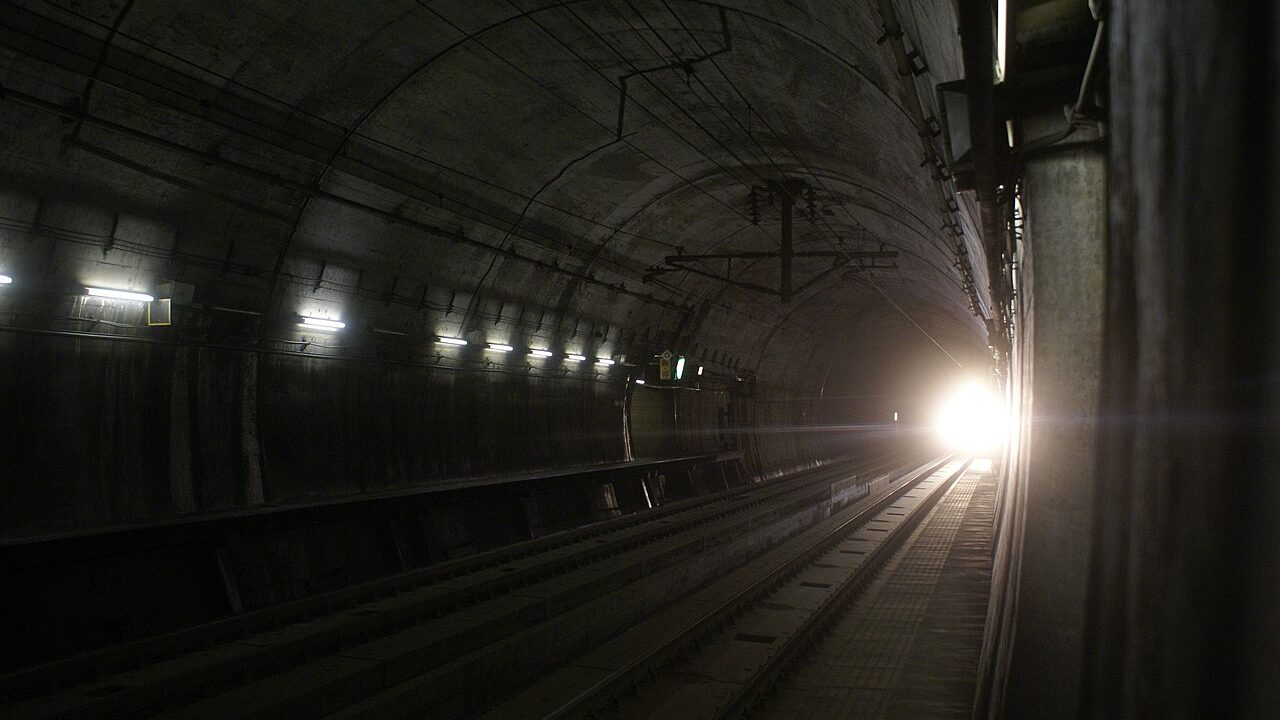
The Seikan Tunnel stretches 53.85 km between Honshū and Hokkaidō, with 23.3 km lying beneath the Tsugaru Strait. Construction on the main works began in 1971, and it opened on March 13, 1988, after a project that claimed the lives of 34 workers. By that time, air travel had already won over a large portion of travelers.
Thirty-four lives lost for a link that many already preferred to cover by air.
- The Seikan Tunnel measures 53.85 km, with 23.3 km beneath the Tsugaru Strait, linking two Japanese islands.
- Its construction from 1971 to 1988 cost 34 workers their lives, amid extreme heat, floods, and earthquakes.
- Air travel had already won over travelers: Tokyo–Sapporo took 1 h 30 by air versus over 9 hours by train.
- Since 2016 the Shinkansen runs through the tunnel in 4 hours and 2 minutes, connecting Tokyo to Hakodate.
A sunken ferry, a national project
The story begins with a typhoon night in September 1954. The ferry Toya Maru capsized off Hakodate, and the official tally from the Japanese National Railways listed 1,153 dead. Four other ships on the same route sank that night, raising the total to 1,430 victims according to a different count. The idea of a fixed link wasn’t new—the geological studies had started in 1946—but this disaster shifted the project from engineering dream to national endeavor.
In May 1964, a reconnaissance tunnel began to be dug at Yoshioka on the Hokkaidō side. The main project followed in 1971.
The name fuses two cities: “Sei” from Aomori and “Kan” from Hakodate. The rails run roughly 100 meters beneath the sea floor and 240 meters below sea level. No country had yet drilled a tunnel of such scale beneath the ocean.
Against water, heat and rock
At the height of the works, some 3,000 workers were inside the tunnel at once, facing 35 °C temperatures and more than 90% humidity near the cutting face. They rotated in three shifts, around the clock. It felt like the heat of a sauna, but with the sea above the ceiling.
The substratum spared nothing for the crews. They had to contend with volcanic rock, unstable tectonic plates, and the constant threat of earthquakes. Four major inflows of water halted work, each requiring months of sealing. The main tunnel was finally bored on March 10, 1985, three years before it entered service.
Falls, floods, and various accidents claimed 34 lives.
Arriving after the battle
For travelers, the arithmetic was straightforward. In the era of conventional trains, reaching Sapporo from Tokyo took more than nine hours, compared with roughly 1 h 30 by air. Britannica’s encyclopedia summed it up bluntly: air travel had become far more practical, and the tunnel carried far fewer passengers than anticipated.
Yet rail would reclaim some ground, at least partially. Since March 26, 2016, the Shinkansen travels through the tunnel, and conventional trains no longer carry passengers. Tokyo and Shin-Hakodate-Hokuto are linked in four hours and two minutes, with a maximum speed of 140 km/h inside the tunnel and 260 km/h outside. The high-speed line currently stops at Hakodate, leaving Sapporo outside the network.
Freight, meanwhile, never left the route: the Kaikyō Line has become a freight-only corridor after 2016. The dual-gauge tracks allow Shinkansen trains and freight trains to share the same bore. About 30 trains per day run on the passenger side.
A disputed record, and a ferry that returns
The Seikan held the title of the world’s longest railway tunnel for a long period, until the Gotthard Base Tunnel in Switzerland reached 57.1 km in 2016. It remains ahead of the Channel Tunnel, which measures 50.45 km. It also remains the longest tunnel with a marine section, as noted by the Fun Japan tourist site.
A relic of the construction era can be visited. The Tappi-Kaitei underwater station, closed to travelers on November 10, 2013, now serves as an emergency exit and a tunnel museum. Visitors descend 140 meters below sea level to the place where workers once dug.
And the ferry, finally, did not disappear. Since the arrival of the Shinkansen, the Aomori–Hakodate route has seen a revival in interest as an economical option, offering a crossing of three to four hours.
Sources: fascinant-japon.com | blog.sbbcargo.com
