
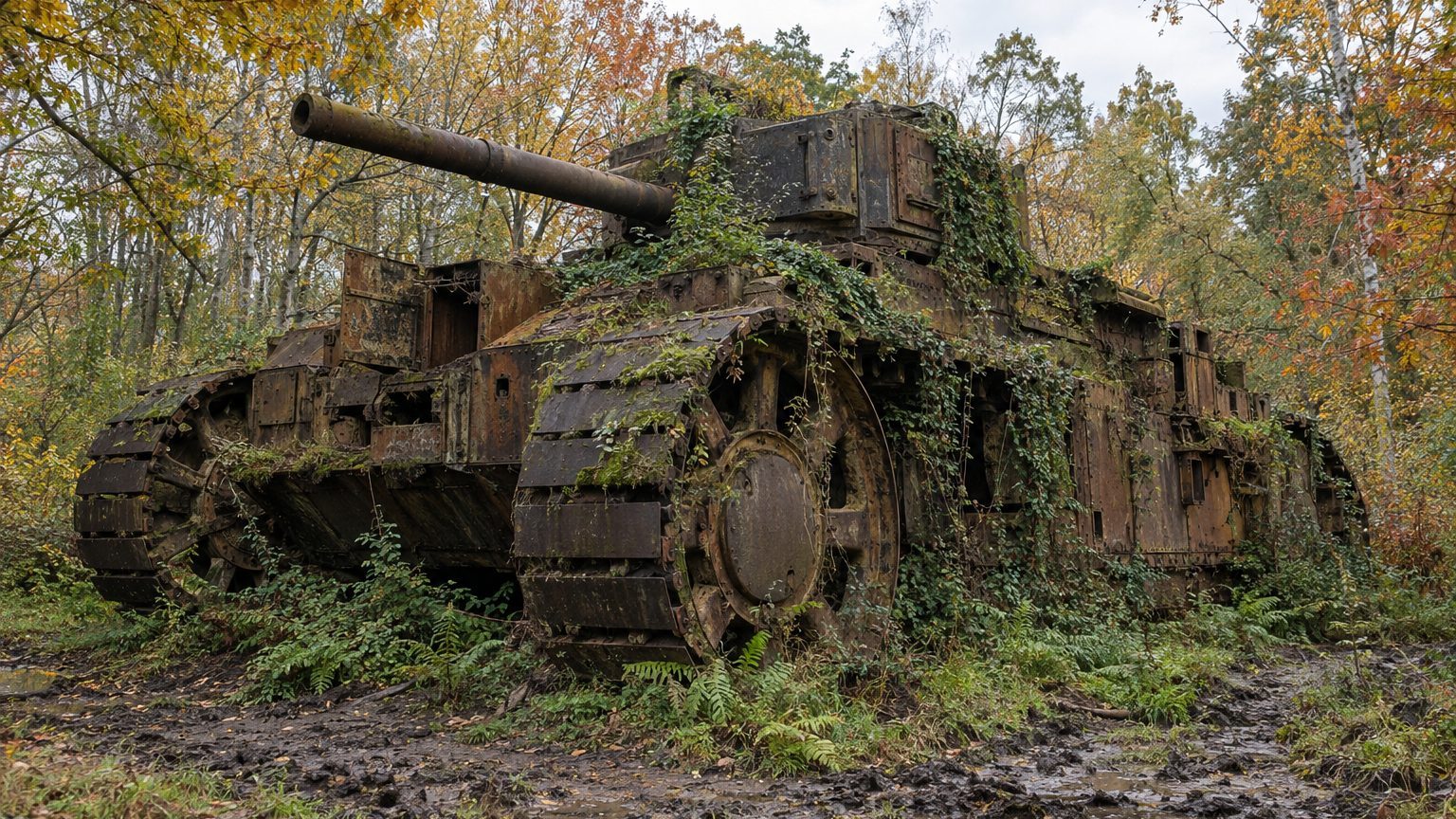
In August 1915, a steel behemoth weighing about 60 tons, mounted on two 9-meter wheels, sank into a swamp north of Moscow. It was the largest armored vehicle in history. It never reemerged: the Char-tsar remained in the forest until 1923, when it was scrapped on site.
- The Char-tsar measures 18 meters in length and 9 meters in height, weighing around 60 tonnes
- A small spring-driven model shown to Nicholas II unlocked more than 200,000 roubles of funding in February 1915
- The undersized steering wheel sank during the first test on 27 August 1915 in the swamp
- The vehicle remained bogged down for eight years before being cut up on site for scrap metal in 1923
A spring-driven toy in front of the Emperor
The idea came from Nikolai Lebedenko, head of the experimental laboratory at the Russian War Ministry. His own confession put him in mind of the araba, a cart whose oversized wheels could glide over bumps and ditches. If a cart can make it there, why not an armored vehicle?
A spring-powered miniature was presented to Tsar Nicholas II in early 1915. During a private audience on February 8, the small contraption skittering across the carpet delighted the emperor. He doubled the stake: depending on the source, the project received 210,000 roubles, or as much as 250,000. That budget, roughly 125,000 dollars at the time, was enormous for a prototype that had barely crossed a stack of books.
A toy was enough to unlock more than 200,000 roubles.
A tricycle as tall as a house
On paper, the machine was impressive. It measured 18 meters in length and 9 meters in height, with a crew of about ten men. A fixed armored compartment, perched at the height of a two-story house, was intended to house a machine gun or a cannon. Sources vary on the powerplant (two Maybachs at 240 hp each in some accounts, or two Sunbeams at 250 hp in others), but the principle was clear: one engine per large wheel.
Parts were built in a Moscow factory in the Khamovniki district and then assembled from late spring to late summer 1915 near the Orudyevo station, beside Dmitrov. Work proceeded under the greatest secrecy.
August 27, 1915: the steering wheel fails
On August 27, 1915, the trials began with relatively good pace. The armored vehicle moved along a track laid across a swamp, crushed a tree, and then veered into the waterlogged area. That’s where everything depended on. At the rear, the 1.5-meter steering wheel bore too heavy a share of the mass, was poorly balanced, and with a diameter gap between the wheels that was far too wide. It sank, and the giant was imprisoned on its very first attempt.
Between 9 meters and 1.5 meters, the ratio was one to six.
No one managed to free the machine, and the project did not survive this failure. It was abandoned in 1915, judged underpowered and too vulnerable to artillery. The tank remained where it had bogged down, as the war and the 1917 revolution consumed minds and resources. In 1923, after eight years in the forest, it was cut up on site to reclaim the metal.
What the tracks resolved elsewhere
The Char-tsar banked on sheer size to clear obstacles. The British chose the opposite approach: tracks that distribute weight over a long contact area with the ground. Their first Mark I tanks went into action on the Somme in September 1916, barely a year after the Orudyevo fiasco.
Lebedenko, for his part, did not witness the end of his machine. He left Russia for the United States in the autumn of 1917, and little is known of his fate thereafter. A page at the Moscow city museum lists him as born in 1879 and died in 1948, suggesting he lived more than thirty years after the colossal setback.
Sources: warhistoryonline.com | militaryfactory.com
