
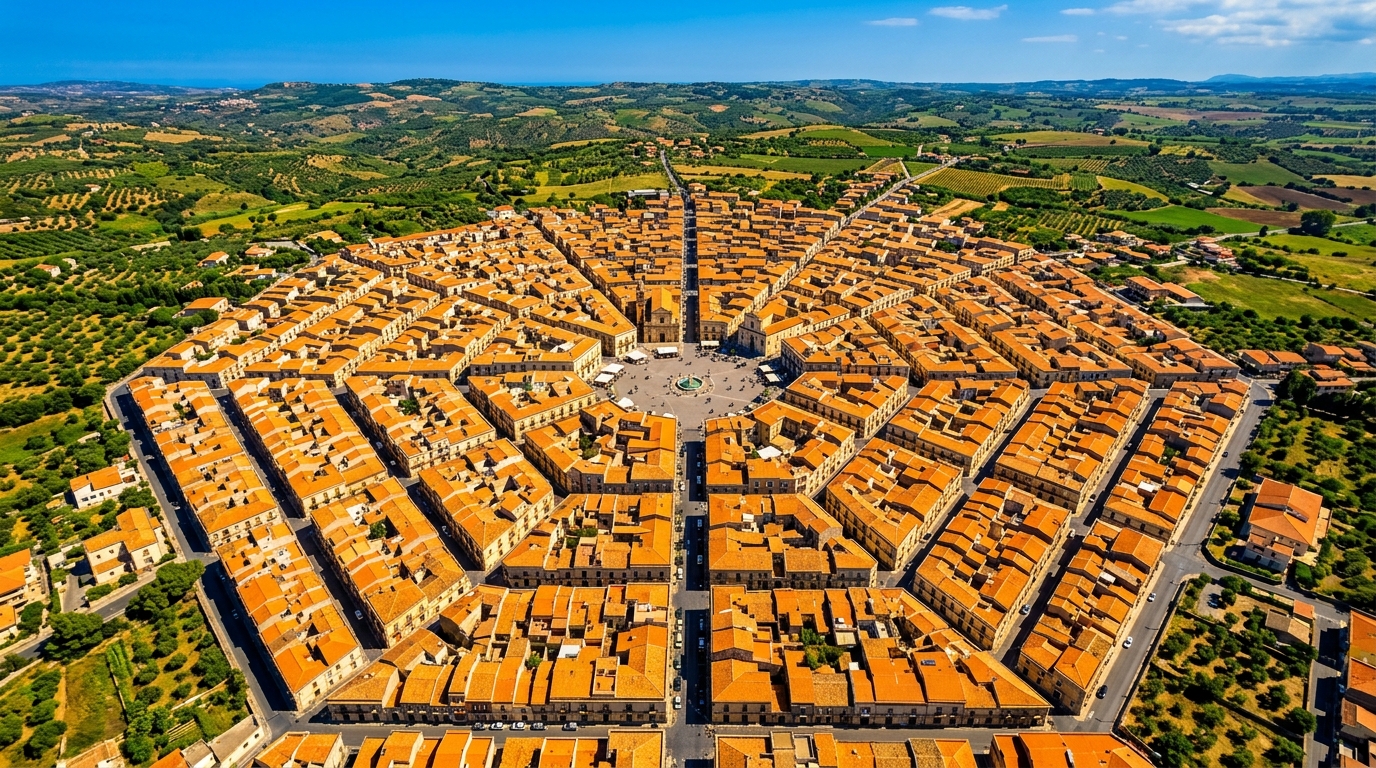
What if the key to surviving an earthquake lies not in the thickness of walls but in the very shape of a city? In eastern Sicily, tucked within the hills of the province of Catania, a settlement has answered this question for more than three centuries. Its secret does not hide in miracle materials or in a revolutionary construction technique, but in a simple six-sided polygon, echoed at every scale of its urban fabric. Grammichele, that is its name, remains today a fascinating case study, the example of a community that chose to rethink its territory from scratch rather than replicate the mistakes of the past.
- After Occhialà’s total destruction by the 1693 earthquake, Prince Carafa Branciforte founded Grammichele on a new site, rebuilt according to an unprecedented hexagonal plan designed by architect Michele da Ferla.
- This hexagonal plan, organized around a central square and six converging roads, aimed to facilitate rapid evacuation of inhabitants through evenly spaced gathering places and a network of concentric streets.
- Although this geometry also allowed savings on water and sewer networks, it was never reproduced on a large scale, remaining a unique exception in European urbanism.
- When the Earth Shakes, Occhialà Disappears Forever
- An Architect Envisions a City That Didn’t Exist Anywhere Else
- A Geometry Meant to Save Lives, Not to Impress
- Why No One Ever Copied This Model
When the Earth Shakes, Occhialà Disappears Forever
The great earthquake of 1693 devastates eastern Sicily in mere seconds. Occhialà, a city perched for centuries, collapses almost entirely under the blast of the tremors.
Survivors immediately realize they cannot simply rebuild in the same place. The ground itself seems condemned, weakened by the catastrophe and bearing a risk that no one dares to ignore any longer. A fresh start, somewhere else, with a radically different approach, is required.
Carlo Maria Carafa Branciforte, prince of Roccella and Butera, makes a decision that will leave a lasting mark on the Sicilian landscape. He chooses a new site and gives birth to a city conceived from the outset to endure the next catastrophe. The chosen name for this urban rebirth is not accidental. Grammichele, named in honor of Saint Michael, embodies the hope of divine protection against future disasters.
An Architect imagines a City That Didn’t Exist Anywhere Else
It falls to a singular figure for the era to undertake this audacious task: Michele da Ferla, entrusted with drawing an entire metropolis according to a hexagonal plan, a venture unprecedented among European cities at the time. Inspiration drew on Palmanova, the fortified town built a century earlier on a nine-sided polygon. Yet Grammichele pushes the idea further, placing the hexagon not merely as a defensive perimeter but as the very core of urban design.
Six roads converge toward a central square, itself drawn as a perfect hexagon. This nerve center would later become the Piazza Prince Carafa, surrounded by the essential public buildings that sustain city life. Around this geometric core, four rectangular quarters were intended to complete the ensemble. One of these quarters was even planned to house the prince’s palace, an ambitious project that ultimately never came to fruition.
A Geometry Meant to Save Lives, Not to Impress
The choice of the hexagon is not a whim or a stylistic gesture meant to set Grammichele apart from other Italian towns. It responds to a concrete preoccupation: the rapid evacuation in the event of a future earthquake. Every detail of the urban plan seems crafted to spare residents the trauma endured at Occhialà.
Equidistant gathering squares are thus distributed throughout the city. Each neighborhood has a fallback point reachable in a few minutes on foot, as if the entire city had been designed around a built-in evacuation plan. A network of concentric roads links these spaces, enabling easy movement and preventing anyone from being trapped in dead-ends when the moment of danger arrives.
The Australian engineer Rudolf Mueller later highlighted another hidden advantage of this configuration. According to him, the hexagonal geometry would also allow notable savings on water and sewer networks, thanks to a more uniform distribution of infrastructure across the urban area.
Why No One Ever Copied This Model
Hexagonal urban planning experienced a brief revival at the dawn of the 20th century, far from the Sicilian hills. The New York architect Charles Lamb imagined it as an elegant solution to the problems of modern cities.
But the excitement soon faded. Researchers Eran Ben-Joseph and David Gordon today describe this approach as little more than a curiosity, never truly adopted on a large scale by urbanists around the world. World War II abruptly interrupted these reflections, priorities shifted, and the hexagonal concept slipped from prominence for decades.
Ben-Joseph sums up the issue in a single, crisp line: this model works in theory but not in practice, hampered by navigational challenges and by developers’ rejection of triangular plots. Grammichele thus remains a rare exception, a unique testament to a time when the urgency of survival gave rise to a level of urban geometry unmatched in Europe.
