
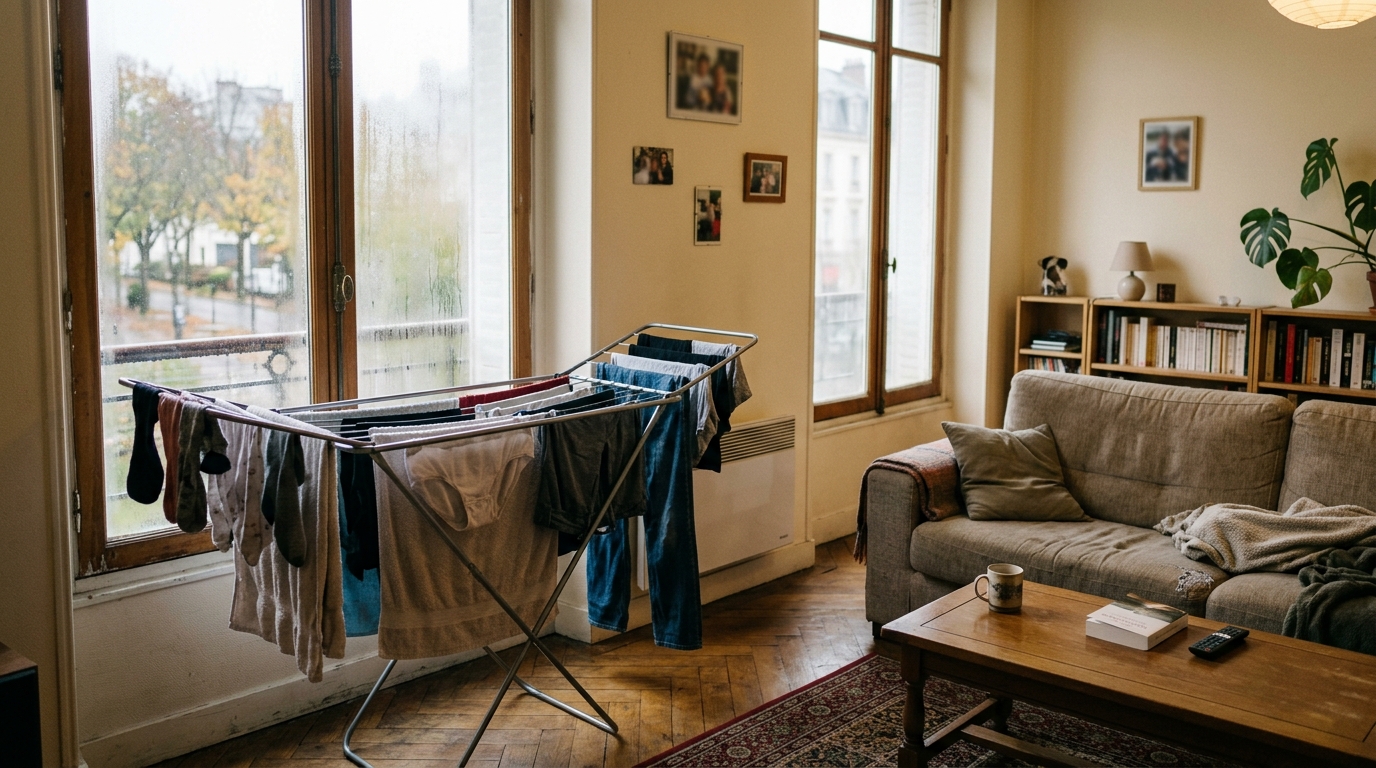
What if the real culprit behind your sneezes wasn’t the cat, nor the dust under the sofa, but a totally unsuspected everyday object? In autumn, when windows stay shut and the radiator comes back into service, interiors turn into true pressure cookers. A lingering cough, a scratchy throat, the sensation of heavy air in the living room: the symptoms are well known, but their origin is often poorly identified. We readily blame dust mites or animal dander, without realizing that a gesture repeated several times a week, innocently, actively contributes to the problem. This gesture, almost nobody questions. Yet it profoundly changes the air quality we breathe at home, far more than we imagine.
- Drying clothes indoors can raise a room’s humidity by up to 30%, fostering mold and dust mites.
- These two factors contribute to coughing and respiratory irritations often observed in autumn.
- Airing regularly, wringing out laundry, using a dedicated room, and employing a dehumidifier if needed help limit these effects.
- The seemingly innocent gesture that changes everything in the air of your living room
- Mold and dust mites: the winning duo created by your damp towels
- Simple solutions to dry your laundry without polluting indoor air
- What this phenomenon reveals about our daily habits
The seemingly innocent gesture that changes everything in the air of your living room
Drying clothes indoors may seem obvious as soon as rain sets in and the garden becomes impractical. The drying rack then finds a spot near the radiator, in the living room or in a bedroom, without a second thought about the consequences. Yet this ordinary act has a direct and measurable effect on the room’s atmosphere: the damp laundry gradually releases all of its moisture into the surrounding air. A complete laundry load can contain several liters of water which, instead of evaporating outside, becomes trapped between four walls. The result is that the humidity level soars, sometimes dramatically, and the air becomes a particularly favorable ground for phenomena most of us would rather avoid at home.
Mold and dust mites: the winning duo created by your damp towels
Drying laundry indoors can raise the humidity of a room by as much as 30%. This rise, far from being inconsequential, creates ideal conditions for two quiet but formidable enemies of the airways: mold and dust mites. The former especially enjoy poorly ventilated nooks, cold walls, or window corners, where they quietly develop before releasing irritating spores. The latter thrive on air rich in humidity to proliferate in textiles, carpets and bedding. This pair explains, to a large extent, why autumn coughs can linger for some people, without a clear link to a classic cold. The air may look healthy to the eye, but it is actually saturated with invisible elements that attack the bronchi and sinuses.
Simple solutions to dry your laundry without polluting indoor air
Fortunately, a few adjustments are enough to limit these undesirable effects without giving up drying at home. The first rule is to ventilate the room where the laundry is drying, by opening the window for a few minutes several times a day, even when it’s chilly. A dehumidifier can also prove very helpful in homes that are poorly ventilated or insulate poorly. Here are some daily habits to adopt:
- Prefer a bathroom or a dedicated room, rather than the living room or a bedroom
- Wring the laundry as much as possible before hanging it
- Aerate the room morning and evening, even in autumn
- Use a dehumidifier if humidity exceeds 60%
- Avoid drying several loads at once in a closed space
These steps, seemingly simple, greatly limit the proliferation of mold and help preserve a more breathable air throughout the seasons.
What this phenomenon reveals about our daily habits
This observation about indoor laundry drying illustrates a broader reality: many of our small domestic habits escape our vigilance, even though they directly affect our well-being. We readily monitor outdoor air quality, urban pollution, or spring pollen, but we often overlook what happens inside the walls of our homes. Autumn, with its closed windows and the heating system restarting, acts as a revealer of these tiny imbalances that accumulate without us realizing. This phenomenon ultimately invites us to rethink certain automatic behaviors, not in a constraint-driven logic, but as a simple way to breathe better at home, season after season.
Next time rain arrives and the drying rack seems the only option, a quick detour to the bathroom, window slightly ajar, could make all the difference. A small, almost invisible gesture, but one that concretely changes the way we breathe at home.
