
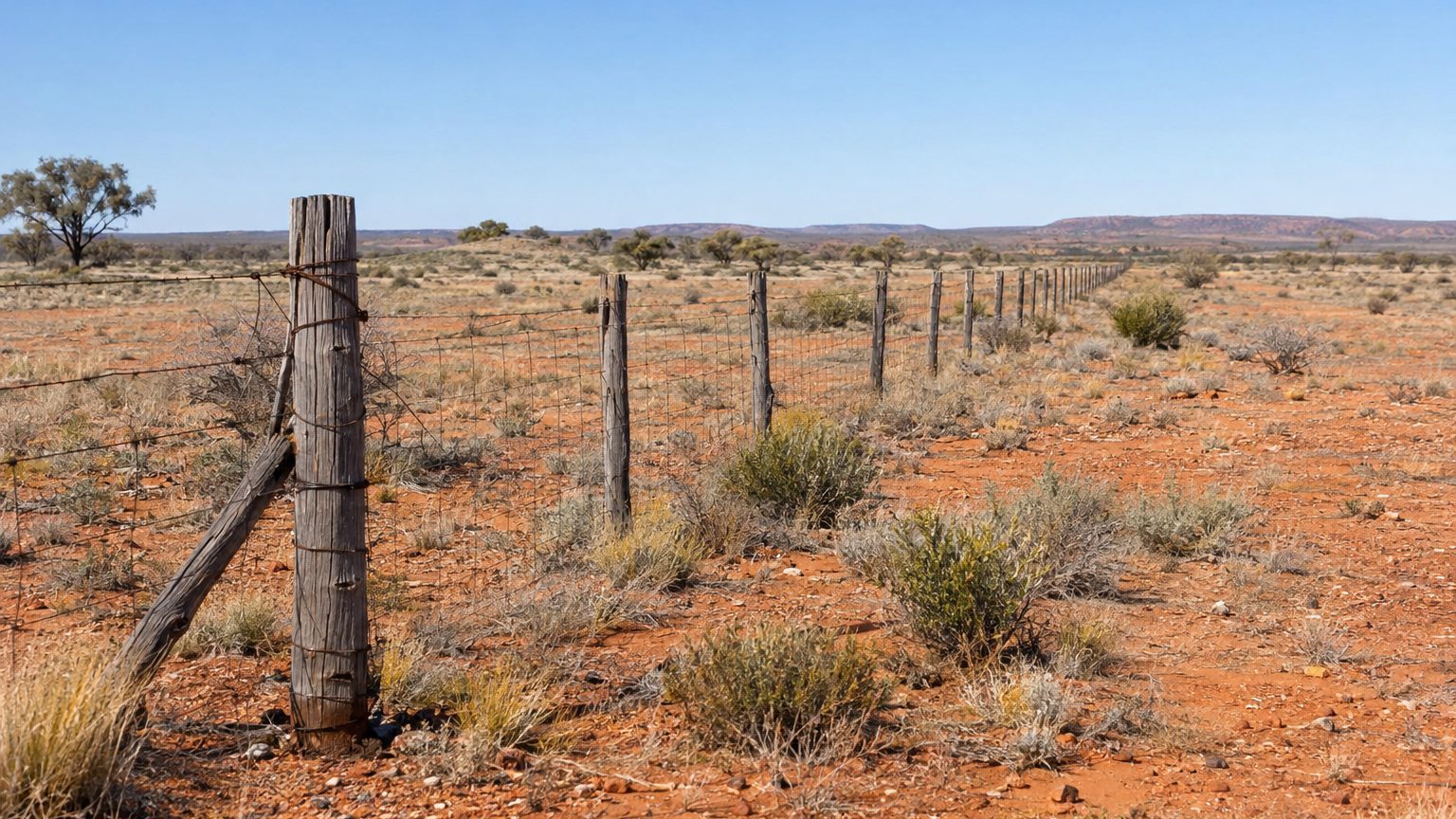
- Western Australia stretched 3,256 km of fencing in three lines between 1901 and 1907 to contain rabbits
- Rabbits had already breached the first fence before its completion in 1907
- The project mobilized 120 men, 350 camels, 210 horses and 41 donkeys for six years
A Fence That Arrived After the Battle
The No. 1 fence of Western Australia runs from Starvation Boat Harbour on the southern coast to Cape Keraudren, north of Port Hedland: 1,833 kilometres. When it was completed in 1907, it stood as the longest uninterrupted fence in the world. Yet rabbits had already found their way through, and the state had to lay two more lines behind the first.
December 1904: rabbits are spotted near Cordingup Gap.
Even before Fence No. 1 was finished, rabbits were moving into the regions it was meant to protect, including this eight-kilometer stretch east of Ravensthorpe. The invasion trace back to October 1859, when Thomas Austin released 24 wild rabbits from England for hunting. Fearing that Western Australian farmers would be ruined as those in the East had been, the government of Western Australia commissioned the fences. The project started from Burracoppin, a southwestern town that served as the main depot: a first section was launched in 1901 toward the southern coast, a second, three years later, toward the northwestern coast.
To put the scale in perspective, 1,833 km is roughly the distance as the crow flies between Paris and Athens. The construction cost ran about 250 dollars per kilometre at the time.
Wood, Wire and Camels
The No. 1 fence was only a first draft. Two additional fences, completed in 1905 and 1907, were built alongside it, and together the three reached 3,256 kilometres. All of this required six years of work. Sources vary slightly on the start dates (1901 or 1902), but not on the order of magnitude.
The posts were wooden, and the mesh was buried sixteen centimetres underground to deter burrowing animals. On the eastern side, a 3.7-metre maintenance track was cleared; on the western side a 2.4-metre firebreak was left, and a gate was installed approximately every 3 km.
One of the project’s foremen, Anketell, had 120 men, 350 camels, 210 horses and 41 donkeys at his disposal. In the desert, the pack animals were as numerous as the workers. Water and provisions had to be sustained for a project that advanced through stretches where wells were scarce. The route was laid out by Alfred Canning, the same surveyor who would later map the famous Canning Stock Route.
Patrollers on Bicycles, Then on Camelback
Such a fence of this length cannot be guarded by itself. Four inspectors divided the work, each overseeing a section of about 800 km, while 25 patrollers covered 160-kilometre tracts, initially by bicycle and later on camelback or in a camel-drawn buggy.
In 1910, a car trial ended quickly because it kept puncturing.
These “fence runners” earned 213 pounds a year to inspect the line, repair damage and clear the routes. Their camps were spaced roughly 30 km apart, near wells, bores or any other reliable water point.
A Barrier That Gave Way, a Line That Remains
The verdict arrived in 1927. A large number of rabbits collided with the fence north of Murchison, and the barrier ceased to prove its effectiveness. It slowed their advance and helped shape the fight, though it did not stop the invasion entirely. It would take biological controls—the myxomatosis in the 1950s and the calicivirus in the 1980s—to drive the populations back.
Since 1948, some sections have been abandoned, sold to farmers or transferred to local authorities. The system still exists under the name State Barrier Fence, and over much of its southern half, Fence No. 1 marks the clear boundary between the Great Western Woodlands and the Wheatbelt.
In the 1930s, three young Aboriginal girls, Molly Craig, Daisy Burungu and Gracie Fields, fled Moore River Native Settlement and walked more than 1,600 km along this fence to reunite with their families in Jigalong. It is this journey that gave the fencing its international notoriety, well beyond the rabbits’ story.
Source: breakingthecycle.education
