
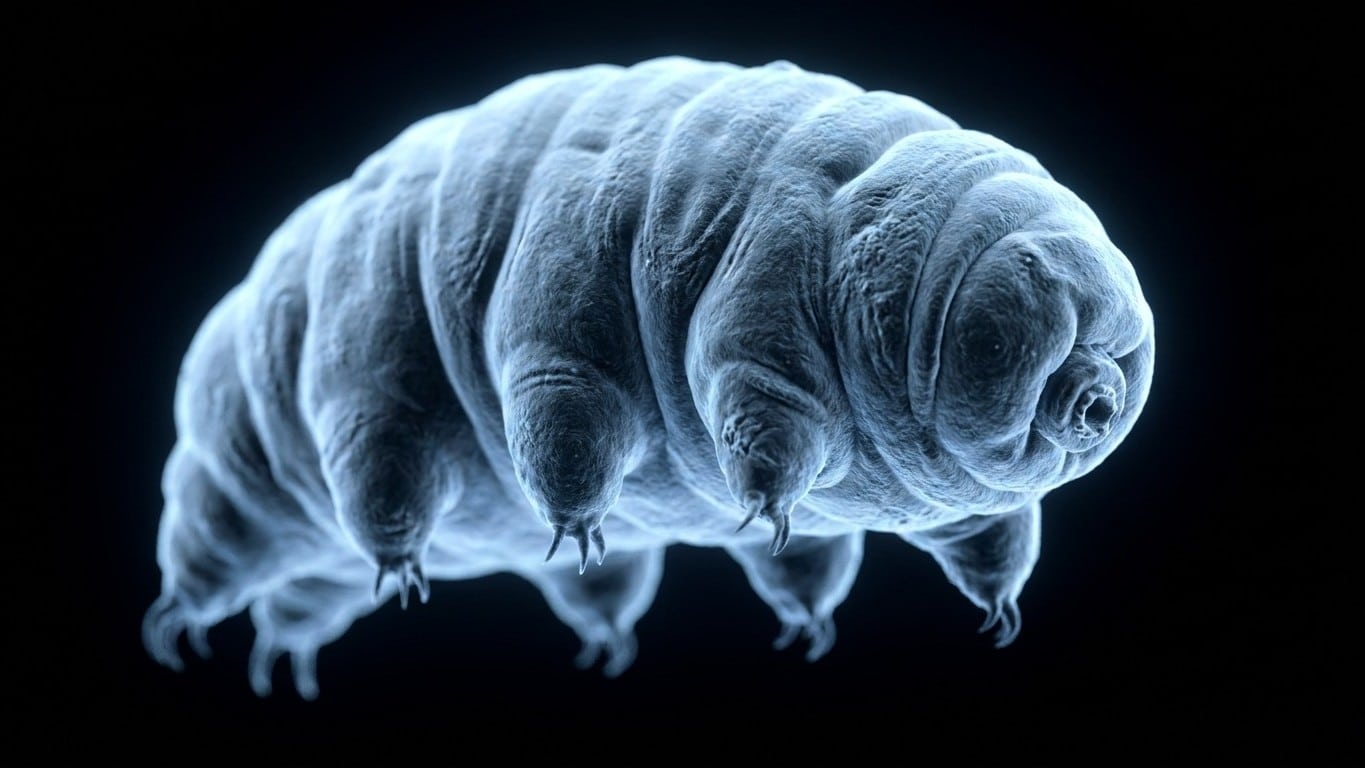
On September 14, 2007, a Russian Soyuz-U rocket placed into orbit a spherical capsule loaded with 43 scientific experiments. Among them, a Petri dish containing several thousand desiccated animals, exposed without any protection to the vacuum of space. Ten days later, the capsule returns to Earth. Scientists rehydrate their samples. And the creatures wake up.
These extraordinary survivors are tardigrades, also nicknamed “water bears.” These microscopic invertebrates measuring less than a millimeter are capable of withstanding dangerously high levels of radiation, temperatures ranging from near absolute zero up to 150 °C, and thus, as learned in 2007, the vacuum of space. It was the first time that an animal was subjected to such an experiment: simultaneous exposure to the vacuum of space, cosmic radiation, and direct solar ultraviolet light.
Key takeaways
- Invisible-to-the-eye creatures defied the laws of biology by surviving the universe’s most extreme conditions
- Their molecular secrets could transform medicine and radiation protection
- Panspermia, that wild theory that life travels between planets, suddenly seems much less far-fetched
An experiment at the edge of reason
The Swedish biologist Ingemar Jönsson, from Kristianstad University, designed the TARDIS experiment (Tardigrades in Space), mounted on the ESA’s Biopan-6 platform, outside the FOTON-M3 capsule at an altitude of 270 kilometers. Tardigrades from four different species, in anhydrobiosis, were arranged in containers open to space for ten days: one group shielded from all radiation, two others exposed only to UV-A or UV-B, and the last one completely unprotected.
It was known that bacteria could endure vacuum conditions, but it seemed inconceivable that animals could withstand the two major dangers of space: the vacuum, which would boil internal water, and ultraviolet radiation, which would shred chromosomes. The tardigrades challenged this premise with disarming nonchalance.
A group of European researchers exposed dehydrated tardigrades to the vacuum and solar radiation of space for ten days. When the specimens were rehydrated upon returning to Earth, 68% of those shielded from radiation survived, and even a handful of those with no protection came back to life and produced viable offspring. For groups subjected to the most intense UV, the survival rate fell to between 10% and 15%. Of the species Milnesium tardigradum, only three individuals survived the most extreme conditions. These three reproduced, and their descendants showed no detectable damage.
The “tun”: the tardigrade’s secret weapon
Understanding how such a complex animal can pass through space without dying requires a plunge into its molecular biology. It all starts with a process called anhydrobiosis. Triggered by the lack of water, the tardigrade loses up to 95–99% of its body water and contracts into a desiccated form known as the “tun.” This phenomenon is made possible by the production of specific proteins, the CAHS proteins.
In this folded form, their vital activity drops to 0.01% of normal. It is no longer life in the strict sense: it is total standby, a suspension of biological time. The vacuum of space, which would cause immediate dehydration and would burst most organisms within minutes, causes no damage to them precisely because they are already dry. Brilliant, in a sense.
But space is only part of the problem. To guard against radiation capable of destroying DNA, tardigrades rely on another protein: Dsup (Damage Suppressor Protein), which binds to the chromatin of cells and protects DNA from hydroxyl radicals produced by X-rays. Special configurations of DNA and other cellular components that prevent damage are probably involved, along with an efficient system for repairing damaged DNA. When damage does occur, the animal actively repairs it upon rehydration.
It is this double capacity, passive and active, that makes tardigrades so perplexing to classical biology. A follow-up study published in 2016 by the same team, tracking the descendants of the space survivors across multiple generations, did not find any decrease in performance compared with non-exposed lineages. The authors suggested that the tardigrades that survive do so by fully repairing their damage, rather than passing on residual mutations.
What this changes, concretely
The question that truly interests scientists is not whether the tardigrade is a superhero (that is a given). It is how to transfer its capabilities to other biological systems, including humans. The TARSE project notably revealed that spaceflight triggers antioxidant responses in tardigrades, increasing the production of glutathione to neutralize harmful oxidizing molecules that threaten DNA integrity.
Researchers have identified precise molecular mechanisms: the protein Dsup shields DNA from radiation, the CAHS proteins form protective gels during desiccation, and pigments neutralize free radicals. Teams are now working to integrate these tardigrade genes into human cells, cultures, and medical treatments, with potential applications in anti-radiation protection for chemotherapy patients and for astronauts.
The astrobiological angle is just as dizzying. Building on these results, some researchers have suggested that tardigrades could survive interplanetary travel inside a large meteorite, lending credence to panspermia, the theory that life could spread between planets via celestial bodies. The hardiest creature on Earth could also be the most cosmically mobile. In 2011, Angela Maria Rizzo and her colleagues sent tardigrades aboard the Space Shuttle Endeavour (STS-134) to the ISS, and concluded that microgravity and cosmic radiation “did not significantly affect tardigrade survival in flight.” The coherence between the two missions leaves little doubt: these animals have co-evolved with environmental stresses so severe that space itself does not scare them. The real limit, for now, remains the sun’s direct UV-C and unfiltered rays. All organisms have a threshold. Even them.
Sources: journaldugeek.com | spacedaily.com
