
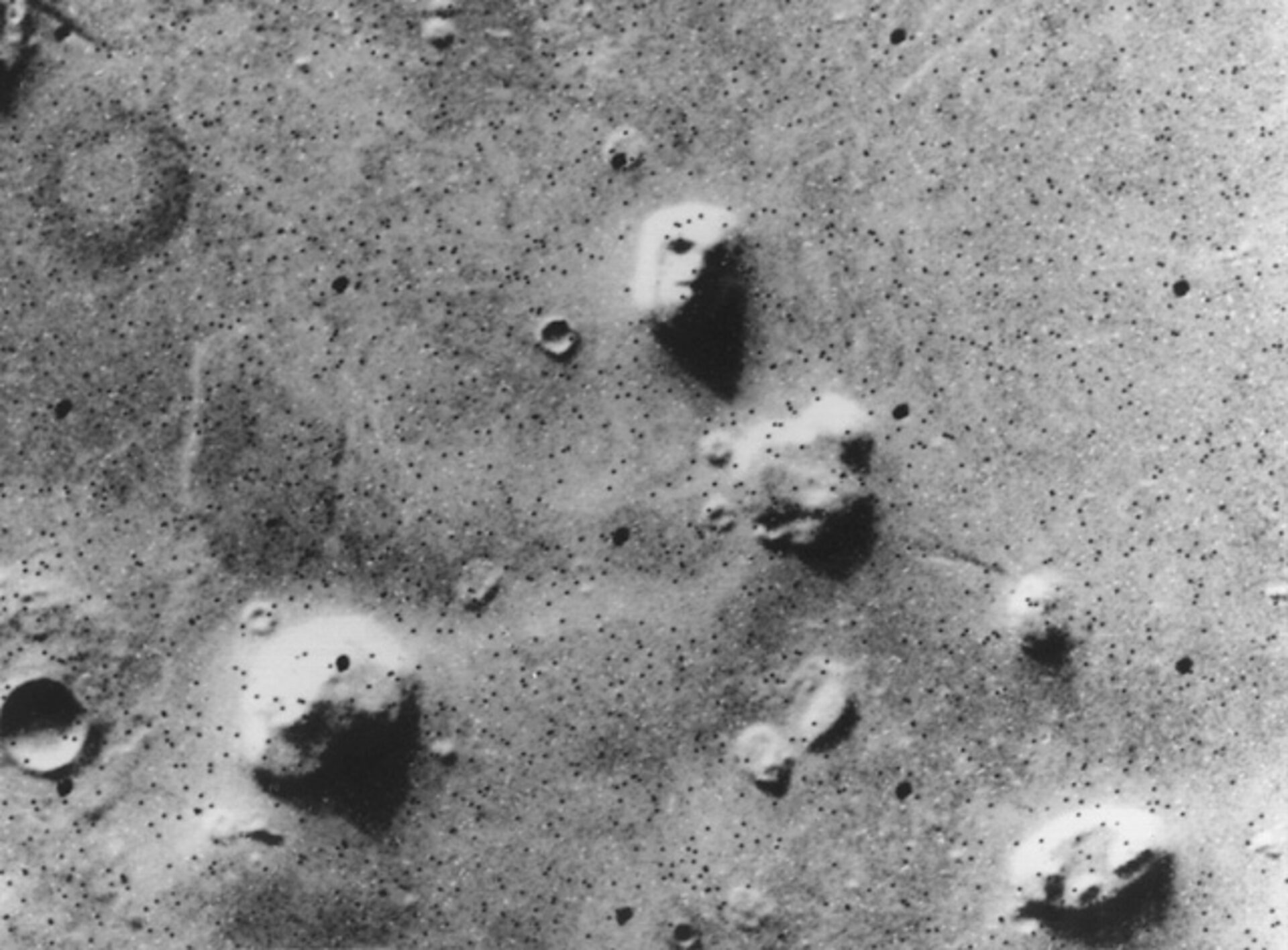
All it took was a simple black-and-white photograph, a little blurred, taken millions of kilometers away from Earth: that was all it took for a portion of humanity to become convinced that a vanished civilization had once built cities on Mars. The most astonishing aspect of this story is that the agency that released the image already knew, at the very moment of publication, that it was an optical illusion. A look back at one of the most persistent misunderstandings in space exploration, where science took more than twenty years to catch up with the collective imagination.
- On July 31, 1976, NASA distributed a Cydonia image showing a relief reminiscent of a face, while noting from the outset that it was very likely a solar-illumination effect tied to the terrain morphology and lighting.
- In April 1998, the Mars Global Surveyor camera revealed that it was only an eroded surface with no artificial structure, ending twenty-two years of speculation.
- In July 2006, Mars Express confirmed with its High Resolution Stereo Camera that it is merely a mesa shaped by natural erosion.
- July 31, 1976, a simple Viking 1 photo sufficed to ignite the myth of a Martian civilization, even as NASA already knew it was a shadow game
- A blurry shot, a planetary rumor: how the Face of Mars set minds ablaze
- Cydonia, that Martian region where the terrain plays tricks on our brains
- 1998, the year Mars Global Surveyor put the mystery to rest in a single image
- Mars Express confirms the verdict: a natural mesa, nothing more
- From myth to science: what the Face of Mars really reveals
July 31, 1976: a simple Viking 1 photo was enough to give rise to the Martian civilization myth, even as NASA already knew it was an optical illusion
Credit: © ESA/DLR/FU Berlin (G. Neukum)
It all began on July 25, 1976, when the orbiter of the American probe Viking 1 captured, almost by accident, an image of the Martian surface. A few days later, on July 31, 1976, NASA chose to publish this shot in an official statement. In the photo, a relief displays a striking symmetry suggesting two eyes, a nose, and a mouth, like a face frozen in rock. The agency mentioned this formation while noting, from that time, that it was very likely a solar-illumination effect combined with the terrain morphology and the play of shadows. Yet this detail passed largely unnoticed in the face of the image’s striking power.
A blurry shot, a planetary rumor: how Mars’ Face set minds ablaze
It took little more than that to spark human imagination. The “Face on Mars” quickly became a cultural phenomenon in its own right, fueling theories about the existence of Martian artificial structures: pyramids, archaeological remnants, or even an entire city buried beneath the red dust. Science fiction literature and popular culture embraced the topic with enthusiasm, turning a geological formation into a symbol of a possible extinct extraterrestrial civilization. For more than two decades, this enigmatic face fed a collective imagination that proved hard to extinguish, even though scientific explanations had already been proposed from the outset.
Cydonia, that Martian region where the terrain plays tricks on our brains
The famous face lies in a precise region of Mars named Cydonia, located approximately at 40.75 degrees North and 350.54 degrees East, in the Arabia Terra region. This sector corresponds to a particular geological transition, between the southern highlands and the northern plains of the Red Planet. Here one finds broad valleys strewn with debris and isolated residual mounds, whose shapes can be startling. It is precisely this diversity of relief, combined with grazing illumination, that can give rise to deceptive forms for the human eye. This natural relief, sculpted by erosion, could be perceived as a familiar shape during the initial observation.
1998, the year Mars Global Surveyor put the mystery to rest in a single image
We had to wait until April 1998 for the question to be definitively settled. The Mars Orbiter Camera, aboard NASA’s Mars Global Surveyor spacecraft, flies over the Cydonia region and captures a new image of the area. The scientific verdict comes without appeal: the so-called face is nothing more than a heavily eroded surface, with no sign of any artificial structure. What was thought to be carved features was, in reality, a play of natural relief, highlighted by the sun’s angle at the time of the first shot. A much higher technical resolution thus suffices to dispel twenty-two years of speculation.
Mars Express confirms the verdict: a natural mesa, nothing more
A few years later, the European Space Agency adds its contribution. Its Mars Express probe managed, on July 22, to photograph Cydonia using its High Resolution Stereo Camera, after several unsuccessful attempts between April 2004 and July 2006, hindered by the altitude of the flyover and the presence of atmospheric dust. The data, collected during orbit number 3253, provide a ground resolution of about 13.7 meters per pixel. Result: this long-fabled relief is actually just a mesa, that is to say an isolated rocky plateau, shaped by erosion over time. Dr. Agustin Chicarro, Mars Express project scientist at the ESA, even highlights the value of these new images for planetary geology, far beyond the mere curiosity they arouse in the general public.
From myth to science: what the Face of Mars really reveals
This story ultimately reveals less about Mars than about ourselves. It illustrates how a low-quality image, combined with a mystery-prone context, can be enough to give birth to a durable legend, even when scientific explanations exist from the start. The Face of Mars has never been a doorway to a vanished civilization, but a simple Martian relief, misled by its own lighting at the moment of the shot. It remains, however, an excellent educational example for understanding how a play of shadows and light can create an illusion, and why it is essential to continue observing, measuring, and verifying before drawing conclusions. Twenty-two years separate the first photo from its scientific refutation: a delay that underscored how space exploration, patient by nature, always ends up having the last word over the most stubborn rumors.
