
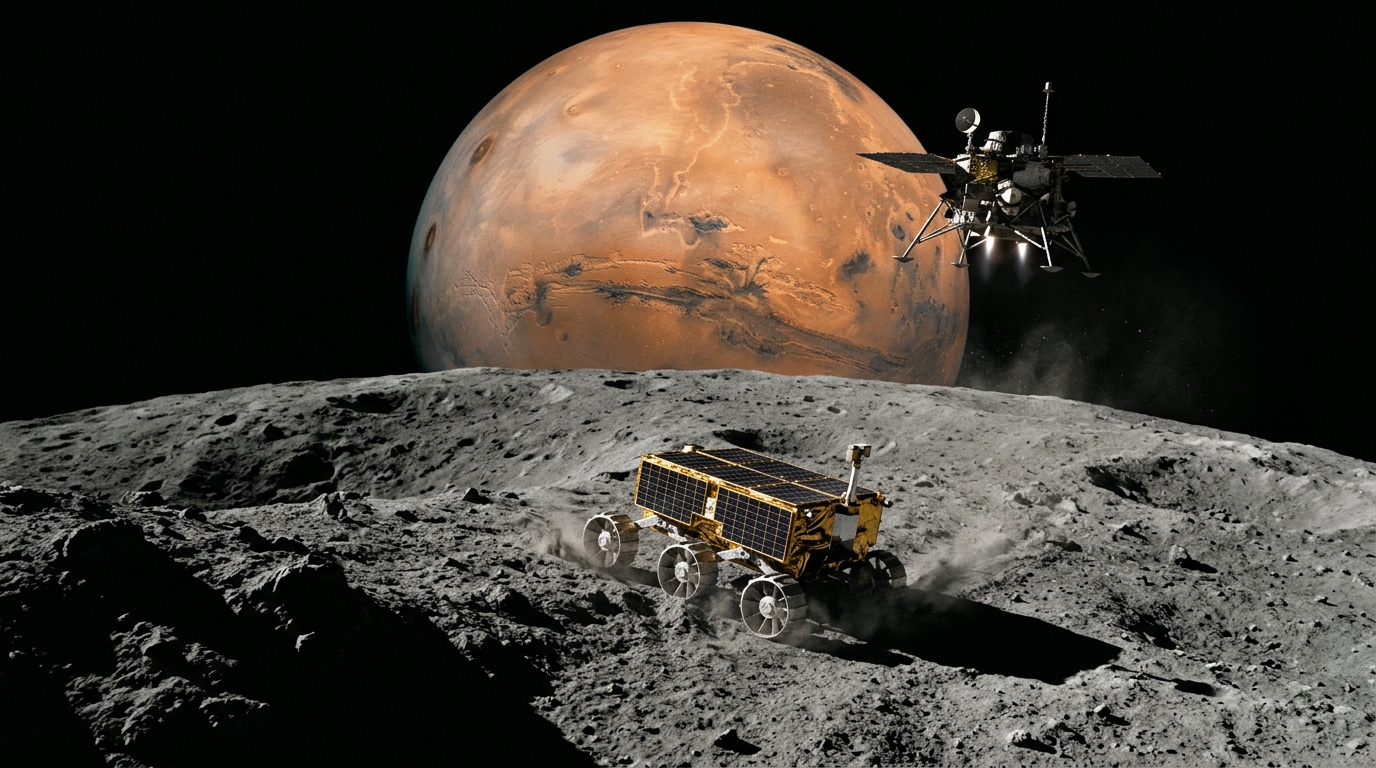
Imagine a device capable of landing on a celestial body without truly slowing its descent. This isn’t science fiction; it’s a rather bold bet that France and Germany are about to attempt with their rover Idefix, carried aboard the Japanese MMX mission. As autumn begins and the countdown to lift-off from Tanegashima ticks away, the teams at CNES and DLR are fine-tuning the final adjustments of a craft that will have to tame one of the solar system’s most puzzling environments: Phobos, the larger of Mars’s two moons.
- Idefix, released at an altitude of 40–100 meters, will land softly on Phobos after a fall of 60–80 seconds, at less than one meter per second
- With a release velocity of about 11 meters per second, the rover must avoid any sudden movement to prevent it from permanently escaping the surface
- Equipped with paddle wheels and limited to a few centimeters per second, Idefix will have about 100 days to explore Phobos thanks to the MMX relay spacecraft
- Idefix, the rover lighter than a bicycle but not by accident
- Eleven meters per second: the speed that separates landing from involuntary takeoff
- Moving at snail’s pace, the only option to avoid liftoff
- What the MMX mission will change in our understanding of the Martian moons
On Phobos, even a fall can count as a landing
On Earth, landing softly is a formidable technical feat, involving retrorockets, parachutes and centimetre-precision trajectory calculations. On Phobos, the problem is almost the inverse. Gravity is so weak that simply letting go from a few tens of metres up is enough to land. During one of MMX’s closest passes above the tiny moon, Idefix will be released from a height between 40 and 100 metres. On our planet such a fall would be fatal in mere seconds. On Phobos, it will last between 60 and 80 seconds, giving the rover time to descend almost in slow motion before touching down at a speed under one metre per second.
This detail, seemingly anecdotal, alone encapsulates the mission’s singularity. While engineers usually aim to slow a craft as it plunges too rapidly, the CNES and DLR teams had to contend with the inverse: a fall so slow that it becomes almost hypnotic, yet one that had to be simulated with precision before the big day.
Idefix, the rover lighter than a bicycle—but not by accident
With its 45 x 40 x 35 centimeters, Idefix has roughly the footprint of a microwave oven perched on four wheels. Its weight, just under 25 kilograms, makes it a featherweight beside the large Martian rovers that typically traverse kilometres on the red planet. But this choice is not random: every gram saved matters when sending a craft tens of millions of kilometres from Earth, tethered to a main orbiter that must also carry fuel, scientific instruments and a means to bring back samples.
To operate autonomously once landed, the small rover relies on four miniature solar panels, each capable of delivering a maximum power of around 15 watts. This energy powers its instruments and communication systems, which are then relayed to Earth by the MMX orbiter itself, remaining in orbit around Phobos. This dependence on the orbital relay is not incidental: it is precisely this arrangement that will limit the surface mission to about one hundred days, the window during which MMX gradually moves away from the moon to pursue its own science program.
Eleven meters per second: the speed that separates landing from involuntary takeoff
Here lies the crux of the challenge, and perhaps the mission’s most dizzying fact: on Phobos, gravity is only about one thousandth of Earth’s, precisely 1,800 times weaker. A direct consequence and almost comic: the 25-kilogram rover, once on the surface, would weigh only the equivalent of 15 grams, roughly the mass of a chocolate bar.
But this lightness carries a dangerous flip side. On such a small, loosely bound body as Phobos, the escape velocity—the speed beyond which an object will permanently break free from gravitational pull—nearly reaches only 11 meters per second. To put it in perspective, an Olympic 100-meter sprinter could reach that mark without breaking a sweat. In other words, if Idefix accelerated a little too much, or bounced awkwardly on touchdown, it could literally fly off the surface of Phobos and vanish into space, with no chance of return. This constraint, as strange as it may seem, set the rover’s entire design philosophy.
Moving at snail’s pace, the only option to avoid lifting off
Confronted with this real risk of accidental liftoff, the DLR engineers reimagined even the wheel geometry. On Phobos, the ground-contact pressure is extremely low, and the exact nature of the surface remains uncertain: is it a solid rock, a powdery dust, or something more like powdery snow? Facing this ambiguity, the teams chose paddle-like wheels designed to provide grip without generating jolts capable of launching the rover upward.
The result: Idefix will not roll in the conventional sense; it will move at a snail’s pace, just a few centimetres per second at most, within an approximate landing zone of 100 metres in diameter, vastly larger than the 20 by 20 metre area reserved for the MMX orbiter itself. To validate this behavior before the mission’s big step, the teams used a simple yet clever lab trick: they dropped a rover prototype from a height of only 5 centimetres, a fall sufficient to faithfully reproduce Phobos’s extreme gravity while remaining on Earth.
What the MMX mission will change in our understanding of the Martian moons
Beyond the engineering feat of this Franco-German-Japanese rover, the scientific stakes of MMX extend far beyond mere technical prowess. Phobos remains an enigma for astronomers: is it an captured asteroid, gravitationally bound to Mars, or a fragment from an ancient impact on Mars itself? The data gathered by Idefix, together with those from the primary orbiter that must return samples to Earth, could finally settle this debate that has energized the scientific community for decades.
As the launch, planned for this month from the Tanegashima Space Center, approaches, this Franco-German-Japanese mission embodies a rare form of space cooperation where each partner contributes a piece of the puzzle. The 25-kilogram rover would become, if successful, the first vehicle ever landed and able to move on the surface of Phobos, paving the way for a deeper understanding of these peculiar Martian moons.
Between a controlled fall and an escape velocity teetering on the edge of a hair’s breadth, Idefix illustrates how space exploration can transform a seemingly insurmountable constraint into an elegant, simple solution. Whether, once deployed on this still-mysterious ground, the little rover will confirm all the promises placed in it remains to be seen, as does what Phobos will finally reveal about its origins, long a topic of debate.
