
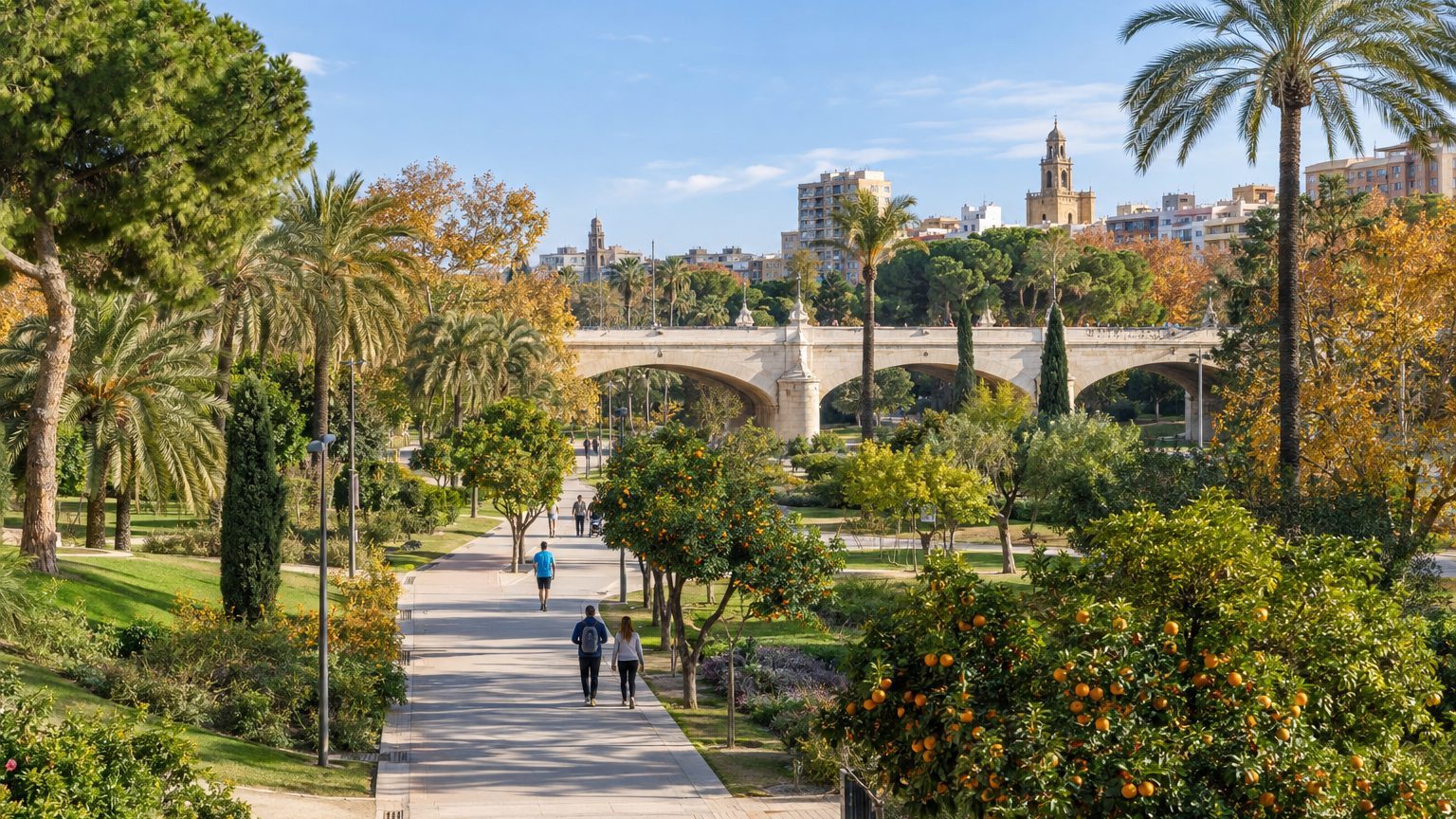
By excavating 11.868 km of newly carved riverbed south of Valencia, the Spaniards literally pushed the Turia away from the city it had just flooded. The old bed, now dry, was destined for asphalt. The inhabitants turned it into a 136-hectare garden, opened in 1986.
- The Turia flooded Valencia on 13 and 14 October 1957, causing at least 81 deaths and substantial material damage.
- The Plan Sur, approved in 1958, diverted the river into a new bed of 11.868 km calibrated for 5,000 m³/s.
- The old bed, promised for an urban highway, became in 1986 a 136-hectare garden hosting 3 to 7 million visitors annually.
October 1957, the river in flood
On 13 and 14 October 1957, the Turia overflowed into Valencia.
The human toll varies depending on the source, from at least 81 deaths to around a hundred. The water figures are more precise: approximately 300 litres per square metre in 24 hours and an estimated flow of 3,700 m³/s. Entire districts, including Campanar and los poblados marítimos, were submerged. It was not the first time: some 75 floods are recorded over the previous seven centuries.
The Plan Sur, or the art of digging a river
Three solutions were on the table: the North Plan, which would divert the river to the north; the Centre Plan, based on a dam at Vilamarxant; and the South Plan. It was the last one that won.
The Plan Sur was approved by the Council of Ministers on 22 July 1958. The river was diverted to the west of the city, near Quart de Poblet, to reach the sea via an estuary located about 3 km further south. The new bed, 11.868 km long and 175 to 200 m wide, was calibrated for 5,000 m³/s, far above the 3,700 m³/s estimated in 1957.
The works began in February 1965 and were officially completed on 22 December 1969. The project was not universally welcomed: Quart de Poblet and Mislata, to the west, protested the route. Environmental consultant Antonio Estevan later questioned the necessity of diverting the river entirely.
Left behind was the old bed, dry, cutting through the city.
A planned highway, a garden obtained
As early as 1966, while the Plan Sur work was not yet finished, the future of the old bed was already being discussed. The City Hall and the government envisaged a major axis of communication linking the port to the airport. An urban highway at the bottom of a riverbed, in effect.
Residents answered with a slogan, “El llit del Túria és nostre i el volem verd” — The Turia bed is ours, and we want it green. The road project was abandoned, the bypass route having rendered the idea obsolete.
The garden opened in 1986. It spans 136 hectares and nearly 8.5 km, roughly the equivalent of about 190 football fields. Ricardo Bofill designed one of its central stretches. Estimates place the garden’s annual visitors at 3 to 7 million, with the higher figure exceeding Norway’s population (about 5.5 million inhabitants).
The historic bridges, including the Mar Bridge dating from 1591, no longer span water but tree-lined promenades. The park connects the City of Arts and Sciences to the Bioparc. In driving away the river that had drowned it, Valencia gained a park that traverses the city from end to end.
October 2024, the new bed put to the test
Ten days before the anniversary of the flood, October 2024 remains vivid in memory. The new bed channeled the floodwaters as planned.
The Poyo ravine, another basin, inundated the southern municipalities.
Experts consulted by Maldita.es disagree on the exact role of the new bed during the DANA. They agree, however, on one point: a large share of the damage is due to construction in flood-prone zones.
Sources: maldita.es | elespanol.com
