
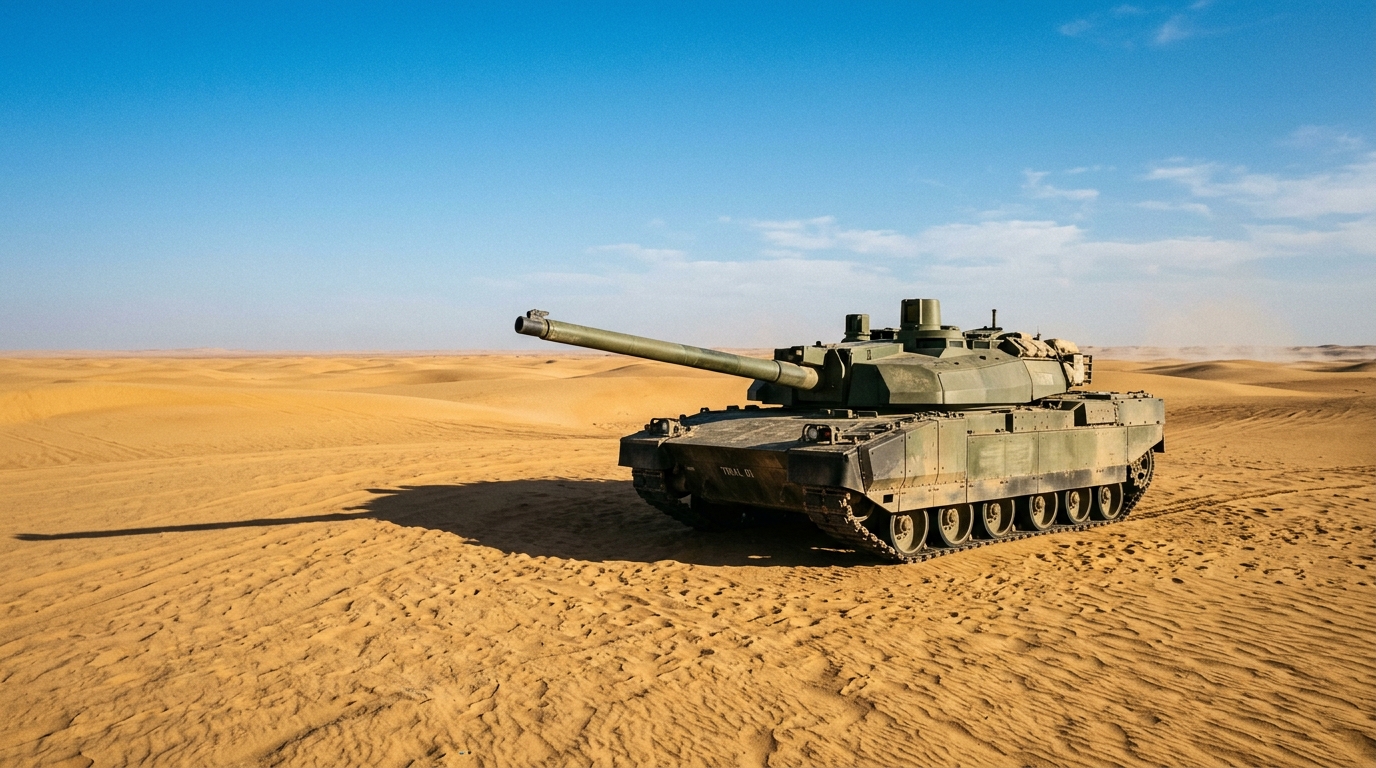
A South American tank that outshines the flagship of American military industry on its own playing field: a scene that reads like something straight out of an improbable screenplay. Yet, this is exactly what happened in the Saudi desert in the mid-1980s, when the EE-T1 Osório, designed by the Brazilian firm Engesa, literally dominated the M1 Abrams and the British Challenger in head-to-head trials. A resounding technical achievement, nearly forgotten today, which nevertheless never allowed this armored vehicle to progress beyond two prototypes. For what sealed the fate of this exceptional machine was not a firing range duel or a workshop setback, but something far removed from both.
- In 1985, the Brazilian EE-T1 Osório outperformed the M1 Abrams and the Challenger in desert trials, thanks to its speed, accuracy, and reduced operating costs
- Saudi Arabia ultimately turned to the United States to buy the Abrams under diplomatic pressure and the Gulf War geopolitical context
- Deprived of this vital contract after investing more than $200 million in the program, Engesa went bankrupt in 1993, sealing the Osório’s fate
- When Brazil dreamed of dominating the global armored vehicle market
- On the ground, the Osório literally crushes the American Abrams
- When diplomacy and finance prevailed over the machine
- The legacy of a mechanical giant never put into service
When Brazil dreamed of dominating the global armored vehicle market
In the 1980s, Brazil was far from being a mere footnote in the arms industry. The São Paulo-based company Engesa already exported armored vehicles to about thirty countries worldwide, building a solid reputation for rugged machines suited to difficult terrains. Riding on this success, the firm decided to aim higher: to design a main battle tank capable of challenging the best Western productions of the era.
From this ambition emerged the EE-T1 Osório. The first hull was completed in September 1984, but it would take until May 1985 to install the final turret, armed with a 105 mm Royal Ordnance L7 cannon of British origin. A second prototype followed, this time equipped with a French 120 mm smoothbore gun manufactured by GIAT Industries, designed to meet the Saudi army’s exacting requirements. By July 1985, the first unit was airlifted to Saudi Arabia to undergo desert trials under extreme conditions, where mechanical endurance and electronic reliability make all the difference.
In the field, the Osório literally crushes the American Abrams
The desert-based comparative trials quickly swung in favor of the Brazilian tank. Facing the M1 Abrams and the British Challenger, the Osório impressed with its speed, maneuverability, and the precision of its fire-control system, regarded as particularly advanced for its era. International military observers present on-site did not hide their astonishment at the performance of this armored vehicle from a country not typically seen as a contender on such a competitive stage.
The technical edge was not the only argument in favor of the Brazilian tank. Its production and maintenance costs proved markedly lower than those of its Western rivals, a decisive factor for Saudi Arabia, which sought to equip its armored forces on a large scale. Some estimates even spoke of a potential order of several hundred units, a contract that could have propelled Engesa to the rank of a global giant in land-armament. The dream seemed within reach, yet in this ultra-politicized sector, a technical victory alone never suffices.
When diplomacy and finance prevailed over the machine
Behind the spotlight of the military trials, another battle unfolded, quieter but just as decisive. Washington frowned upon the idea that a South American tank could threaten its own export markets in the Middle East, a region deemed strategically crucial. Diplomatic pressure intensified, and the geopolitical context ultimately turned against Brazil: the Gulf War reshuffled the cards, pushing Saudi Arabia to align with the United States, in exchange for the purchase of the M1 Abrams.
The final decision, described as highly political, escaped any purely technical logic. For Engesa, which had poured more than $100 million of its own funds into the Osório’s development, not counting the broader investments estimated at over $200 million, this reversal was catastrophic. Without this vital contract, the company could not service its debts to creditors and banks. By 1988, it was already teetering on bankruptcy, gradually losing credibility with its international partners. The end of the Iran-Iraq War, followed by the dissolution of the Cold War, further depressed demand for this type of heavy armor, while Brazil’s return to democracy significantly reduced the state support the company had enjoyed. In 1993, Engesa finally closed its doors, bringing the Osório program to a definitive halt.
The legacy of a mechanical giant never put into service
The tale of the Osório starkly illustrates a brutal reality well known to defense-industry players: technical superiority does not guarantee success without solid political backing and the financial means to weather setbacks. Brazil, through Engesa, possessed the know-how to rival the established powers in heavy armor—a sector still dominated by the United States, France and the United Kingdom.
This episode left a lasting mark on Brazil’s ambitions in heavy armor. No project since has attempted to echo its audacious technological leap and the resources it mobilized. Today, the two remaining Osório prototypes are kept by the Brazilian Army, silent witnesses to a era when the country nearly upended the global market order for main battle tanks.
In the end, the Osório remains the emblem of an industrial dream thwarted not by a flaw in armor or cannon, but by broader geopolitical and economic considerations that outweighed mere engineering prowess. A lesson that still resonates in a sector where the balance of power can weigh more than the finest engineering. It remains to be seen how many other projects worldwide will suffer a fate as unfair as that of this Brazilian tank that was ahead of its time.
