
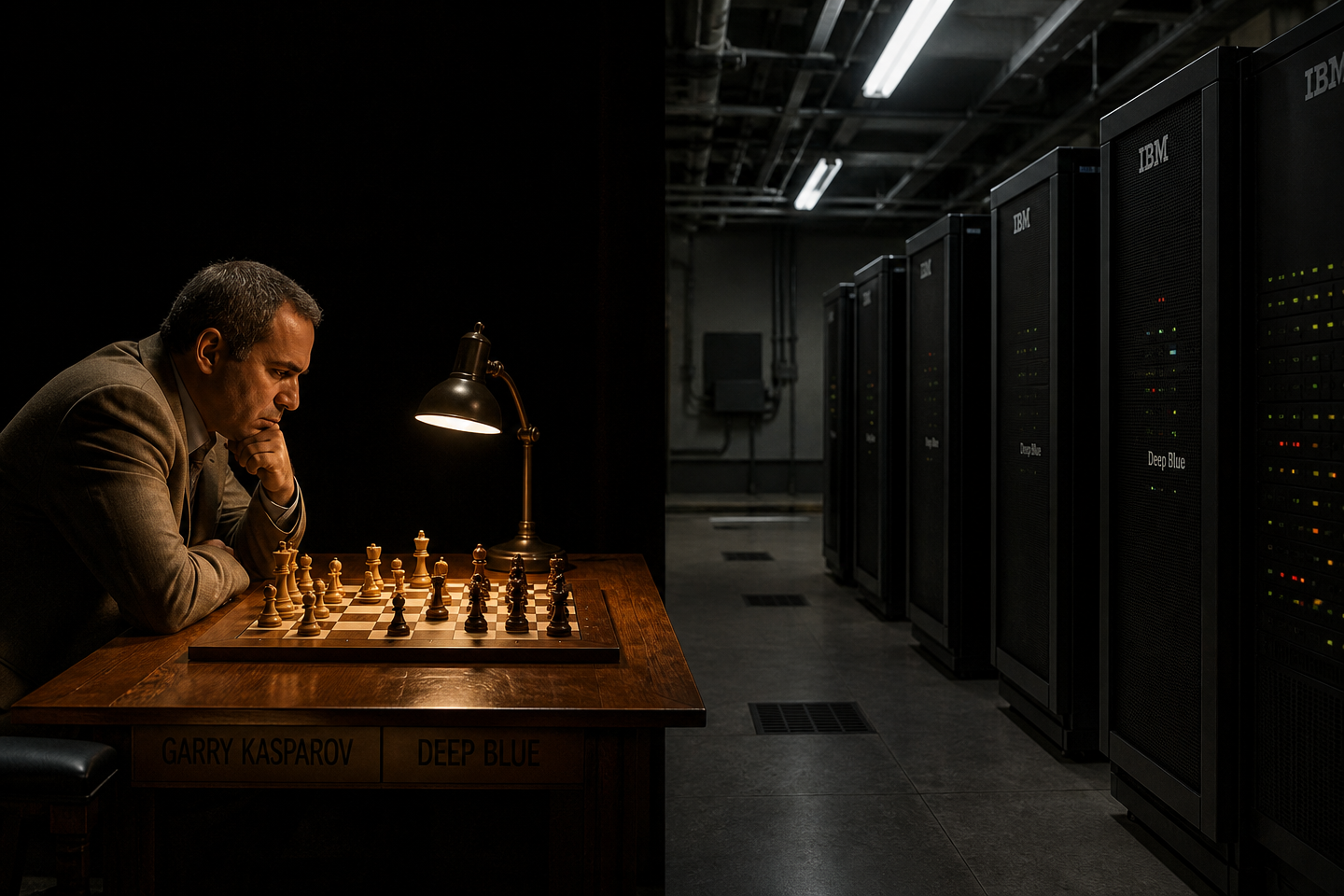
New York, a May afternoon in 1997. In a New York room heated by cameras, Garry Kasparov rises abruptly from his chair, face stern, after the game has officially ended. Across from him, a black metal cabinet has just accomplished the unthinkable: dethroning the greatest chess player of all time. That day, IBM won a battle, but unknowingly signed the death warrant of its own creation.
- On May 11, 1997, Deep Blue defeats Kasparov 3.5 to 2.5, becoming the first computer to beat a reigning world chess champion.
- Despite Kasparov’s accusations of cheating and his demand for a rematch, IBM refuses a third match and permanently dismantles Deep Blue, whose two blocks are today exhibited at the Smithsonian Institution and the Computer History Museum.
- Deep Blue’s massive parallel computation (480 specialized chips, 200 million positions per second) foreshadowed architectures used today in data centers and in training AI models.
- Six chapters that changed the history of artificial intelligence
- Why IBM chose to kill its own legend rather than keep it alive
- The invisible legacy of Deep Blue in our current computers
- What this victory teaches us about today’s technological race
Six chapters that changed the history of artificial intelligence
The story actually begins a year earlier, when Kasparov faces an initial version of the machine and wins decisively, four games to two. Humans reassure the world: the machine can calculate, yes, but it does not think. That certainty shatters on May 11, 1997, when Deep Blue, significantly strengthened, wins the rematch by a tight score of 3.5 to 2.5. For the first time in the history of chess, a computer defeats a reigning world champion in a classical confrontation.
The technical feat behind this result was colossal for the era. The machine rested on an RS/6000 SP architecture, distributed across two massive cabinets. It housed about thirty general-purpose processors, overseeing an impressive network of 480 specialized chips, entirely dedicated to calculating chess positions. The result: Deep Blue could analyze up to 200 million positions per second, with a raw power of around 11.38 billion floating-point operations per second. By comparison, it was dizzying for the time, even though a modern smartphone far surpasses these performances today.
Why IBM chose to kill its own legend rather than keep it alive
This is arguably the most troubling part of the story. Furious at losing, Kasparov openly accuses the engineering team of cheating, suggesting human intervention masked behind certain moves deemed too human for a machine. He demands a rematch and calls for access to the computer logs of all games to verify his suspicions. IBM will provide only the logs of the fifth game. According to Feng-hsiung Hsu, one of the project’s original engineers, this withholding of information fed a controversy that, even today, has never been fully silenced.
But the surprise lies in what happened next: IBM flatly refused to organize a third match. The reason is purely strategic. The company had achieved its communication objective and, in its view, had nothing to gain by trying to confirm a victory many considered lucky. Not long after the tournament, the decision was made: Deep Blue is dismantled. The machine would never play another official game. The 1.4-ton mass of metal and silicon that had toppled Kasparov was literally stripped, separated into two large physical blocks.
The invisible legacy of Deep Blue in our current computers
Today, the remains of this legendary machine reside in two renowned museum institutions. One half of the supercomputer is exhibited at the Smithsonian Institution in Washington, while the other part has joined the collections of the Computer History Museum in California. Deep Blue is thus no longer a machine, but a relic, an artifact visible behind a display case, like a technological fossil.
And yet, its influence has never truly vanished. This demonstration of massive parallel computing opened the path to far more modern computer architectures, where multiple processing units work simultaneously to solve complex problems. We see this logic in today’s data centers, in training artificial intelligence models, or in the supercomputers used for climate modeling. Deep Blue never played again, but its foundational principle still runs somewhere, hidden in servers far more discreet than that 1.80-meter-tall black cabinet.
What this victory teaches us about today’s technological race
In hindsight, Deep Blue’s power seems almost comical compared with contemporary chess engines. Programs like Stockfish or AlphaZero now crush any human champion, relying on radically different methods based on machine learning rather than brute-force calculation alone. The 1997 victory was therefore not a technical culmination, but a symbol.
And it is precisely this symbolic dimension that explains IBM’s radical choice. By stopping the project at the height of its glory, the company turned a mere machine into an untouchable myth. A perfect image, frozen for eternity, was worth infinitely more than a string of later matches that could have tarnished the triumph. This strategy has inspired many current tech players, where announcing a feat sometimes matters more than its long-term replication.
Thus, by sacrificing Deep Blue at the pinnacle of its glory, IBM did not merely end a project; it created an indelible legend, protected from any future defeat. This lesson resonates oddly with our era, where every new advance in artificial intelligence is presented as historic even before proving its durability. So, the next time a company proudly announces that it has solved a major technological problem, perhaps it is worth asking whether it, too, is about to quietly tuck its machine away in a museum.
