
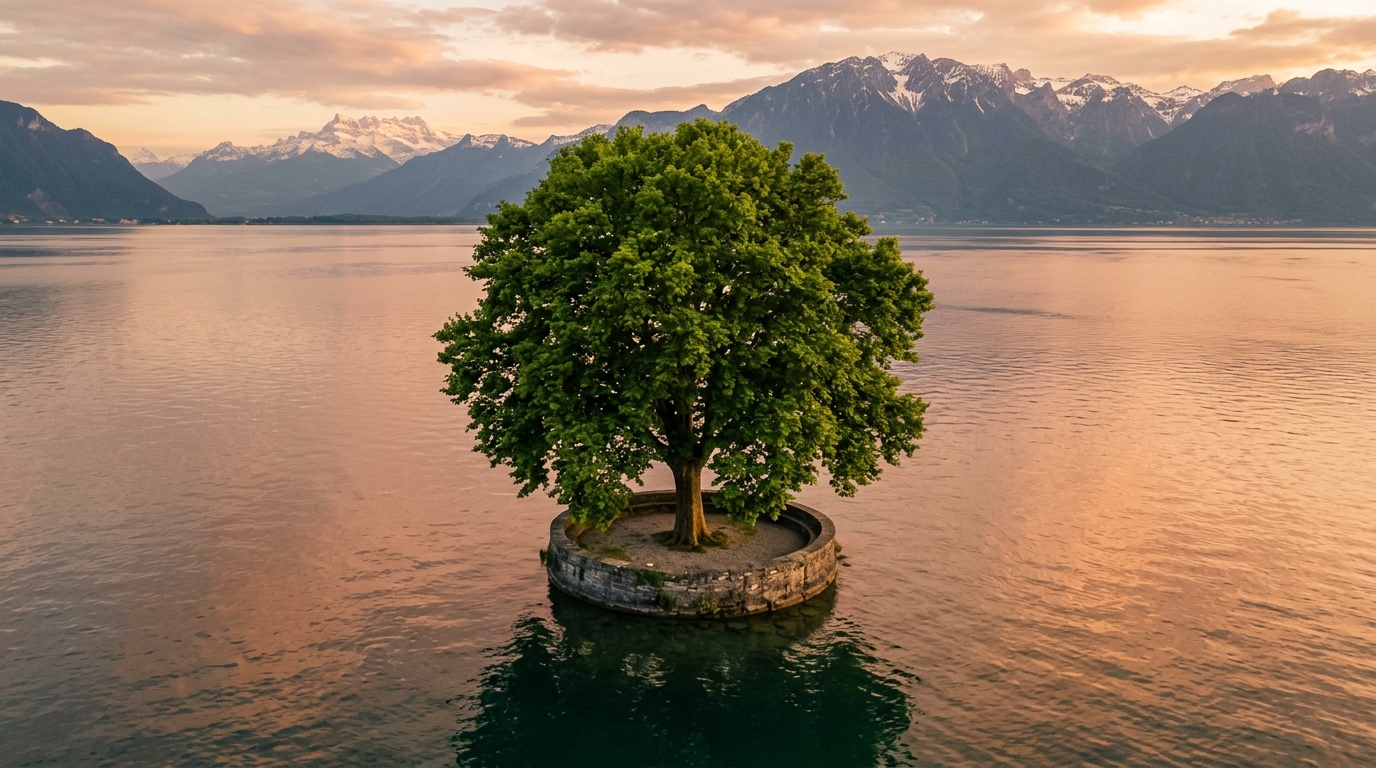
Is there in Europe a territory so tiny that it could almost fit on a café terrace? Yes, and it lies in Switzerland, right in the middle of Lake Geneva. There, a scrap of land barely 40 m² challenges the usual geographer’s yardsticks. What makes this place even more fascinating is that its sole resident isn’t a fisherman or a passing ornithologist, but a hundred-year-old tree whose roots and branches have come to colonize every available square centimeter. A story that blends discreet engineering, romantic poetry, and stubborn legends, to be explored without delay.
- Peilz Island, on Lake Geneva, covers about 40 m² and would be the lake’s only natural island, originally a simple rock landscaped in 1797 for reasons unknown.
- Among three plane trees planted in 1851, only one survived and now occupies the entire islet, reaching 175 years old in 2026.
- The island inspired Lord Byron and Hans Christian Andersen, but the legend that it belonged to Queen Victoria is unfounded.
- An island the size of a Parisian studio, born from a forgotten decision
- A rock transformed into an island by unexplained works
- The sole survivor of an 1851 planting
- Byron, Andersen, and the legend of the Isle of Peace
- Queen Victoria never owned this patch of land
An island the size of a Parisian studio, born from a forgotten decision
Facing Villeneuve, a small municipality perched on the shores of Lake Geneva, Peilz Island rises. According to sources, its area fluctuates between 20 and 77 m², but the most commonly cited measurement places it at about 40 m², barely larger than a comfortably packed Paris studio. It is regarded as the smallest island on the lake, and perhaps the only natural island in all of Léman.
What strikes the eye at first, whether you glimpse the island from a boat or from the quays, is this singular vegetal silhouette that seems to float on the water. A single Western plane tree dominates the islet, so completely that the ground itself almost vanishes beneath its foliage.
A rock transformed into an island by unexplained works
The story of this speck of land begins well before the arrival of its famous tree. According to local tradition, Peilz Island was originally only a rock protruding above the lake’s surface. It was in 1797 that the residents of Villeneuve supposedly undertook to transform it, covering it with earth and constructing a retaining wall to stabilise the whole thing.
Fait troublant : no period documents explain why such a costly operation, undertaken by a small commune, was carried out. The mystery still lingers today over the exact motivations of this project. What is known, however, is that the wall required several repairs throughout the 19th century, proof that nature regularly asserted its rights against this artificial island.
The sole survivor of an 1851 planting
It is in 1851 that the island’s fate genuinely shifts. That year, three plane trees as well as chestnut trees were planted on the little territory, probably in the hope of creating a true green haven in the middle of the lake. But time had its say: only one tree endured to this day, a plane tree so imposing that it now occupies the entire available surface.
In 2026, this vegetal survivor will celebrate its 175th birthday, a respectable age for a tree that has never had any choice but to grow upward, for lack of space on the ground. It embodies a silent lesson in resilience: when space is scarce, nature always finds a way to flourish in another form.
Byron, Andersen, and the legend of the Isle of Peace
Peilz Island owes part of its fame to an illustrious visitor. In 1816, the British poet Lord Byron stayed in the region and fell in love with this tiny patch of land, which he mentions in his poem The Prisoner of Chillon. This text would greatly help to spread awareness of the island far beyond Swiss borders.
Another, even more romantic tale has circulated since the 19th century. It tells of a young Englishman who supposedly drowned near the island, and his grieving fiancée who had a memorial erected, named the Isle of Peace, a name that gradually evolved into Peilz Island. Whether true or not, the legend left such a mark that the Danish writer Hans Christian Andersen drew on it as the plot for his 1861 tale, The Ice-Maiden.
Queen Victoria never owned this patch of land
A stubborn rumor persists about the island to this day: that it was gifted to Queen Victoria, who would then have returned it to avoid taxes, or that her descendants still hold it. A delicious anecdote, worthy of a novel, but it does not stand up to factual scrutiny.
Research conducted in municipal and cantonal archives found no trace of such a transfer. Even more, archivists remind us that a gift of this kind would have been legally impossible, as the island has never been Swiss federal property. The legend remains a charming tale, but nothing more.
Between an 18th-century project left unexplained, a solitary tree that has outlasted all its neighbors, and legends that crossed borders to inspire a Danish tale, Peilz Island condenses more stories into 40 m² than its size would suggest. A reminder that the smallest territories can hide the most surprising narratives, and that nature, left to its own devices, ultimately lays down the law—even on a confetti of land adrift in the middle of a lake.
