
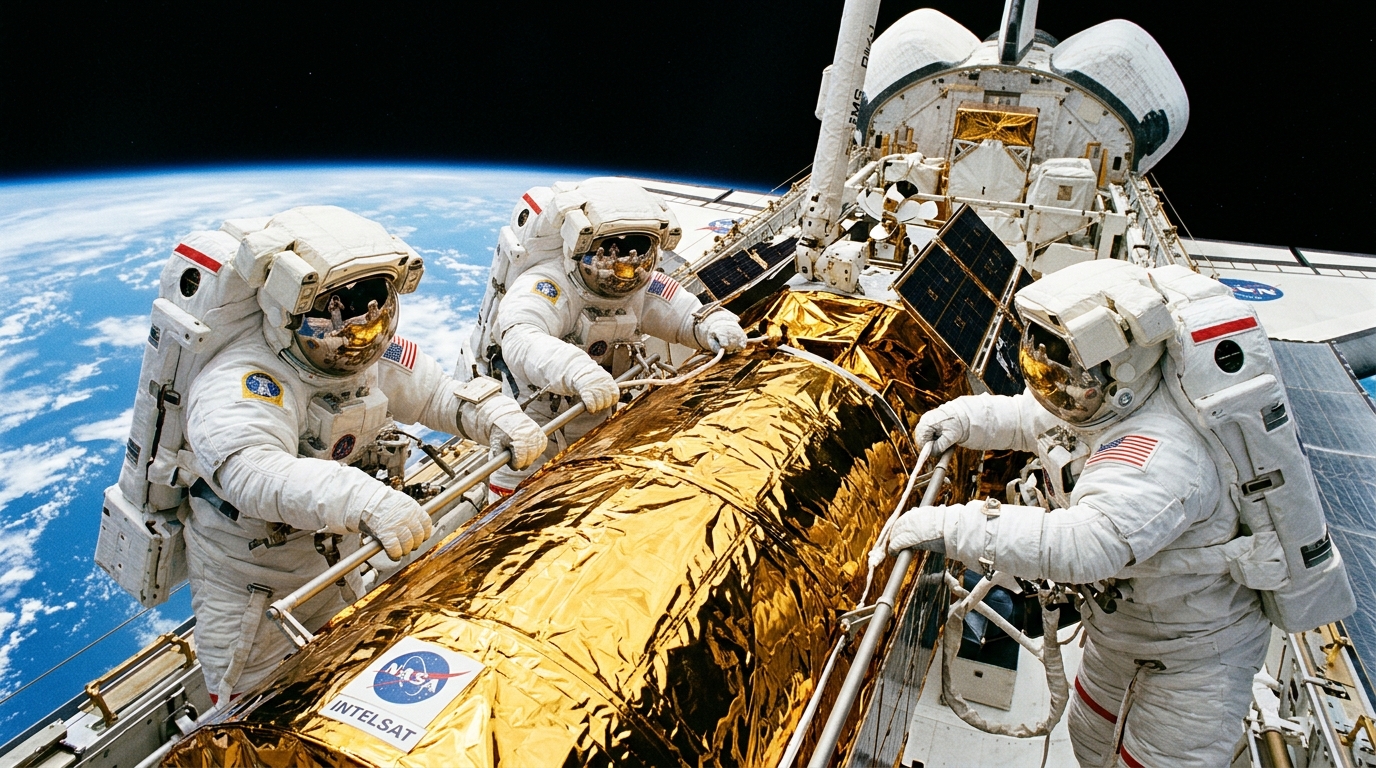
A satellite weighing several tons drifted in the vacuum of space, out of reach of any robotic arm, doomed to become a costly orbital wreck. The cause of this situation? A failing launcher that, two years earlier, had left Intelsat 603 on an unusable orbit. Faced with a problem that seemed insoluble, NASA would nevertheless find an answer as bold as it was unprecedented: sending three astronauts to grasp by the sheer force of their arms an object as heavy as a small truck. This story, one of the most spectacular in the American space venture, deserves attention, for it illustrates how improvisation and composure have sometimes outweighed the most sophisticated technology.
- After repeated failure of the robotic capture bar, NASA improvised a novel, manual grasp by three astronauts to recover the Intelsat 603 satellite.
- This EVA on May 13, 1992 lasted 8 hours and 29 minutes, setting at the time the record for the longest spacewalk in history.
- The STS-49 mission logged four extravehicular activities for a total of 25 hours and 23 minutes outside the shuttle, an absolute record for the era, and no three-astronaut capture has been repeated since.
- Three Men in the Void to Save a 4.5-Ton Satellite
- When the Capture Bar Fails, NASA Improvises the Unthinkable
- Three Pairs of Hands Against 4.5 Tons of Metal in Zero Gravity
- Eight Hours and Twenty-Nine Minutes That Redefined the History of Spacewalks
- What This Manual Capture Changed for Future Space Missions
Three Men in the Void to Save a 4.5-Ton Satellite
It all began with a technical incident: in March 1990, the Intelsat 603 communications satellite was placed into an incorrect orbit due to a failure of its launcher, a Commercial Titan III. The device, owned by the Intelsat consortium, found itself unusable, yet it represented a financial stake far too large to abandon. Hughes, the prime contractor, then signed with NASA an agreement valued at $90 million to organize a Space Shuttle rescue operation, an unprecedented mission in the program’s history.
This is the STS-49 mission, entrusted as early as December 1990 to a crew charged with recovering this lost satellite, which would carry this ambition forward. It also marked the first flight of the Space Shuttle Endeavour, freshly built to replace Challenger. Among the crew were three men whose names would soon enter the annals of aviation history: Pierre J. Thuot, Richard Hieb and Thomas Akers. On paper, their mission seemed simple: approach the satellite, latch it, then bring it back to Earth. The reality proved far more complex.
When the Capture Bar Fails, NASA Improvises the Unthinkable
The original procedure called for using a capture bar, a tool specially designed to be attached to the satellite from the shuttle’s robotic arm. Thuot and Hieb attempted a first Extravehicular Activity (EVA), stationed on this articulated arm, to hook the bar onto Intelsat 603. The operation failed. The next day, a second attempt, strictly identical, ended in the same failure: the satellite, rotating slightly, stubbornly refused to be grasped by this equipment designed for the occasion.
Faced with these two setbacks, ground teams and the crew had to react quickly. It was then that an idea as surprising as it was bold emerged, proposed by astronaut Bruce Melnick, who remained aboard to pilot the robotic arm: what if, instead of persisting with the bar, they attempted a manual capture by three astronauts? The proposal was startling, since never in the history of spacewalks had more than two people left the airlock simultaneously. The reasons were both logistical—the cramped airlock making the operation delicate—and safety-related, as each additional pair of hands in the void increased risk. Yet the option was chosen.
Three Pairs of Hands Against 4.5 Tons of Metal in Zero Gravity
On May 13, 1992, Thuot, Hieb and Akers stepped out together from Endeavour’s cramped airlock, a maneuver in itself given how limited the space is. Meanwhile, Commander Daniel Brandenstein brought the orbiter toward the satellite with surgical precision, leaving only a few meters between the shuttle and Intelsat 603. This approaching phase, conducted with ground-based navigation and calculations but without an automated capture system, rested on the pilot’s experience and dexterity.
Once within reach, the three men extended their arms and, together, managed to stabilize and then grasp with their bare hands an object weighing about 4,215 kilograms, nearly 4.5 tons, drifting in zero gravity. The image is striking: a vehicle-sized device immobilized by the sole muscular force and coordination of three men floating in the vacuum. Once the satellite is stabilized, it could finally be attached to a new auxiliary engine that would, once released, allow it to reach its final orbit.
Eight Hours and Twenty-Nine Minutes That Redefined the History of Spacewalks
This manual capture did not unfold in a matter of minutes. It lasted precisely 8 hours and 29 minutes, a figure confirmed by multiple specialist sources and by the astronauts themselves. According to Pierre Thuot, this EVA remains to this day the only one in history to bring three spacewalkers simultaneously outside their vehicle. It also set, at the time, the record for the longest spacewalk ever conducted, surpassing a twenty-year-old record held by the Apollo 17 crew.
More broadly, the STS-49 mission as a whole left a lasting impression: never before had a shuttle flight accounted for so many spacewalks. The crew would ultimately perform four in total, accumulating 25 hours and 23 minutes outside the shuttle, an absolute record for the era. The mission would conclude on May 16, 1992, after 141 orbits of the Earth in 213 hours of flight, for a total journey of around 3.7 million miles, or about 6 million kilometers.
What This Manual Capture Changed for Future Space Missions
Beyond the athletic and technical feat, this extraordinary EVA permanently influenced how NASA now views orbital rescue operations. It demonstrated that a controlled improvisation, supported by rigorous training and flawless coordination between the astronauts and the orbiter’s pilot, could compensate for the failure of a procedure planned in meticulous detail. This capacity to adapt has since become a cornerstone of training for crews assigned to the most delicate missions, particularly those involving satellite maintenance or, later, repairs to the Hubble Space Telescope.
This achievement also confirmed that human presence remained of irreplaceable value at a time when automation was beginning to take hold in the space sector. No other three-astronaut EVA has been repeated since, which gives this May 1992 episode a truly unique place in the annals of space exploration.
From this adventure, the most enduring image is of three men suspended in the void, wrapping their arms around a stubborn satellite, where even the most advanced technology had failed twice. More than three decades after this episode, as orbital maintenance and debris retrieval projects multiply, this manual capture continues to resonate as a sobering reminder: when faced with the unforeseen, human ingenuity and courage can make all the difference, far more than any sophisticated tool.
