
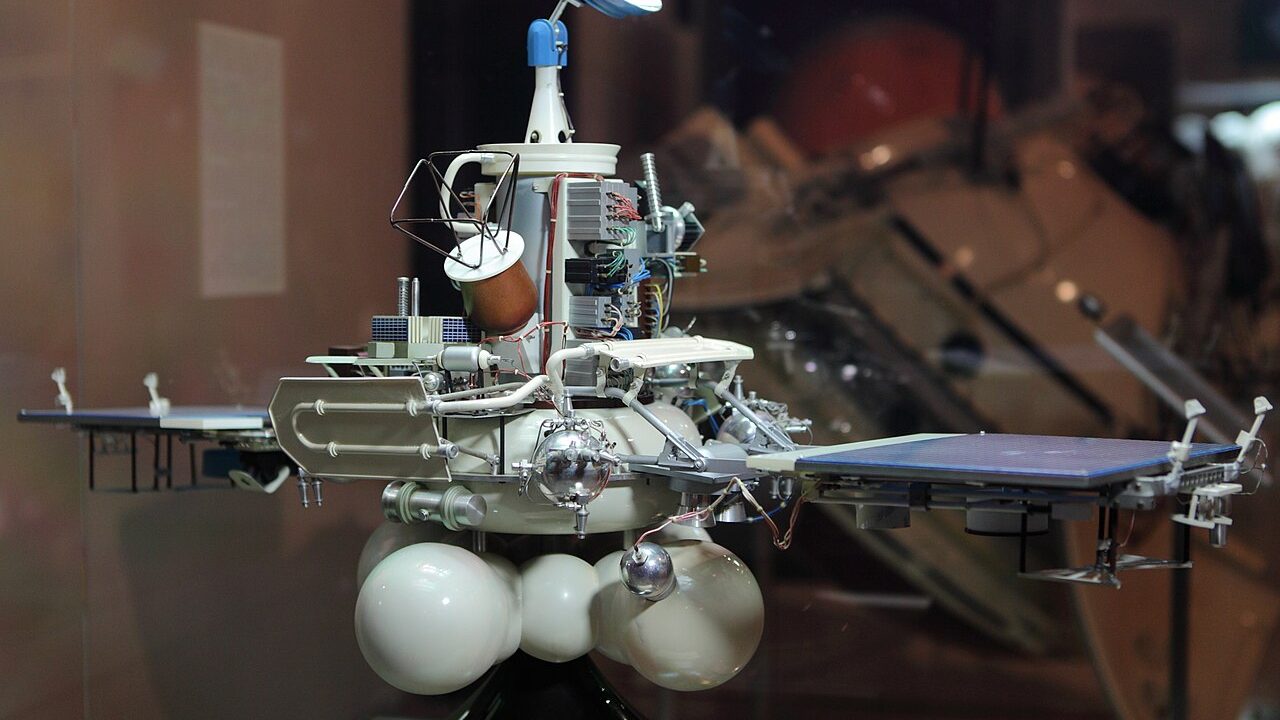
Just a single character, a dash according to several accounts, was enough to doom Phobos 1, the Soviet probe weighing more than six tons launched toward Mars. Omitted from a long sequence of commands sent in late August 1988, it led the onboard computer to initiate a test routine that cut off attitude control. By September 2, 1988, contact was lost forever.
Phobos 1 would never see Mars.
- A missing character in a 1988 command activated a test routine that should have been removed before launch.
- This routine disabled Phobos 1’s attitude thrusters, causing drift and draining its batteries.
- Two Phobos probes failed: Phobos 1 lost en route and Phobos 2 malfunctioned in Martian orbit in 1989.
A probe designed to land on a moon
The Proton-K launcher lifted off from Baikonur on July 7, 1988 with 6,220 kilograms of probe aboard, roughly the weight of four family cars. Its primary target wasn’t Mars itself but Phobos, the larger of its two moons. The craft also carried instruments to study the Sun, the interplanetary medium, Mars’ environment, and gamma-ray bursts. Its twin Phobos 2 departed five days later, for a journey of about 200 days and roughly 190 million kilometers.
The program aimed high: to deploy landers on Phobos, which would have been the first landing on a Martian moon. The spacecraft’s orientation relied on a three-axis system guided by solar and stellar sensors. Everything therefore hinged on those tiny attitude thrusters, the very thrusters that were to be cut.
The truncated sequence and the forgotten routine
On August 28, 29, and 30, 1988, according to sources, the control center sent the probe a long load of commands. A single character was missing. The onboard computer did not signal an error: it read the truncated sequence as the invocation of a test routine, intended for ground tests and kept in its memory.
This routine disables the attitude thrusters. Normally, it should have been removed before launch, something that did not happen. Without thrusters, Phobos 1 drifts, loses sight of the Sun, and can no longer present its solar panels to the light, so its batteries gradually exhaust themselves.
On September 2, the planned communication session never took place.
The probe was then a few weeks from its planned departure, far from its destination. When the Soviets eventually informed the European Space Agency by telegram, they spoke of a “command error” that had left the craft unguided and unresponsive to signals. Western sources, however, reported difficulties as early as August 29. Attempts to restore the link continued, in vain.
Ground control caught in a turf war over responsibilities
The typing error does not tell the whole story. A dispute pitted the Ievpatoria center in Crimea against Moscow over who directing the mission: Moscow gained control, while Ievpatoria was responsible for checking every transmitted command. This division of roles made it harder to issue valid commands.
A widely repeated account, though to be treated with caution, adds that the computer responsible for rechecking sequences was under maintenance that day. The technician supposedly sent the code without waiting. The verification procedure would thus have been bypassed.
An investigation was ordered immediately, but sanctions were postponed until the end of the Phobos 2 mission. Roald Sagdeev, director of the Space Research Institute (IKI), pressed for this postponement so as not to demoralize the team of the second probe.
Phobos 2 takes over, then goes dark in turn
Phobos 2 successfully inserted into Mars orbit in January 1989 and collected data on the Sun, the Red Planet, and Phobos. It was to approach within about fifty meters of the moon to drop its two landers. On March 27, 1989, communications suddenly ceased, the victim of a failure in the onboard computer.
Two probes, two losses, and no lander deployed. Yet, the measurements of plasma around Mars and Phobos largely succeeded, according to the authors of an article published in Spaceflight in 1988. As for the forgotten test routine, it remains one of the most cited examples when discussing flight software that should never have left the test bench.
Sources : heasarc.gsfc.nasa.gov | astronomy.com
