
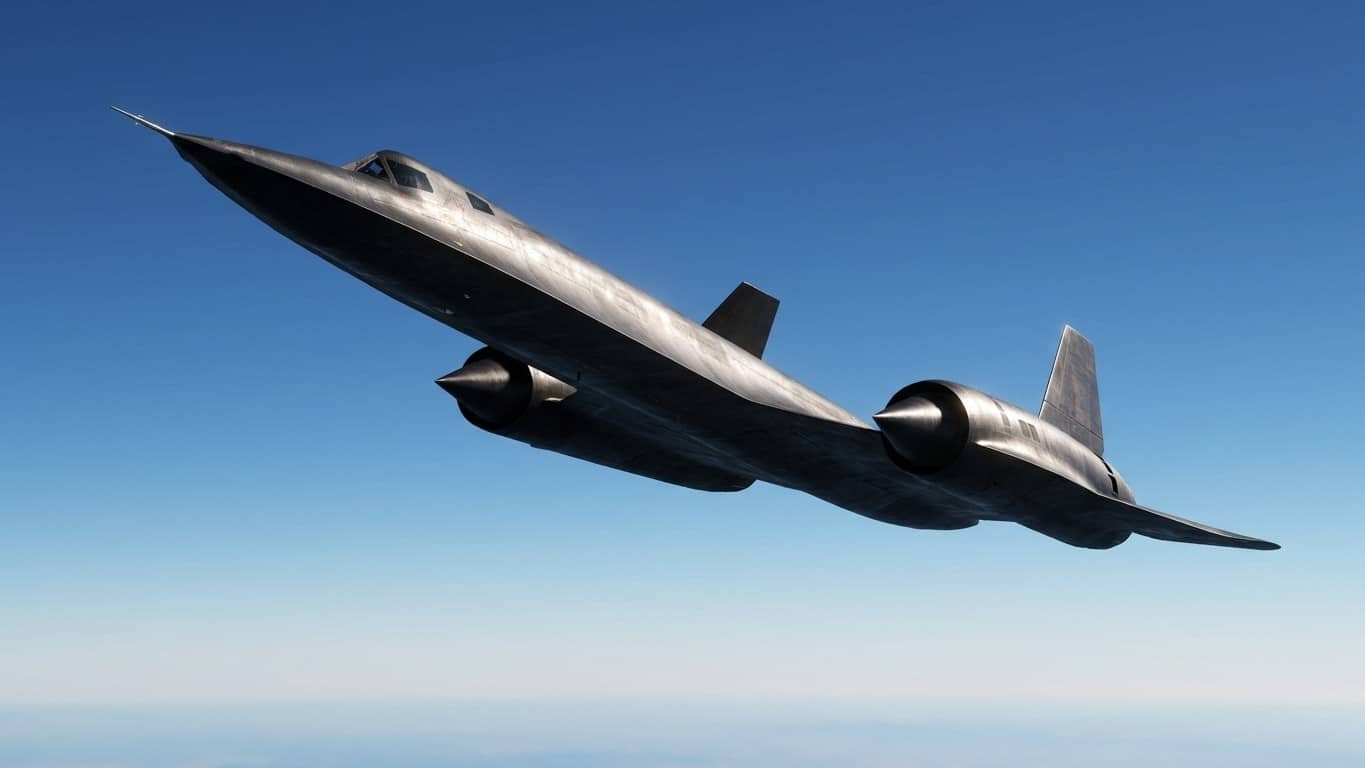
On May 1, 1960, a Soviet missile shot down an American U-2 spy plane over the Ural. The pilot, Gary Powers, was captured. Washington absorbed the diplomatic blow and drew a brutal conclusion: flying high was no longer enough. You had to fly fast. Very fast. Fast enough that no missile could keep up. This major diplomatic incident accelerated the search for a new reconnaissance platform. The answer would come from Lockheed and its famed “Skunk Works.” The result, the SR-71 Blackbird. And behind this legendary aircraft lies one of the Cold War’s most beautiful ironies.
Key takeaways
- At Mach 3, temperatures exceed 500°C: aluminum would have melted, only titanium could survive
- Only one country possessed the reserves and facilities to refine titanium to aerospace standards: the USSR
- How did an American agency persuade Moscow to sell the technological heart of its foe?
Mach 3 Against an Aluminium Fuselage: An Impossible Equation
At speeds beyond Mach 3, air friction generates extreme temperatures on the fuselage, potentially exceeding 500°C. Traditional airplane aluminum would have simply disintegrated. The solution was the massive use of titanium, a rare, expensive metal that was extremely difficult to machine at the time. Difficult to machine is a polite understatement. Titanium’s hardness demanded special tools, and welds had to be performed in a vacuum to avoid oxidation. Titanium reacts with hydrogen and oxygen when heated. So every weld on the airframe had to be done in an argon gas chamber. The Skunk Works engineers were not merely assembling a plane; they were inventing, in real time, a new branch of metallurgy.
According to Colonel Rich Graham, the legendary Blackbird pilot, “the aircraft is composed of 92% titanium, inside and out.” To put it into perspective: 92% titanium on a 30-meter-long aircraft represents a colossal supply constraint. The problem wasn’t that titanium was rare per se, but that high-quality refined titanium reserves were severely lacking. And the only country capable of providing them in quantities sufficient, with industrial facilities to refine to aerospace specifications? A single country in the world at the time had enough titanium reserves to build the spy plane: the Soviet Union.
The CIA Goes Shopping with the Enemy
Washington faced an extraordinary dilemma: the plane conceived specifically to perform reconnaissance missions over Soviet territory required materials that only the Soviets could reliably supply. The solution is straight out of a spy novel, except that it was rigorously real. To acquire the necessary titanium, the CIA set up a carefully constructed network of shell companies, third-country intermediaries, and paperwork to buy the quantities needed and ship them to the United States.
The CIA created at least five primary shell companies. Each had a different cover and a coherent backstory. The best known, documented in the memoirs of Ben Rich, head of the Skunk Works: to justify the massive quantities of titanium ordered, one of the shell companies’ cover stories was that the metal was needed to build thousands of commercial pizza ovens. Other fictitious companies claimed to purchase the metal to manufacture textile machines, agricultural storage silos, and chemical-processing pipes.
Why did the Soviets bite so easily? The operation succeeded largely thanks to the Soviet Union’s desperate need for hard currency during the economic stagnation of the 1960s. The Soviet government was so eager to inject cash into its economy that it accelerated exports of raw materials without carefully vetting buyers. According to Colonel Graham’s memoirs, Soviet trade bureaucrats readily swallowed the cover story because of their own ideological biases. The Soviets would have believed that Americans were simply too lazy to cook for themselves and were building vast fast-food networks.
There is something almost comic about this image: CIA agents signing purchase orders for pizza ovens while Lockheed engineers drew the world’s most secret aircraft. This story rests mainly on Ben Rich’s memoirs published in 1994, which the Smithsonian and reputable historians have since echoed. It is credible and widely accepted, but it mainly rests on a single primary source rather than declassified archives.
An Aircraft Built by Its Adversary, Returning to Spy on It
The CIA eventually managed to obtain enough titanium to build 32 SR-71s, as well as more than a dozen A-12s and some derivatives, all from ore illicitly obtained from the Soviet Union. Unbeknownst to them, the Soviets financed the SR-71’s espionage cell designed to spy on their own territory. The metal mined from their rutile mines, refined in their factories, and routed through intermediaries in Africa and Asia, ended up forming the fuselage of the aircraft that photographed their military bases.
The titanium itself posed ongoing headaches, well beyond procurement. This metal has a property: thermal expansion. In flight, as it heated, the aircraft lengthened by several centimeters. The fuselage panels were therefore designed with expansion joints, which explains why the aircraft leaked fuel on the ground before its skin temperature stabilized. Each Blackbird during taxiing left a kerosene trail on the tarmac. It was only at Mach 3 that the skin heated enough to seal the tanks. Every time a Blackbird took off, it had to refuel in flight immediately to continue its mission.
No SR-71 was shot down on a mission, for two simple reasons: it flew too high and too fast. More than 4,000 missiles were fired at Blackbirds during their career. None hit their target. The procedure upon detecting a launch? Accelerate. The aircraft simply outran the missile. No declassified evidence confirms that the Soviets, during the aircraft’s operational life, realized that their titanium was being used for this purpose. The CIA’s shell company network maintained operational security throughout the program.
The Legacy of an Industrial Paradox
Titanium was so brittle and reactive that Skunk Works had to invent new tools and procedures from scratch. This constraint sparked metallurgical advances that permeated the aerospace industry for decades. The SR-71 was built from three different titanium alloys, but the vast majority of its skin and primary structure were made from a beta alloy. Titanium offered steel-like strength but at roughly 50% of the weight, which was vital for an aircraft carrying massive amounts of fuel.
The aircraft’s very name comes from a presidential slip: during his re-election campaign, President Lyndon B. Johnson decided to announce its existence on television to demonstrate that he would not let a military rift with the USSR widen. During the broadcast, he misstated the plane’s name, calling it “SR-71” instead of RS-71, and the Air Force stood by. A plane whose name stemmed from a presidential lapse, built with the enemy’s titanium it overflew, and whose pilots warmed their meals on glowing quartz windows at 300°C. The fleet logged over 53,000 flight hours in total. At its peak in the early 1970s, SR-71 missions were daily. The aircraft logged more than 2,700 flights above Mach 3. Today, more than sixty years after its first flight, no operational aircraft has flown higher, faster, or longer, and the airframe that made it possible was, in part, purchased from the very adversary it was built to monitor.
Sources: korii.slate.fr | vol-avion-chasse.com
