
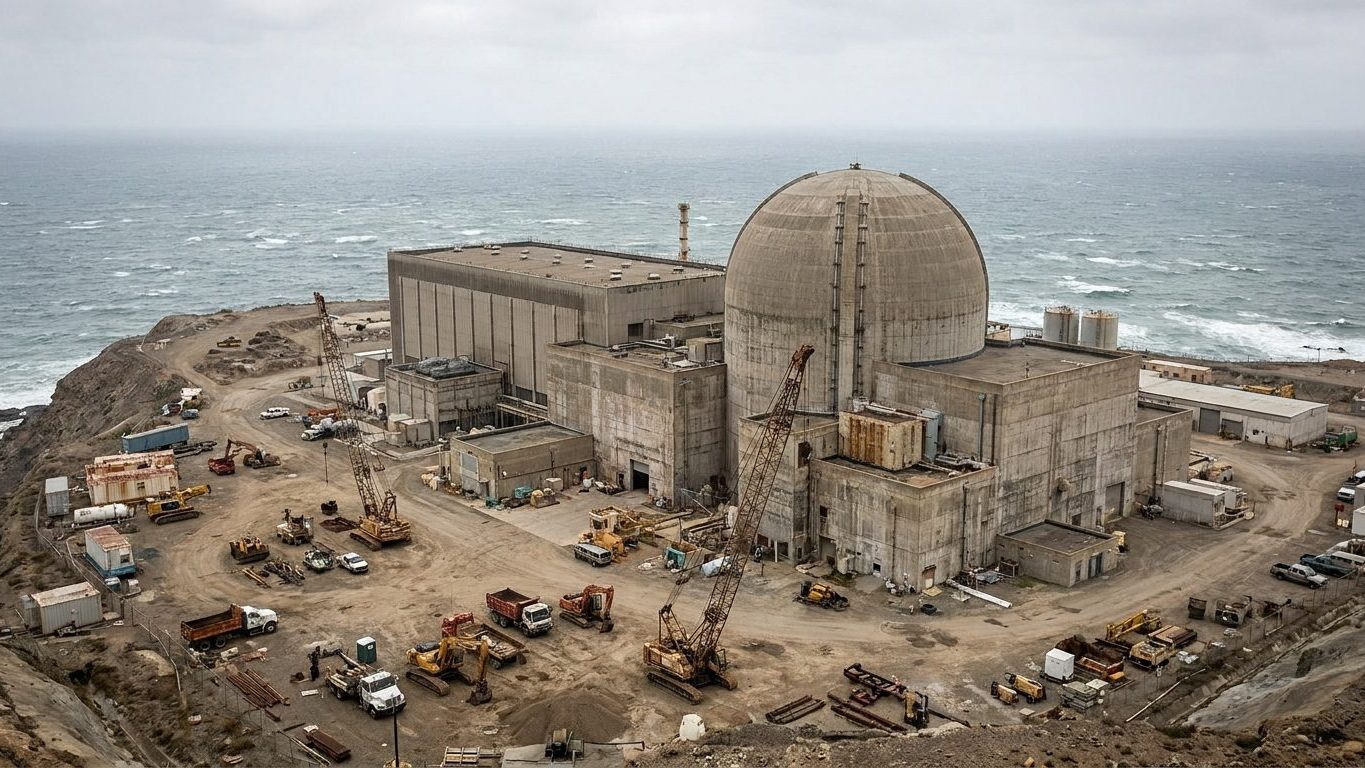
Twenty-three point seven billion euros. This is the amount the Court of Auditors attributes to the total cost of the project, which now stands at 20.4 billion euros in 2015 constant euros, or 23.7 billion euros updated to 2023, for a reactor announced in 2007 at 3.4 billion euros and a commissioning promised as early as 2012. Twelve years later, on December 21, 2024, at 11:48 a.m., EDF teams carried out the first connection of the reactor to the national grid, which then began generating electricity. Between the promise and the reality, not a single kilowatt-hour had left the site for more than a decade.
Seven times the promised budget, for twelve years of delay.
- The Flamanville EPR reactor cost 23.7 billion euros according to the Court of Auditors, i.e., seven times the initial budget of 3.4 billion announced in 2007
- Not a single kilowatt-hour was produced before December 2024, i.e., 12 years after the initially promised commissioning for 2012
- The EPR2 program of six new reactors already shows a 30% budget increase, rising from 51.7 to 67.4 billion euros
A schedule promised in 2007, quickly derailed
The project began in 2007 on the Flamanville site in Manche, with the ambition of delivering a next-generation reactor capable of producing electricity by 2012, within an announced budget of 3.4 billion euros. This schedule was meant to demonstrate the French nuclear sector’s technological mastery, presented at the time as a model exportable to other European countries. Yet difficulties quickly emerged on this exceptional site, including civil engineering problems and equipment qualification issues. Safety concerns were soon raised, notably a fragility of the steel used in the reactor vessel, a matter that would occupy experts for several years.
A first delay, then a second. In September 2015, EDF re-evaluated the project cost to 10.5 billion euros and pushed the commissioning to the fourth quarter of 2018, a timetable that, too, would not be met.
23.7 billion euros: the bill according to the Court of Auditors
In a report published on January 14, 2025, the Court of Auditors recalculates the project’s final tally. It estimates the total cost at 20.4 billion euros in 2015 euros, or 23.7 billion euros when updated to 2023. This new estimate exceeds the previous 2020 figure of 19.1 billion euros by 1.3 billion, a number already considered staggering at the time.
An overrun of almost seven times the original quote.
This re-evaluation is explained in particular by adjustments in the calculation of financial provisions reported by EDF and in the project’s financing costs. The Court also includes expenditures related to testing and the very first phase of operation once the reactor is connected. It accounts for the preparation of the plant’s first shutdown, planned for 2026, the upcoming replacement of the reactor vessel cap, and the purchase of spare parts. Taken together, these items explain nearly 1.5 billion euros of added costs compared with the most recent estimates.
Between 2007 and the early 2010s, the bill climbed in increments: 4 billion euros in 2008, 5 billion in 2010, 6 billion in 2011, then 8.5 billion a few years later. Each new official estimate is almost systematically accompanied by a new postponement of the commissioning schedule.
Une rentabilité incertaine, un programme EPR2 sous surveillance
The Court of Auditors also expresses concerns about the reactor’s future profitability, which it deems mediocre. For a load factor of 85%, each produced megawatt-hour would have to be sold at 122 euros to yield a 4% return, and at 176 euros to reach 7%. The reactor was not expected to reach full capacity until the summer following the report’s publication, several months after its initial connection to the grid.
Six new EPR2 reactors are announced, with the same financial risks looming in the background.
EDF, for its part, cites a figure different from the Court’s. The utility estimates its own total cost at 19.3 billion euros in 2015 euros, i.e., 22.6 billion euros in 2023, financing costs included, about one billion euros less than the magistrates’ calculation. For the six promised EPR2s, the Court already notes a 30% increase in the construction estimate, rising from 51.7 to 67.4 billion euros, assuming unchanged economic conditions and excluding the effects of inflation.
Sources: assemblee-nationale.fr | ici.fr | connaissancedesenergies.org
