
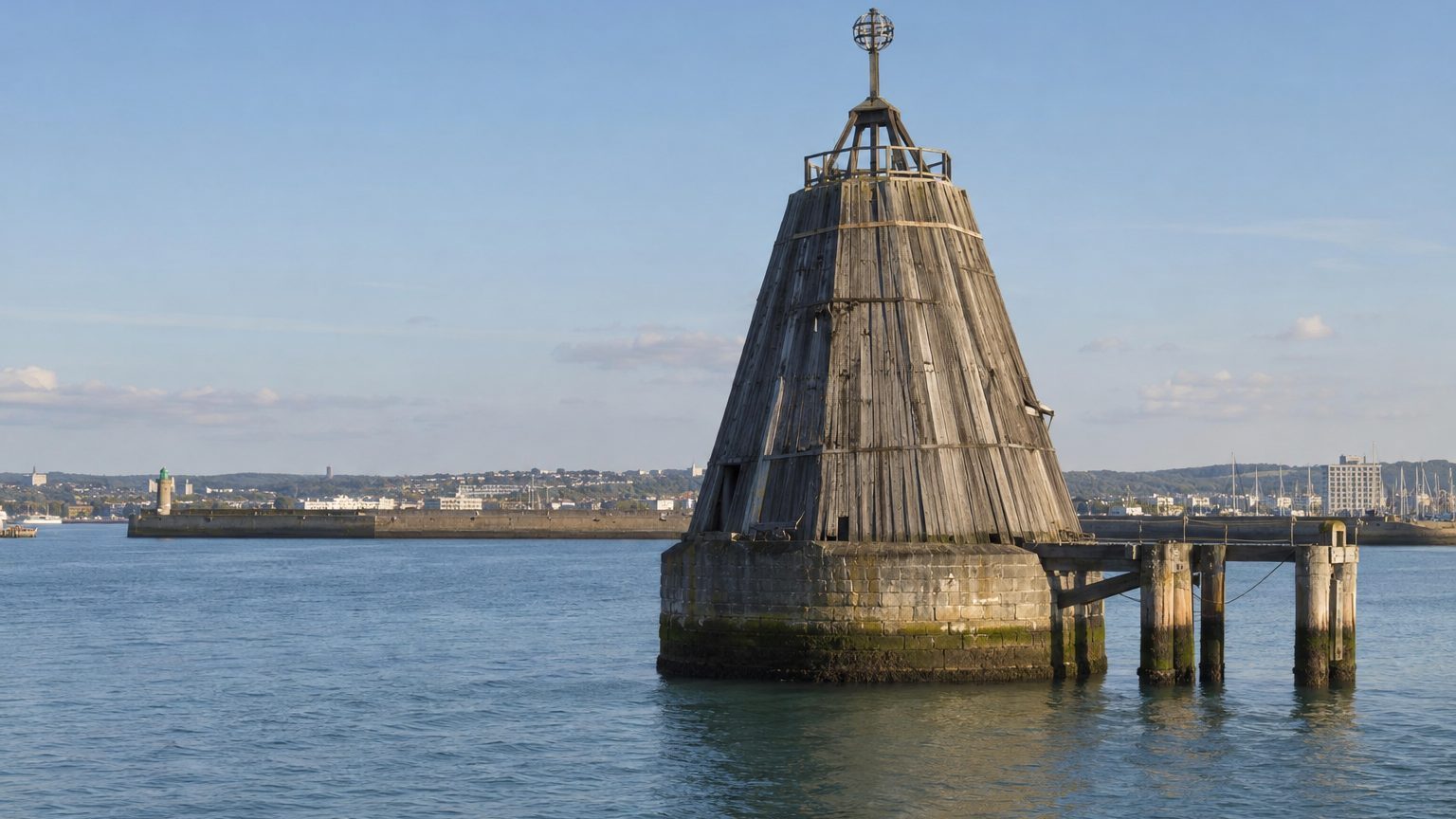
In 1776, Louis XVI asked a commission to select the strategic port that would defend the Channel coasts. France sought a war port against England, and Cherbourg emerged victorious. To close its harbor, the monarchy relied on 90 wooden cones filled with stones. In 1788, the project was abandoned, and the harbor remained open.
- Louis XVI approves Cessart’s revolutionary project in 1784: build a breakwater of truncated wooden cones, 20 m tall, in the open sea on a sandy bottom.
- The first four cones do not withstand storms, and only about twenty of the 90 are launched over five years.
- The 1788 failure forces abandoning the avant-garde plan in favor of La Bretonnière’s rustic technique: sinking old warships and dumping lost stones.
A War Port for 80 Vessels
The commission was led by Suffren and included, among others, Dumouriez, who would later become governor of Cherbourg, and La Bretonnière. La Bretonnière’s report argued that only the Normandy port could adequately protect 80 warships. He proposed a four-kilometer-long seawall between Île Pelée and Pointe de Querqueville.
But another plan was ultimately chosen by the royal authority.
Louis-Alexandre de Cessart, an engineer with the Bridges and Roads service, proposed a breakwater unlike anything known. In the eighteenth century, no one had imagined building a seawall in the open sea, on a sandy bottom 15 m deep, without any initial rubble toe. His idea: 90 truncated timber cones, about 50 m in diameter at the base and 20 m at the top, standing 20 to 24 m high. Each cone would be towed offshore, sunk, filled with stones, then connected to its neighbors by iron chains.
June 1784, the First Cone
The first cone was sunk on June 6, 1784, one kilometer from Île Pelée. The harbor then filled with 300 to 400 boats shuttling from Becquet Port to load the stones. The structures were built of oak and beech, with openings at several levels to pour the stones regardless of the tide.
On June 22, 1786 (some sources give June 23), Louis XVI made his only trip to the provinces to attend the immersion of the ninth cone. Never before had a French king undertaken such a long journey to watch a construction site.
Yet the schedule posed a problem. In a 1846 account of Cherbourg, Alexis de Tocqueville noted that launching these caissons could take place only two or three months a year, and two or three days within each of those months. Thirty-six days of favorable seas per year at most for a project of 90 cones.
1788: The Sea Wins
The first four cones did not withstand the storms.
The following ones suffered serious damage. In five years, only about twenty cones were launched, out of the planned 90 (other sources speak of 18; the Musée des Arts et Métiers mentions eighteen caissons at the time of the Revolution). Cessart tried to protect them by dumping large masses of stones around, a patch that contradicted the very principle of his system.
In 1788, it was concluded that Cessart’s option had failed; the caissons were left empty. The fallback was to revert to La Bretonnière’s method, the one that had been set aside: sinking old warships and dumping stones around. The argument against it was the fear that these stones would be swept into the inner harbor. The contrast is striking: an avant-garde project abandoned in favor of the most rustic technique of the fallback plan.
The consequences were felt in the town. The abandonment of the cones created unemployment in Cherbourg on the eve of the Revolution, and funding was cut in 1790; then La Bretonnière’s resignation in 1792 halted the works for ten years. A local historian, Magali Lachèvre, argues that this failure ruined the monarchy and accelerated the arrival of the 1789 Revolution. The assessment is decisive, but it serves as a reminder that a failed harbor project weighs heavily on the finances of a kingdom already in debt.
Seventy Years to Finish the Work
The offshore breakwater, for its part, would not be completed until 1853, about 70 years after the first cone. It measures 3,640 meters in length, with an average base width of 100 meters, a top width of 12 meters, and a height of 27 meters. The East and West breakwaters would be added there in the 1890s. A succession of engineers oversaw the project: Cessart, La Bretonnière, Joseph Cachin, then Fouques-Duparc and Félix Reibell up to 1853.
Breakwaters and forts have been listed as Historic Monuments since 2021. Of Cessart’s cones, what remains are mainly models: the Musée des Arts et Métiers preserves a wooden-and-iron model measuring 38 by 85 cm, entered into its collections in 1849.
Sources: france-pittoresque.com | arts-et-metiers.net
