
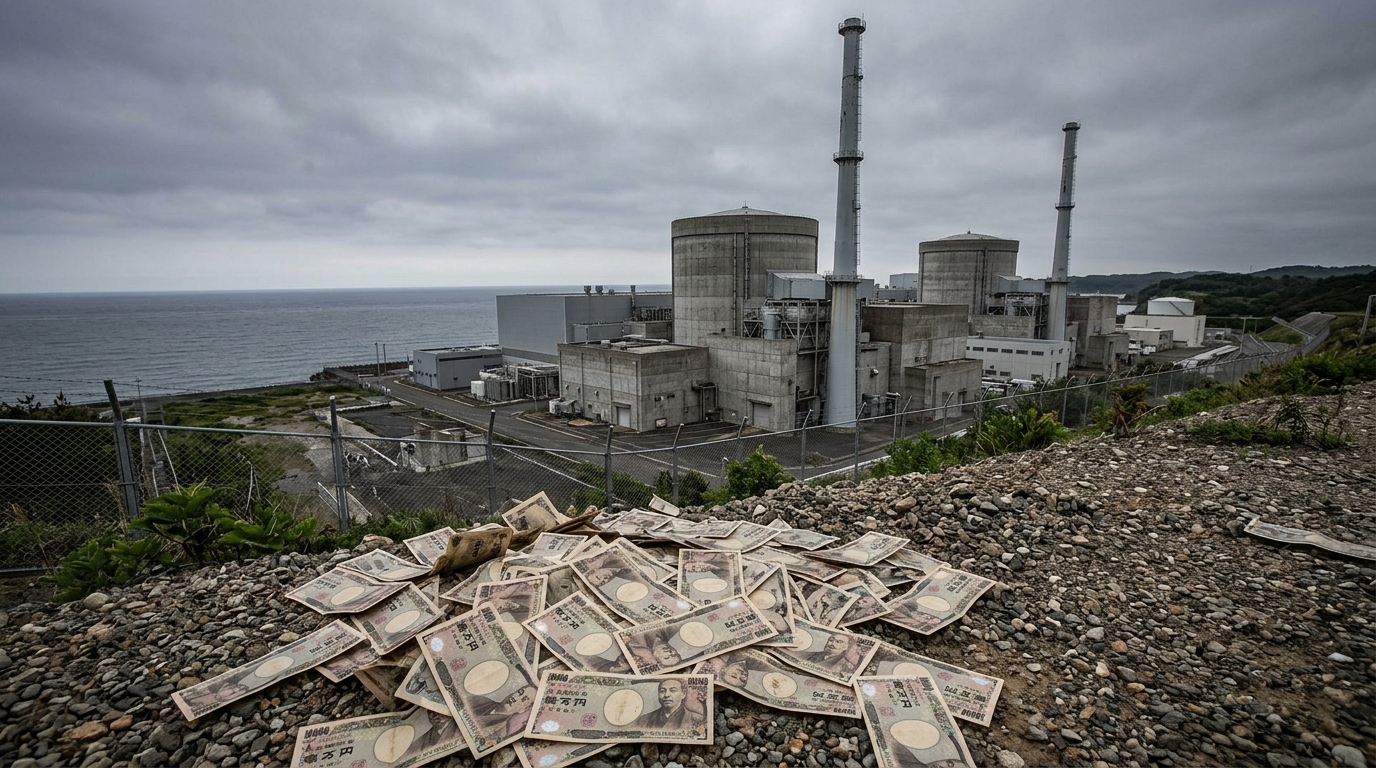
Imagine buying an outrageously expensive sports car, parking it in a garage for twenty-two years, and only having driven it for a total of eight months, not because of a engine failure, but because the owner never managed to locate the keys or keep the maintenance log up to date. That is essentially the story of the nuclear reactor Monju, that pharaonic project Japan carried forward for more than two decades before, with heavy hearts, deciding to abandon it. A colossal financial disaster that raises questions about how a technology-forward nation could become m trapped in a symbolically charged dossier for so long.
- The Monju reactor, a fast-neutron, sodium-cooled design, ran for only 250 days in 22 years due to repeated incidents (sodium leak, doctored video, a piece of equipment falling, 14,000 components not inspected)
- The Japanese government officially acknowledged that the failure stemmed from “management problems” rather than a technological defect
- The project cost about $9.5 billion, with an additional €2.86 billion for a decommissioning planned over thirty years
- Monju, the reactor that was supposed to change Japan’s energy future
- A sodium leak and a doctored video: the beginning of the end
- The real culprit isn’t technical, it’s human
- 9.5 billion dollars later, what remains of Monju?
Monju, the reactor that was to change Japan’s energy future
Located in Tsuruga, in Fukui Prefecture, Monju was not an ordinary nuclear reactor. It was a fast-neutron reactor cooled with liquid sodium, a technology envisaged as the future of atomic energy. The idea looked appealing on paper: unlike conventional reactors, this type of installation would allow recycling a portion of spent fuel and producing more fissile material than it consumed, somewhat like a frying pan that, while cooking, would manufacture new ingredients itself. For a country nearly entirely dependent on energy imports, the strategic stakes were enormous.
Construction began in 1985 and the works were completed in 1991. It would then take until 1994 to reach the divergence, i.e., the actual start of the chain reaction, and August 1995 for connection to the national grid. On paper, everything seemed finally in place for Japan to have a showcase of nuclear breeding technology. In reality, this elegant machine would start to falter almost immediately.
A sodium leak and a doctored video: the beginning of the end
As early as December 1995, barely a few months after commissioning, Monju faced its first serious accident. A liquid sodium leak, the coolant used by this type of reactor, triggered a substantial fire on the site. Sodium has the peculiarity of reacting violently with air or water, making it an extremely efficient but also notoriously unstable coolant. The incident, while contained, could have served as a valuable lesson.
What followed, however, seriously eroded public trust. The plant operator was accused of concealing the true extent of the fire, notably through a doctored video shown to authorities and the media. This lie eventually came to light, and in 1997 the Japanese government imposed a one-year suspension of operations, not because of the sodium itself, but due to the falsified report that had sought to minimize the accident. The damage was done: Monju, in the eyes of the Japanese public, became the symbol of troubling opacity surrounding nuclear power.
The real culprit isn’t technical, it’s human
Perhaps the most striking aspect of this affair is that when the Japanese government finally acknowledged the project’s failure, it officially stated that the technology itself was not at fault. The problem, in the words used, fell under “management problems.” A courteous way to refer to a buildup of organizational dysfunctions that, taken together, rendered the operation of the reactor untenable.
After a restart in May 2010, driven by the hope of finally reviving the program, Monju stopped again barely three months later, this time due to the accidental drop of a fuel-handling device directly into the reactor vessel. Then, in 2012, a revelation further discredited the operator: about 10,000 pieces of equipment had never been inspected as they should have been, a figure that would later rise to 14,000 cases out of a total of 47,500 components under safety checks. Faced with this parade of neglect, the Nuclear Regulatory Authority ultimately judged the safety culture at the Japan Atomic Energy Agency to be simply deficient. No other company even wanted to resume operating the site, a sign that trust had been irrevocably broken.
9.5 billion dollars later, what remains of Monju?
The verdict finally came in December 2016: after twenty-two years of existence and only 250 days of actual operation, Monju was officially abandoned. The total cost of the project exceeded €8 billion, with some estimates reaching as high as €8.6 billion spent by the Japanese government, i.e., about $9.5 billion sunk into a reactor that, in the end, produced electricity for less than a year in total.
But the tally does not end there. The decommissioning of the site, approved in March 2018, will stretch over thirty years and is expected to cost around €2.86 billion more. In other words, it took nearly as long to dismantle Monju as it took to build it and attempt, in vain, to run it sustainably. The story of this reactor illustrates how, in the field of nuclear energy, the robustness of a technology is never enough to guarantee a project’s success: the people and institutions charged with steering it must also live up to the challenge.
This industrial fiasco, now documented by bodies such as the Japan Atomic Energy Agency or sector observers like NucNet and the Fissile Materials Working Group, continues to fuel debates about the future of fast-neutron reactors around the world. One question remains that goes far beyond the Japanese case: when a country invests billions in a breakthrough technology, where should it draw the line between legitimate perseverance and costly stubbornness?
