
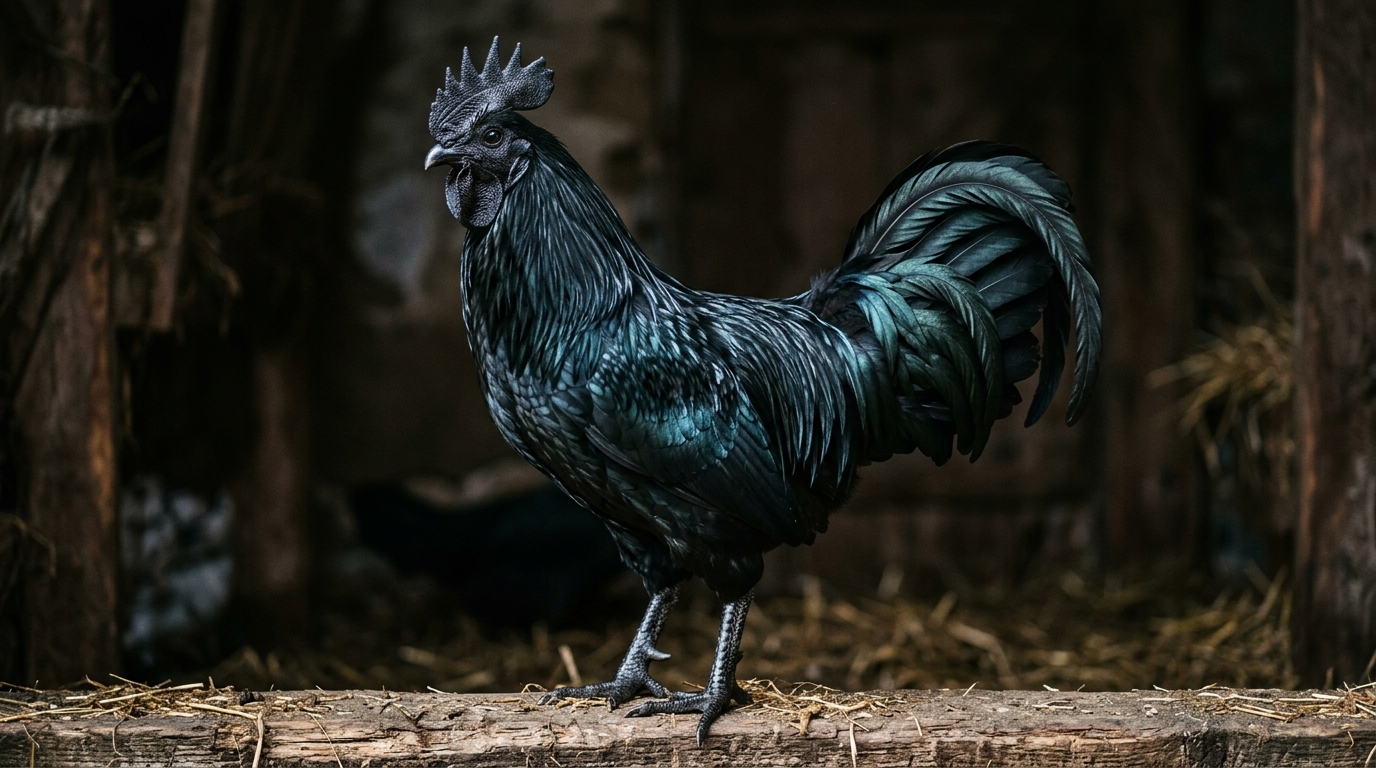
On a belief that a hen could only be black in its plumage: in Java, a breed is black to the bone, to the tongue, and to the organs
A hen that is completely black, inside and out: that would seem like a urban legend or a creature straight out of a fantastical bestiary. And yet, this animal does exist, calmly pecking around the farmyards of Indonesia for centuries, bearing a name as mysterious as its appearance: the Ayam Cemani. While the color black is typically associated with an animal’s coat, this Javanese breed upends that common idea by pushing pigmentation into the deepest corners of its biology. A singularity that, at this moment when we relearn the curiosities of the animal world, deserves serious attention.
- The Ayam Cemani is a Javanese hen whose mutation in the EDN3 (fibromelanosis) gene darkens skin, tongue, bones, muscles, and internal organs.
- Only the blood, which remains red, and the eggshell, ivory-cream, escape this hyperpigmentation.
- Rare and authenticated by a genetic marker on chromosome 20, this breed can fetch prices higher than a smartphone.
- The gene that decided to cover everything with melanin
- Black lungs, a black heart, an inky tongue
- Why this chicken is sometimes worth more than a smartphone
- An anomaly that redefines what we thought about black animals
The gene that decided to cover everything with melanin
To understand what makes the Ayam Cemani so extraordinary, one must dive into its DNA. In the vast majority of chickens, black pigmentation results from limited activity of certain genes, which act only on specific areas such as feathers or a comb. But in this Javanese breed, a genetic phenomenon called fibromelanosis completely changes the game. This mutation is directly linked to the gene Endothelin-3 (EDN3), a key actor in melanin production, the pigment responsible for dark tones in many living beings.
The fundamental difference lies in the scope of its expression. While in a typical hen this gene activates only in targeted cells, in the Ayam Cemani it expands to the entire body, across all cells of the body. It is a bit like a watering system meant to irrigate a corner of a garden suddenly flooding every patch of the land, without exception. This genetic misregulation, far from being trivial, turns the bird into a living demonstration of what a single mutation can produce when it escapes its usual boundaries.
Black lungs, a black heart, an inky tongue
What strikes most about the Ayam Cemani is the extent of this hyperpigmentation. It is not merely a dark plumage: the black extends to the skin, the tongue, the comb, the feet, but also, and this is where the breed’s singularity lies, to the muscles, the bones, and most of the internal organs. Opening up this animal would be like uncovering a photographic negative of a chicken, so thoroughly darkened is every tissue.
Curiously, two elements entirely escape this pigment invasion: the blood, which retains its usual red color, and the eggshell, tinted ivory-cream. These exceptions are not random; they simply show that the mutation, however extensive, respects certain biological limits imposed by the chemical composition of these elements. This striking contrast between a jet-black exterior and blood that remains perfectly red greatly contributes to the mystique surrounding this hen for generations in Java, Indonesia, where it belongs to the Ayam Kedu group. There, she is traditionally called upon during ritual ceremonies, where her distinctive color is linked to mystic beliefs deeply rooted in local culture.
Why this hen is sometimes worth more than a smartphone
For a long time confined to its island of origin, the Ayam Cemani eventually crossed oceans to gradually settle in European farms. But beware, not all specimens are equally valuable. To safeguard the genetic purity of the breed, research has identified precise variations in the chromosome 20 region associated with fibromelanosis, providing a reliable tool to distinguish truly pure lines from approximate crossbreeds.
This scientific rigor comes at a price. A purebred individual, descended from a lineage that strictly adheres to the breed’s genetic criteria, can command sums far beyond those of ordinary poultry, sometimes even surpassing the price of a recent smartphone. The rarity of the breed, combined with the difficulty of rearing it and the growing enthusiasm of enthusiasts for unusual animals, explains this unusual financial valuation for a chicken. In Indonesia, the importance of this breed was even officially recognized by ministerial decree, number 2487/Kpts/LB/430/8/2012, which defines Cemani precisely as a black variant of the Kedu hen carrying the fibromelanosis mutation.
An anomaly that redefines what we thought about black animals
The Ayam Cemani is not an isolated case in the animal kingdom, even if it is one of the most spectacular expressions of it. The hyperpigmentation phenomenon is also found in other species, such as the famous black panther, whose dark coat results likewise from an overproduction of melanin, though through different genetic mechanisms. This parallel reminds us that nature has multiple paths to visually similar results, each revealing a distinct evolutionary and genetic story.
What makes the Ayam Cemani so fascinating is precisely this ability to push the boundaries of what we thought possible in animal coloration. We naturally associate black with an external appearance, a play of reflections on plumage or fur. This Javanese hen reminds us that biology can sometimes be far more radical than our intuitions suggested, coloring down to the bone of the animal we thought we knew inside out.
Between scientific curiosity, cultural symbolism, and an object of desire for dedicated breeders, the Ayam Cemani embodies the unforeseen richness of animal genetics. It invites us above all to ask: how many other equally spectacular mutations lie hidden, quietly, in the corners of global biodiversity, simply waiting to be discovered?
