
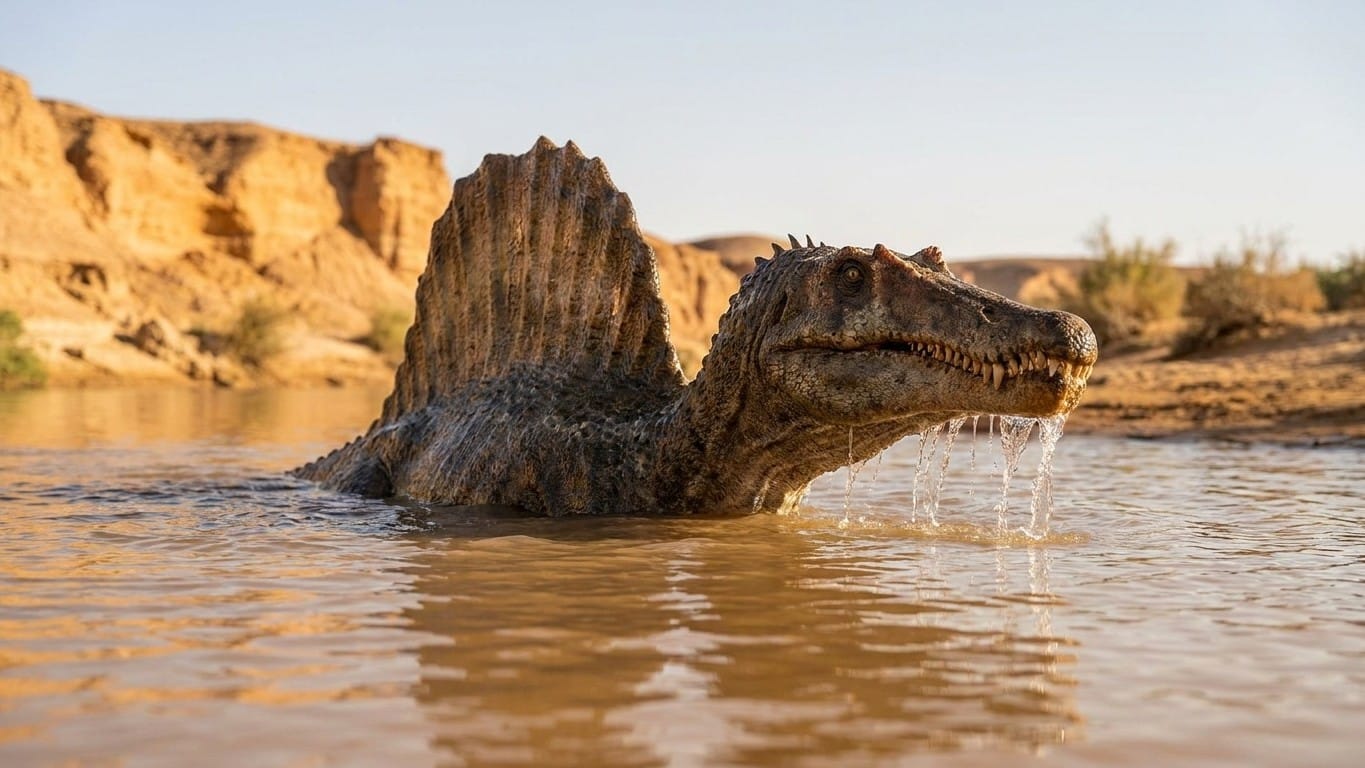
One hundred million years. That is how long it took for the planet’s largest land predator ever known to finally be recognized for what it truly was: a swimmer. In April 2020, the journal Nature published a study led by paleontologist Nizar Ibrahim and an international team. The researchers present unequivocal evidence of an aquatic propulsion structure in a dinosaur, the gigantic theropod Spinosaurus aegyptiacus, whose tail has an unexpected and unique form, consisting of extremely tall neural spines and elongated chevrons, forming a flexible, fin-like organ capable of a wide lateral excursion. Paleontology had just closed a century-long debate in a way no one could have anticipated: thanks to a robot submerged in a pool.
Key Takeaways
- A robot named “Flapper” simulated the movements of a dinosaur tail fossil in a water basin
- The Spinosaurus tail generated eight times more aquatic thrust than the tails of other theropods
- This discovery reverses a long-held belief: dinosaurs could have dominated rivers as much as dry land
A dinosaur discovered twice, and lost once
The first discoveries of Spinosaurus date back to the spring of 1912, when fossil collector Richard Markgraf uncovered a series of bones buried beneath 30 centimeters of sandstone and a meter of hard clay, in the Bahariya Oasis valley, in Egypt. This collection was described in 1915 by German paleontologist Ernst Stromer von Reichenbach, and then completely destroyed during the Allied bombings of Munich in World War II. A rare scientific catastrophe: the only known specimen of the longest animal of the dinosaur era reduced to ashes by war.
Almost a century would pass before a new skeleton could be studied, with the initial bones first unearthed by a nomadic amateur fossil collector in Morocco. It was Nizar Ibrahim, a paleontologist at the University of Detroit, who picked up the thread of the investigation. Ibrahim and his colleagues meticulously surveyed two sites in October and November 2019 in southeastern Morocco near the village of Tarda. What they brought to light would alter the way we understand dinosaurs as a whole.
The tail that changed everything
Tail vertebrae, interpreted as belonging to a Spinosaurus, were uncovered by Nizar Ibrahim in the Kem Kem beds, in the Sahara southeast of Morocco. At first glance, nothing extraordinary. But the researchers quickly realized they were dealing with something radically different from all known theropod tails. This tail possessed an unexpected shape: extremely tall neural spines and elongated chevrons, forming a large flexible fin-like organ capable of a broad lateral swing.
Using photogrammetry, which yields a digital model of this tail, the researchers physically rebuilt it in plastic, then connected it to a robotic system that mimicked swimming motions. The robot, named “Flapper,” hung under a water channel that George Lauder could regulate with precision, equipped with lights, cameras and sensors able to track aquatic movements and the strength of propulsion emitted. Fluid dynamics applied to paleontology: an approach as elegant as it is inexorable.
The verdict from the pool was unequivocal. The tail proved ideal for propulsion in water: remarkably flexible, it allowed a large range of motion, especially a lateral swaying. A robotic version of this tail, tested in a basin, outperformed the simulated tails of other dinosaurs in propulsion, and came close to the performance of semi-aquatic swimmers like crocodiles. The tail generated eight times more thrust in water than the tails of two other theropods, Allosaurus and Coelophysis. Eight times. The equivalent of comparing a kayak paddle to a wooden oar.
The portrait of a hunter from the depths
This predator, 16 meters long and weighing up to seven tons, possessed an elongated snout lined with sharp teeth, akin to the modern crocodile. Living in what was then the Sahara—a vast floodplain—the creature fed on enormous fish and marine reptiles inhabiting the river. Its conical teeth were adapted for harpooning slippery fish, and the nostril position pushed back toward the rear of the snout could have helped it breathe more easily while swimming.
This represents the first direct skeletal evidence that a non-avian theropod carried a tail adapted for aquatic propulsion. Ibrahim summarizes the animal with a line that has become famous in the scientific community: “It was, in a way, a dinosaur trying to fashion itself a fish tail.” A striking example of convergent evolution—the same principle that gave dolphins their tail flukes, but built with the architecture of a theropod.
A complementary study compared the bone density of Spinosaurus aegyptiacus against a wide variety of living and extinct animals, concluding that the dinosaur possessed very dense bone walls, like penguins, suggesting that it spent most of its life in the water, using these heavier bones as ballast to submerge during underwater pursuits.
A debate that is not quite closed
Science, rarely satisfied with a single answer, produced its counterarguments. A study published in 2022 in the journal eLife challenges the interpretation of an active swimmer, arguing that the center of mass of Spinosaurus and its overall body plan were poorly suited to stable underwater locomotion, and that the tail, though paddle-shaped, might not have been biomechanically sufficient for sustained pursuit swimming at the scale of a 14-meter animal. The digital models from this team conclude that the creature would have been unstable while swimming at the surface and far too buoyant to dive and submerge completely.
The debate remains open, but it has shifted. The question is no longer “Did Spinosaurus swim?” but “To what extent, and how?” The minimal consensus now is that Spinosaurus was at least semi-aquatic, spending a substantial portion of its life in and around water. This shift in conceptual ground is itself a revolution: for decades, paleontologists refused to grant dinosaurs any aquatic lifestyle. The historical proposals suggesting that some groups, such as sauropods and hadrosaurs, lived in aquatic environments had been abandoned several decades ago. The Moroccan fossil and its swimming robot reopened the door that the history of paleontology had carefully closed.
The saga is not over. In the middle of the Sahara in Niger, paleontologist Daniel Vidal uncovered a curved bone crest shaped like a saber, belonging to Spinosaurus mirabilis, an entirely previously unknown species that inhabited a riverine ecosystem 95 million years ago. Each new bone fragment exhumed from the Sahara compels science to rewrite a little more of its account of these giants who, contrary to what was once believed, may have ruled the rivers as much as the land.
Sources: cnews.fr | novataxa.blogspot.com
