
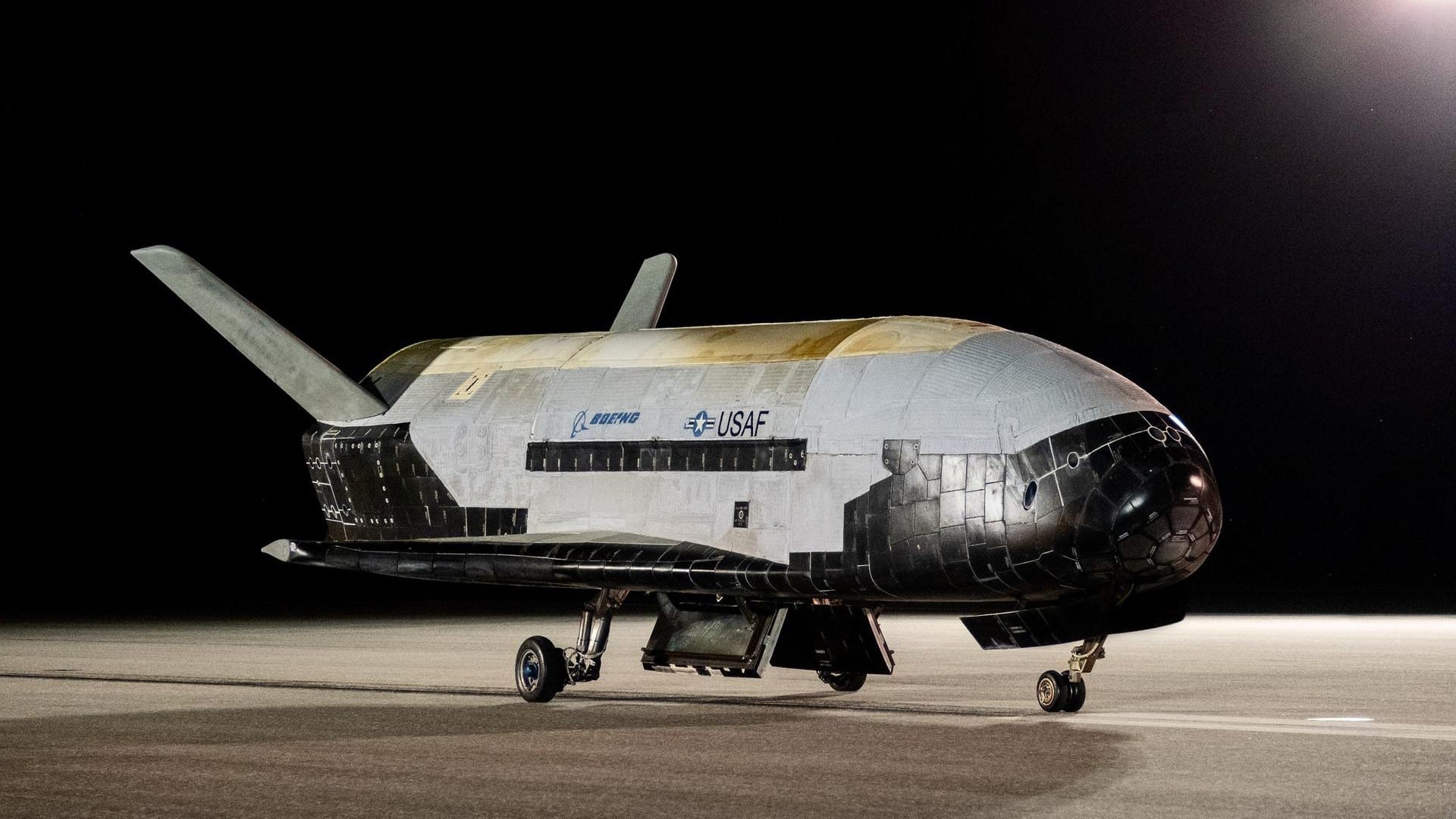
On May 17, 2020, an uncrewed spaceplane lifted off from Cape Canaveral. Mission duration planned: 270 days. It would return 908 days later. No one would truly know what it had been doing up there.
The X-37B is not an ordinary satellite. Measuring 8.38 meters in length, with a wingspan of 4.57 meters and a dry weight of 5 tons, it maneuvers in orbit thanks to its Pratt & Whitney Rocketdyne engine. A craft the size of a large SUV, capable of landing on a runway by itself, like a miniaturized space shuttle, without crew. Originally, NASA had asked Boeing to design the X-37 for a 270-day orbital stay. In reality, the mission substantially exceeded the specification.
À retenir
- Why did a mission planned for 270 days last more than two and a half years?
- What classified experiments are actually taking place aboard this spaceplane?
- How did this unmanned vehicle travel 2.1 billion kilometers without revealing its secrets?
908 Days: The Number That Sums It All
The X-37B established a new endurance record after spending 908 days in orbit, before landing at NASA’s Kennedy Space Center in Florida on November 12, 2022. That’s two and a half years of continuous mission activity, conducted in silence, with no press conference and no public updates. To grasp the scale of this duration: it is the time needed to make two full orbits around the Sun, or for a child to go from first grade to second grade.
In doing so, the X-37B surpassed the previous record held by the earlier mission, which lasted 780 days in space—more than four additional months. Each mission since 2010 has surpassed the one before it. The first ended after 224 days; the second lasted 468 days; the third, 674 days; the fourth and fifth missions lasted 717 and 779 days respectively. A steady, almost methodical progression that more closely resembles a training program than a series of independent missions.
The OTV-6 mission also introduced a new technique. It was the first to incorporate a service module—a ring mounted on the rear of the vehicle—which increases the number of experiments that can be conducted during the mission. Greater payload capacity, more experiments on board, and still as much mystery about their exact nature.
What We Know, and What We Probably Never Will Know
Most payloads are classified, as are the majority of the X-37B’s activities. The Space Force does not disclose the vehicle’s orbital details, nor in advance when each OTV mission will end. The program operates with this ambiguity with notable deftness. We do not know where it is, we do not know when it will return, and we learn after the fact what it did, only in part.
What has leaked from OTV-6 consists of a handful of officially confirmed experiments. The X-37B tested the radio-frequency photovoltaic antenna module from the American Naval Research Laboratory, a device the size of a pizza box designed to convert solar energy into microwaves that could then be transmitted to Earth. A potentially foundational technological building block for space-based solar power. A NASA experiment also sought to evaluate the effects of long-duration exposure to space on seeds, as part of research aimed at future crewed missions to the Moon and Mars.
What remains a vast unknown. A major theme around the program is the gap between public speculation and available data. Recurrent interpretations cast the X-37B as an orbital weapons platform, an inspection satellite, or a clandestine anti-satellite system, but little evidence backs these hypotheses. The Secure World Foundation, a group specialized in space security, states this unambiguously. That does not prevent speculation from thriving, and the program’s opacity from feeding it.
A Program That Never Stops
The return to Earth in November 2022 was only a pause. The seventh mission, launched on December 29, 2023, ended on March 7, 2025 with only 434 days in orbit. “Only,” the word says it all about the scale of reference this program has set. For OTV-7, the technical ambition steps up a notch: it was the first time the spaceplane departed on a SpaceX Falcon Heavy rocket to reach a highly elliptical orbit. This mission also saw the deployment of a so-called aerobraking technique, which allows altering the orbit by exploiting the Earth’s atmospheric drag, thereby limiting fuel use.
Following OTV-7 in March 2025, the X-37B had accumulated seven successful missions, covering more than 2.1 billion kilometers and spending thousands of days in space. To put that figure in perspective: 2.1 billion kilometers is about fourteen times the Earth–Sun distance. A vehicle the size of a minivan traveled that far, in silence, with no one knowing precisely what it was doing.
The eighth mission, OTV-8, launched on August 21, 2025 from Kennedy Space Center, aboard a SpaceX Falcon 9. According to the Space Force, this mission includes testing laser communications and a quantum inertial sensor. This sensor aims to test robust navigation technologies in environments where GPS is unavailable, according to Colonel Ramsey Horn, commander of Space Delta 9, the unit in charge of orbital warfare. A statement that says a great deal about the true nature of this program: the X-37B is not merely paving the way for civilian space exploration. It is preparing a space where communications can be cut, orbits challenged, and where the ability to maneuver without GPS could become a matter of operational survival.
Sources: kulturegeek.fr | futura-sciences.com
