
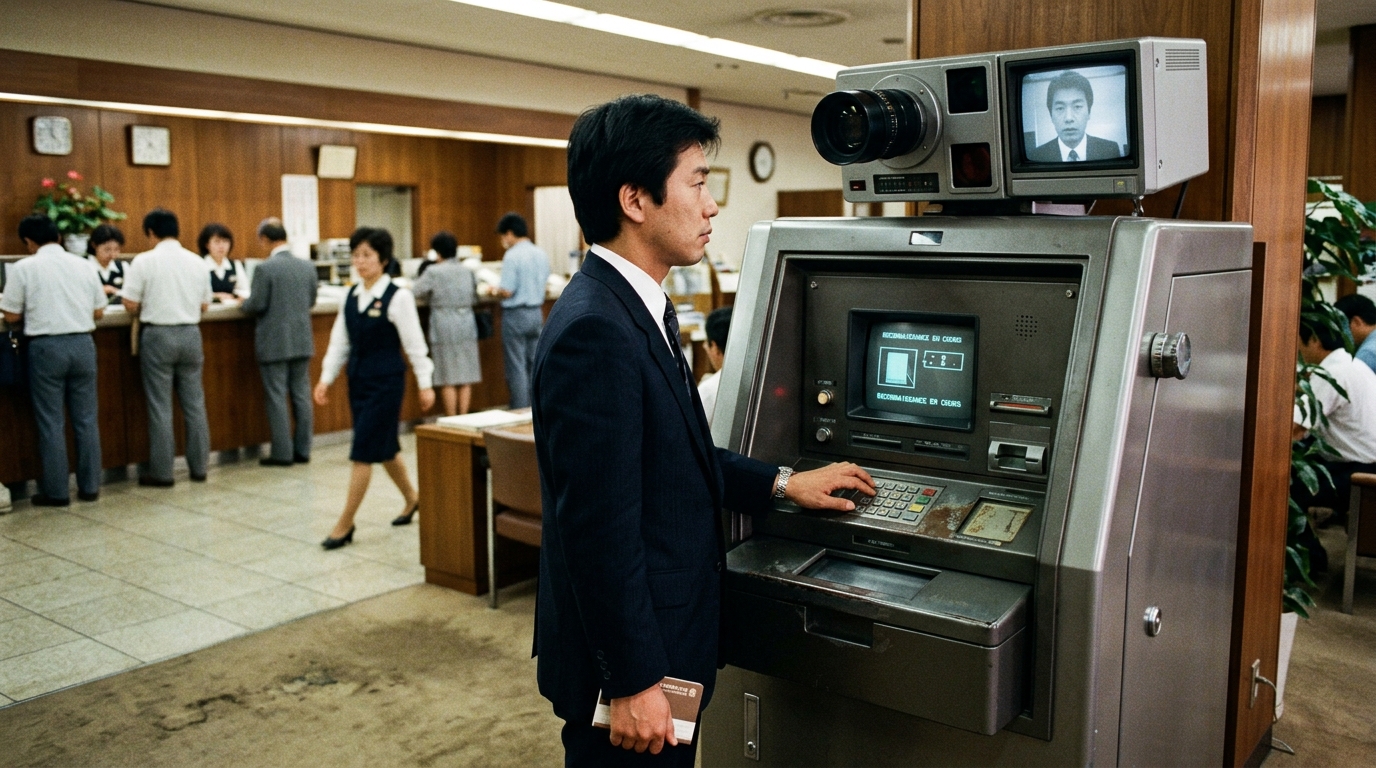
Picture the scene: a customer steps up to a bank dispenser, not to type a code, but simply to present his face to a camera. The machine watches him, hesitates for a few seconds, then refuses to recognize him. The reason? A beam of sunlight filtering through the agency’s window differently than the day before. This anecdote, as surprising as it may seem, actually happened in Japan in 1980, at a time when facial biometric banking was still a halting experiment. While one might have thought the technological limit came from insufficient processing power or a camera too rudimentary for the era, the real flaw lay elsewhere, in a factor so banal that it becomes almost fascinating to study today, decades later, as facial recognition has become widely democratized in our daily uses.
- In 1980, the Japanese company Omron developed a banking dispenser that used facial recognition to open safes.
- The system failed not because of a lack of computing power, but due to ambient lighting variations—an ordinary cloud or sunbeam was enough to perturb the recognition.
- This failure guided future biometric research, leading to innovations such as infrared sensors, automatic calibration, and life-detection sensors used today by banks like CaixaBank or in the French FACCESS project.
- The Japonese entrusted the opening of a vault in 1980 to the face of its customers alone
- When a simple cloud was enough to derail the machine
- The technology was ready, the environment was not
- An failure that laid the foundations of modern biometrics
- What the Omron venture reveals about today’s technologies
In 1980, a Japanese bank undertook a bold gamble that today seems almost visionary: replace physical keys and secret codes with a single face. It was Omron, a renowned Japanese automation specialist, that developed this revolutionary biometric dispenser. The device promised unprecedented security for the era, capable of distinguishing the features of a human face to authorize or deny access to a vault. On paper, the idea immediately appealed to bank officials weary of card theft and fraud tied to easily stolen codes.
But the real threat to this pioneering system would come not from hackers or a camera too rudimentary for the intended use. It would come from an entirely unexpected adversary, almost poetic in its simplicity: the sun.
When a simple cloud was enough to derail the machine
The Omron system rests on a seemingly straightforward logic: identify a face to open a vault. This clever approach, on paper, quickly ran into an invisible and hard-to-control enemy: ambient light. A sunbeam too intense crossing a window, a bulb changed in the branch, or even a passing cloud in front of the sun was enough to seriously disrupt the machine. It would lose its visual references and fail to recognize features it had previously validated without issue the day before.
This detail, seemingly trivial at first glance, reveals a major flaw in the initial design. The technology wasn’t too weak to accomplish its primary mission. It was simply unprepared to face a real world where light changes constantly, across hours, seasons, and weather.
The technology was ready, the environment was not
Contrary to the belief that might suggest a mere technological lag, the processing power available in 1980 was more than sufficient for the use envisioned by Omron’s engineers. They had devised an algorithm capable of analyzing faces with a reasonably respectable accuracy for the time, leveraging the computing capabilities then available in Japan, a country already a pioneer in industrial and banking automation.
The real problem lay elsewhere—in the real usage conditions of the machine. A bank branch is not a controlled laboratory where brightness remains permanently stable. Light varies with the time of day, the weather outside, the presence of neon lighting, or the orientation of windows. This constraint had not been anticipated to such a degree during the prototype’s design. The system worked perfectly in controlled tests, but it collapsed the moment it faced the ordinary daily luminosity of a bank environment, with its unpredictable variations.
An failure that laid the foundations of modern biometrics
The story could have ended there, dismissed as a quirky curiosity stored away in Japanese archives. But this failure, as frustrating as it was for Omron’s engineers, served as a foundational lesson for an entire emerging industry. Biometrics designers learned that truly reliable facial recognition had to withstand the unpredictable variations of the real world, not merely those of a carefully calibrated laboratory. This new requirement steered decades of biometric research.
Today, facial recognition systems still incorporate fixes directly inherited from this constraint identified as early as 1980 in Japan. Indeed, infrared sensors capable of functioning independently from visible light, automatic calibration mechanisms, and dynamic brightness management that continuously adjusts analysis parameters are all solutions that flow from the lessons of that pioneering failure.
What the Omron venture reveals about today’s technologies
This Japanese case illustrates a rule that extends well beyond the realm of banking biometrics. A technology does not always fail because of a lack of power or a poorly designed concept. It often fails more simply due to a lack of adaptation to reality, to its unforeseen elements, and to constant fluctuations. Omron possessed the right idea and the right algorithm, but not yet enough mastery of the environment in which its machine would operate. This nuance profoundly changes how we understand the history of technological innovation.
It would take several more years for this technology to truly evolve. In China, as early as 2015, Tsinghua University in Beijing and the company Tzekwan relaunched this type of system, notably to combat card fraud that was costing financial institutions tens of millions of euros annually. Then, closer to our present time, CaixaBank installed in Barcelona the first European ATMs operating with facial biometrics, capable of detecting more than 16,000 points across a face, while asking the customer to move their head slightly to prevent a mere photo from serving as a lure. In France as well, the FACCESS project contributed to the development of “life detector” software, requiring, for example, an eyelid blink to authenticate genuine human presence. From facial recognition to autonomous cars, the same principle persists: light, weather, and unpredictability remain the true judges of any technology, far more than merely the onboard processing power.
This tale of a Japanese dispenser betrayed by a single cloud ultimately recalls a simple truth often overlooked in the world of innovation. The most striking technological advances do not arise solely from more powerful calculations or more sophisticated algorithms, but also from the ability to learn from failures to better understand the real world in all its complexity. As facial recognition now makes its way into our smartphones and our bank kiosks, one can’t help but wonder what other current technologies, outwardly mature, still conceal an unexpected flaw as striking as a simple sunbeam.
