
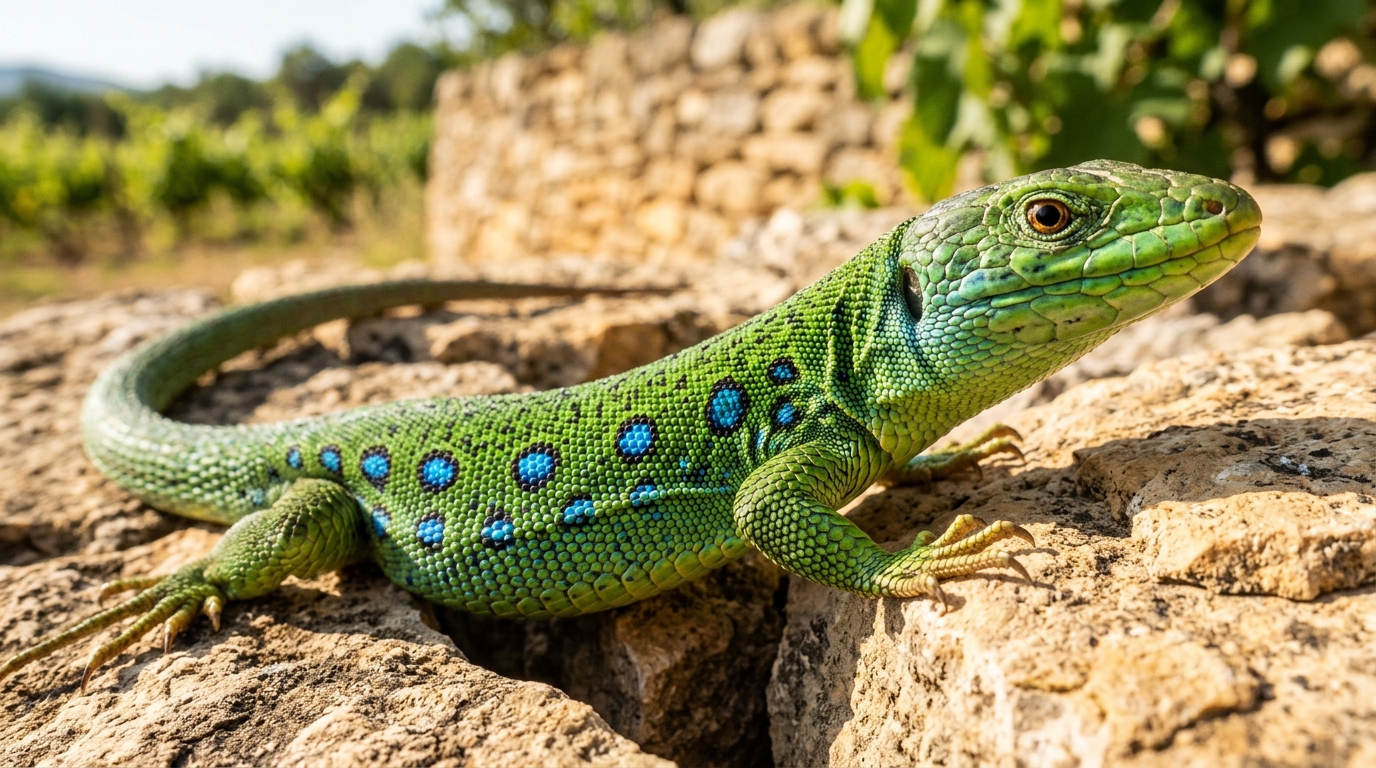
As the grape harvest season draws to a close in the Corbières, a curious quiet coexistence unfolds among the vineyard rows. The ocellated lizard—a formidable reptile that can reach 70 centimeters, and even more according to some local witnesses—shares its territory with a small mammal that, in dietary terms, is unrelated to it. It is precisely this improbable relationship that determines its survival. For without this much smaller creature, the lizard would literally have nowhere to go. Head to Tuchan, in the Aude, to understand why protecting a scaled giant hinges on safeguarding a rabbit burrow.
- The ocellated lizard, the largest reptile in Europe, capable of reaching up to 90 cm in the Aude, depends on abandoned rabbit burrows because it cannot dig its own shelter.
- The species is listed as vulnerable on national, European, and global red lists, threatened by the disappearance of dry-stone walls and urbanization.
- In Cascastel-des-Corbières, 35 winemakers signed a charter to restore the dry-stone walls and to grass over the tournières, enabling the detection of 22 ocellated lizards on the site.
- The largest lizard in Europe hides in your vineyards
- Why this reptile cannot survive without rabbit burrows
- Crumbling dry-stone walls, a refuge disappearing
- What remains to be done before the ocellated lizard leaves the Corbières
The largest lizard in Europe hides in your vineyards
The ocellated lizard is not a small, inconspicuous reptile you might encounter in a garden. This species, the largest in Europe, has roamed the south of France for nearly two million years, making it a living witness to the geological history of our garrigue landscapes. Recognizable by its green coloration dotted with blue spots encircled in black, it can reach up to 70 centimeters, with some individuals observed in the Aude reaching 90 centimeters.
In the Corbières, it is no accident that it settled precisely in this dry region, a terrain of garrigue and Mediterranean maquis that offers it heat, insects to hunt, and rocky outcrops for concealment. This arid landscape, shaped by centuries of terraced viticulture, stands as one of the last French strongholds where the species continues to persist, despite mounting environmental pressures.
Why this reptile cannot survive without rabbit burrows
Here is the paradox that makes this story so fascinating: the ocellated lizard does not know how to dig. Unlike other reptiles capable of shaping their own shelter, it relies entirely on pre-existing cavities to reproduce and to escape predators. Abandoned rabbit warrens, hollow tree stumps, and piles of stones thus constitute its only housing options.
This dependency, almost paradoxical, perfectly illustrates how an ecosystem operates as a balancing act. The wild rabbit, by digging its tunnels to protect itself, unknowingly provides a vital refuge to a creature much larger than itself. Without this subterranean architecture, no reproduction would be possible, no protection against birds of prey or foxes could be guaranteed. The ocellated lizard then finds itself fully exposed, at the mercy of any danger.
Crumbling dry-stone walls, a refuge disappearing
In addition to rabbit burrows, a second type of shelter is equally precious: the dry-stone walls that line the terraced vineyards. These traditional structures, inherited from an ancient farming know-how, offer the lizard cool hiding spots in summer and sunny exposure zones for the rest of the year. Unfortunately, these walls are gradually crumbling due to neglect, the result of abandoned plots or more intensive farming practices.
This gradual loss of habitat helps explain why the species is currently listed as vulnerable on the national IUCN Red List, and also on European and global red lists. Growing urbanization and climate change further aggravate an already fragile situation by shrinking environments suitable for reproduction. This reality led the authorities to implement a National Action Plan between 2012 and 2016, renewed since to try to reverse the trend.
What remains to be done before the ocellated lizard leaves the Corbières
Facing this silent decline, winemakers from the Cascastel-des-Corbières cooperative cellar decided to take matters into their own hands. A charter has been signed by 35 members, committing to restore the dry-stone walls and to grass over the tournières—these strips of earth located at the end of vine rows. The goal is twofold: recreate solid shelters for the reptile and promote the presence of the insects it feeds on daily.
These efforts appear to be bearing fruit. A study conducted by the local naturalist association ECODIV detected 22 ocellated lizards on the Cascastel-des-Corbières site, each individual occupying a territory of about 200 meters around its main burrow. A promising figure that shows biodiversity-friendly farming can coexist with wine production, without sacrificing one for the other.
The story of the ocellated lizard reminds us how the survival of a species can hinge on something as slender as a rabbit burrow or a hand-laid stone wall. By protecting these seemingly mundane elements, the winemakers of the Corbières preserve far more than a single reptile: they maintain an entire ecological balance shaped by centuries of agricultural practices. The question remains whether this local mobilization will be enough to reverse the trend in the long run, or whether other vineyards will follow Cascastel-des-Corbières’ example to grant the largest lizard in Europe the future it deserves.
