
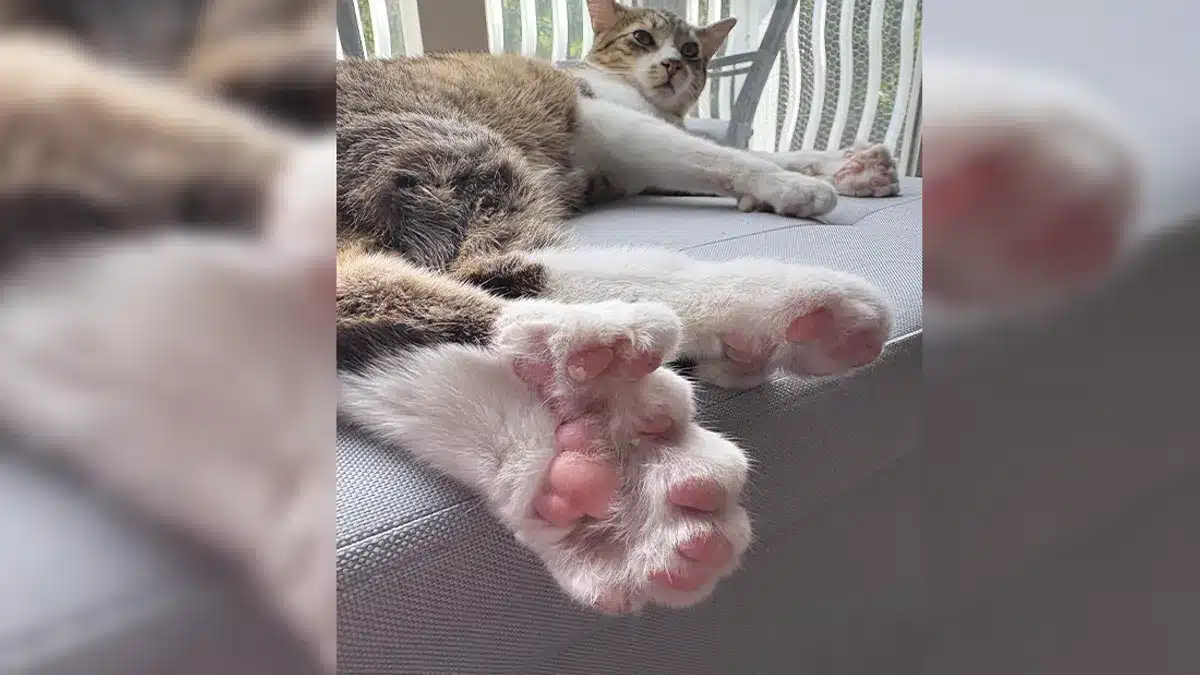
Toby, a 10-month-old kitten from Michigan, has just matched the Guinness World Record for the cat with the most toes: 28, ten more than normal. This trait, called polydactyly, results from a simple dominant genetic mutation—and does not affect the animal’s health in the slightest.
What you will learn
- What polydactyly is and why a single carrier parent is enough to pass on this trait
- How many toes a cat normally has—and how Toby distributes his 28
- Other animals that became viral for similar genetic quirks
28 Toes on Four Paws
Domestic cats are normally born with 18 toes: five on each front paw and four on each hind paw. Toby, however, has 28—ten more than standard. This total allows him to equal the Guinness World Record set in 2002 by Jake, a Canadian polydactyl cat who became legendary in the world of extraordinary felines, and who passed away in 2024.
Toby lives in Michigan with his owner Delaney Henderson and his sister cat Connie — who isn’t left out since she also has two extra toes on her front paws. When Henderson first saw Toby’s paws, she admits she couldn’t believe her eyes. Already housing a polydactyl cat, she expected a few extra “thumbs” — but not a display as striking as the four paws Toby exhibits.
Polydactyly: An Anomaly That Isn’t Really One
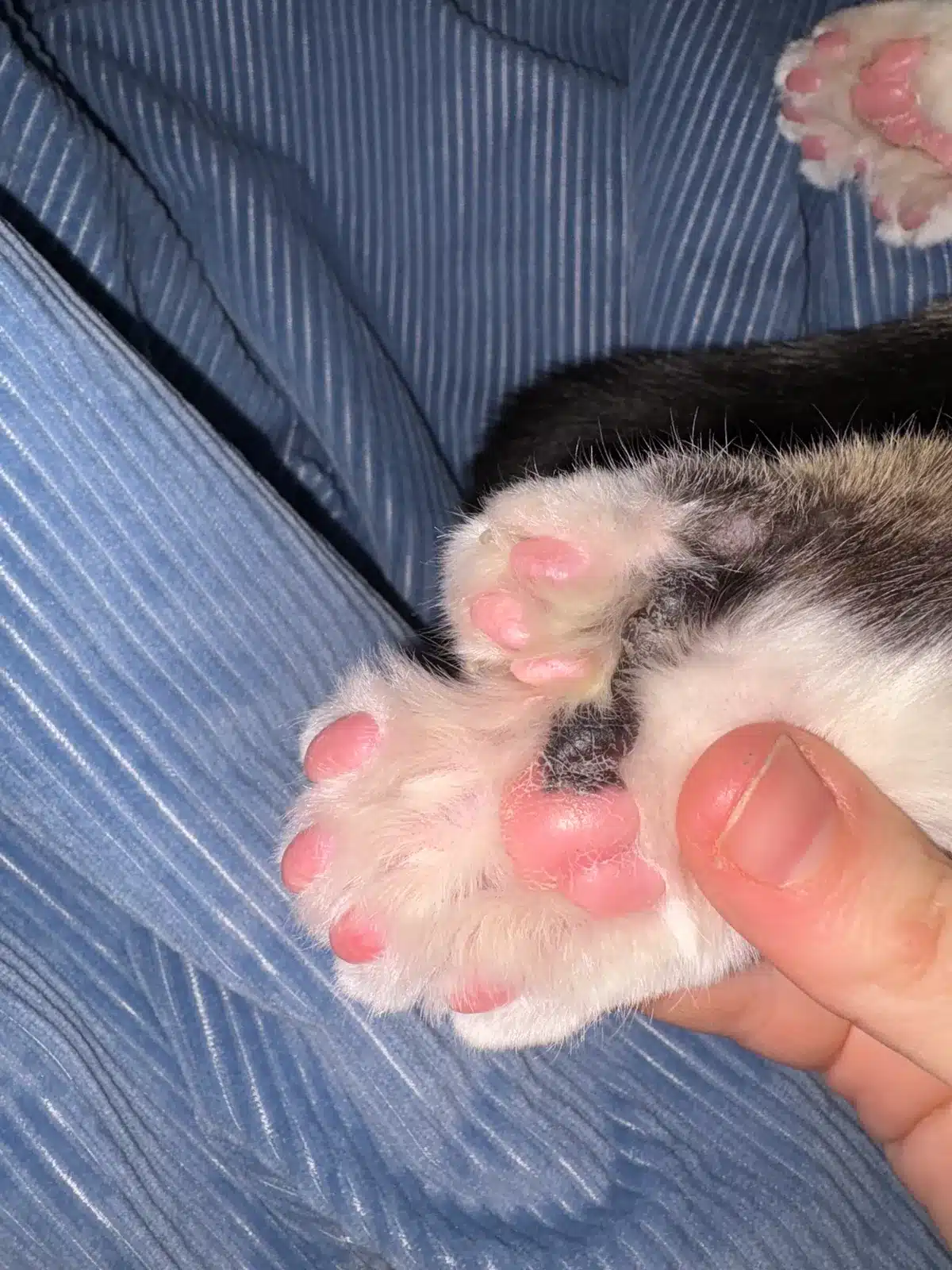
Polydactyly is a genetic quirk present in many species, humans included. In cats, it is characterized by extra toes on one or more paws. These additional toes can develop along the outer edge of the paw — the ulnar side — or along the inner edge — the thumb side — appearing either singly or in pairs.
What makes this mutation particularly common among cats is its autosomal dominant nature. Practically, it suffices for only one of the two parents to carry the mutation for their offspring to have a chance of inheriting it. There is no need for both parents to be polydactyl — a single copy of the altered gene is enough to produce extra toes in the next generation.
Despite its striking appearance, polydactyly is typically perfectly benign. Henderson confirms that Toby’s extra toes have no impact on his health or behavior — they simply grant him paws that could be described as bear-like, broad and furry, along with a look that leaves no one indifferent.
A Long History of Cats with Generous Paws
Polydactyl cats carry a rich cultural history. Ernest Hemingway was a great admirer of these animals, and the house-turned-museum where he lived in Key West, Florida still hosts, to this day, a colony of about fifty polydactyl cats, descendants of his first six-toed companion. These felines are sometimes referred to as “Hemingway cats” in his honor.
Jake’s record, established in 2002 with 28 toes in Canada, had stood for more than two decades. Toby does not surpass it—he merely matches it—but he does so at the age of only 10 months, which suggests a long life ahead as a record holder.
Animals with Genetic Quirks That Take the World by Storm
Toby is part of a lineage of animals that have gone viral for harmless anatomical quirks. In 2024, Audio, a cat rescued from a Tennessee shelter with his litter, moved millions with his four ears — a trait he shares with Midas, the star of a widely followed Instagram account. Neither animal shows any negative effects.
In 2019, Narwhal — nicknamed the “little furry magical unicorn” — drew attention: a puppy with a tail growing on his forehead. According to the Mac’s Mission shelter that took him in, this extra appendage had no real function other than making him the coolest puppy in the world. These cases illustrate how single genetic mutations can produce perfectly healthy animals that are visually fascinating.
