
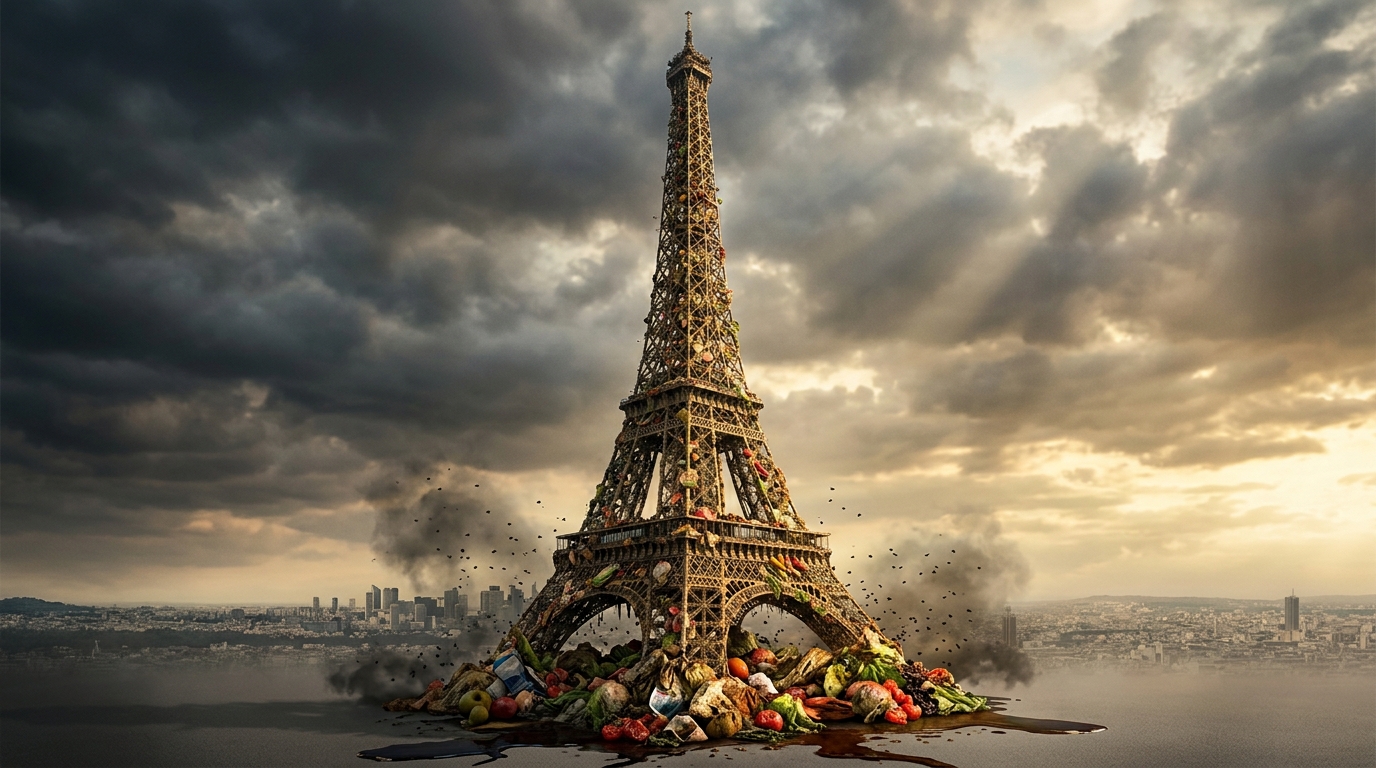
Picture the Eiffel Tower, its 324 meters of riveted iron, its silhouette dominating Paris for more than a century. Now imagine a replica. Then another. Then yet another, until nearly a thousand are lined up, stacked one atop another. That’s about the quiet feat France achieves every year, except that instead of steel, this ephemeral monument is made of stale bread, overripe fruit, forgotten steaks and expired yogurts. The ADEME, the agency for ecological transition, has calculated it, and the result is literally dizzying: our annual food waste weighs the equivalent of several hundred, or even a thousand, Eiffel Towers. Here’s how this invisible mountain is built, meal after meal, without anyone truly seeing it grow.
- France wastes about 10 million tonnes of food per year, roughly 150 kg per inhabitant and the equivalent of about 990 Eiffel Towers.
- This waste is distributed across consumption (33%), agricultural production (32%), processing (21%), and distribution (14%).
- It represents a cost of 16 billion euros and 15.3 million tonnes of CO2 per year, despite the 2020 AGEC law aimed at reducing it.
- Ten million tonnes, a figure that means little until you weigh it
- The meal that nobody ever sees arriving on the plate
- The bin that costs more than the grocery cart
- Fewer Eiffel Towers: what the anti-waste fight actually changes
Ten million tonnes, a figure that means little until it is weighed
Ten million tonnes. On paper, this figure remains abstract, almost harmless. But as soon as it is translated into familiar objects, it becomes frankly alarming. The Eiffel Tower weighs about 10,100 tonnes. Dividing the two numbers yields nearly 990 times its weight, the equivalent of an army of metal towers that, lined up, could traverse the Hexagon several times. Some estimates even round this ratio to a thousand towers, such is the vertigo of the scale. On an individual level, that translates to 150 kilograms of food wasted per person per year, roughly the weight of an average European adult. In other words, every French person symbolically discards the equivalent of one whole person’s worth of food each year.
This finding, established by ADEME in 2016, remains today the most cited reference and continues to guide public policy. It is estimated that 20 % of the food produced in France ends up straight in the bin, a fifth of our food production that disappears without ever feeding anyone.
The meal that nobody ever sees arriving on the plate
What strikes most in this story is that waste doesn’t happen only at the moment we scrape our plates in the kitchen. It begins long before, right in the field. According to the distribution established by ADEME, consumption accounts for 33% of total waste, followed closely by agricultural production at 32%, then industrial processing at 21%, and finally distribution, responsible for 14% of losses. In plain terms, a large portion of what we throw away never even reached our cupboards: misshapen vegetables, unsold items from supermarkets, losses during packaging.
This waste rate also varies greatly depending on the type of food. Eggs, sturdy and easy to store, show a loss rate of only 9%. Salads, by contrast, peak at 57%, meaning one salad in two ends up in the bin. This autumn, as stalls overflow with pumpkins, cabbages and the last seasonal salads, the statistic takes on particular weight: the fragility of these fresh products makes them the first victims of waste.
The bin that costs more than the grocery cart
Behind these tons of lost food lies a real bill. Food waste in France amounts to nearly €16 billion each year, a sum representing what households could have saved by buying only what they actually consume. Environmentally, the price is just as steep: this waste generates 15.3 million tonnes of CO2, about 3% of the country’s greenhouse gas emissions, a climate burden comparable to entire industrial sectors.
And the valorization of these wastes remains limited. Less than 2 million tonnes, barely 20% of losses, find a second life in animal feed. The rest goes to incineration, composting, or landfill, never serving any use. More recent data, compiled by the Ministry of Ecological Transition from Eurostat figures, confirm this trend: in 2023 France produced 9.7 million tonnes of food waste, of which 3.8 million tonnes consisted of foods still perfectly edible at the moment they were discarded.
Fewer Eiffel Towers: what the anti-waste fight really changes
In response to this, France eventually legislated. The AGEC law, adopted in 2020, provided a clear legal definition of food waste: any food intended for human consumption that is lost, discarded or degraded at any stage of the food chain. This text made it possible to impose donation obligations on large supermarkets, tighten the framework around use-by dates, and raise consumer awareness through labeling.
Concretely, every gesture counts in bringing down this pile of imaginary Eiffel Towers. Better planning of purchases, cooking with leftovers, learning to store delicate products properly like salads or ripe fruits: all these simple habits, multiplied by millions of households, could genuinely reverse the curve. Because behind the striking statistic hides a much more tangible reality: a food system still too often designed to produce in excess rather than to match demand precisely.
Ultimately, these hundreds of Eiffel Towers stacked up are not a mathematical inevitability, but a reflection of collective habits that can still evolve. Between the 990 imaginary towers and the 16 billion euros that vanish, a question deserves to be asked at every meal: could what we are about to throw away have, after all, been eaten?
