
A sphere 1,385 kilometers in diameter. This is the result achieved by the United States Geological Survey (USGS) by compiling all the water present on Earth, in all its forms, into a single theoretical volume. If all Earth’s water (oceans, ice sheets and glaciers, lakes, rivers, groundwater, and water in the atmosphere) were gathered into one sphere, the diameter of this water ball would be about 1,385 kilometers. On the scale of the European continent, this roughly corresponds to the distance between Paris and Warsaw.
The illustration dates back several years but continues to circulate regularly, in particular promoted by the USGS Water Resources account on social networks every Earth Day. The message remains the same: gathered into a single ball, all the planet’s water would appear surprisingly small compared to the size of the Earth, even though 71% of its surface is covered by water.
- A sphere containing all Earth’s water would reach a diameter of 1,385 km, about the distance from Paris to Warsaw.
- Approximately 96.5% of the planet’s water is saltwater; only about 2.5% is freshwater.
- The liquid freshwater accessible to humans would form a sphere only 56.2 km in diameter.
A sphere containing 1.386 billion cubic kilometers
The volume of this largest sphere, representing all water on, within, and above the Earth, would be about 1,386,000,000 cubic kilometers. A number that is hard to wrap one’s mind around. To give a sense of scale, a single cubic kilometer of water equates to about 264 billion gallons, or nearly a trillion liters.
This total mass of water includes absolutely everything. The sphere encompasses all water in the oceans, ice sheets, lakes, rivers, groundwater, atmospheric water, and even the water contained in your body, your dog, or your tomato plant. Nothing escapes the calculation, not even the water vapor floating overhead.
About 96.5% of this total is salt water. The vast majority of water at Earth’s surface, more than 96%, is the saline water found in the oceans. The remainder, roughly 2.5%, makes up all the planet’s freshwater: that from glaciers, aquifers, lakes, and rivers combined.
Liquid freshwater, a tiny ball
Remove the glaciers and polar ice caps from the equation, keep only liquid freshwater (aquifers, lakes, rivers, wetlands), and the sphere contracts dramatically. The sphere representing global liquid freshwater, including groundwater, lakes, wetlands, and rivers, would reach a volume of about 10,633,450 cubic kilometers, of which 99% corresponds to groundwater largely inaccessible to humans, for a diameter of about 272.8 kilometers. A ball, by comparison, would be tiny next to the giant 1,385-km sphere.
And if we keep only the lakes and rivers, those that actually feed taps and fields around daily life? The sphere shrinks further. Its volume falls to about 93,113 cubic kilometers, for a diameter of barely 56.2 kilometers. A sphere that would almost fit inside a French department.
This contrast illustrates a reality the USGS has emphasized for years. Water is abundant on Earth, but easily accessible freshwater remains a scarce and precious resource, the planet’s lifeblood. The numbers speak for themselves: of all the available freshwater, about 69% is stored in glaciers and ice caps, and only about 1% is accessible in lakes and rivers.
Why Earth looks so blue from space
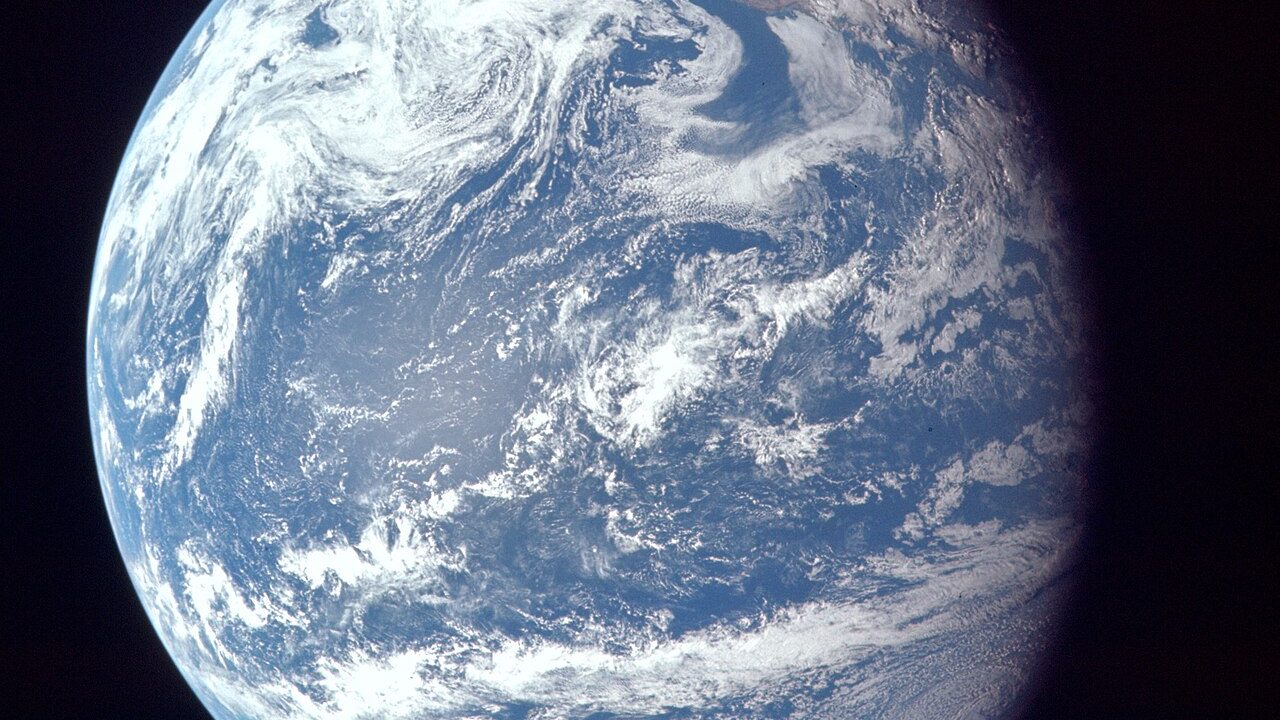
The paradox is right there. The planet is nicknamed the Blue Planet, photographed from space with its dominant oceans, yet all this water accounts for only a tiny fraction of the Earth’s volume. The vast majority of surface water, more than 96%, is saltwater present in the oceans, but this liquid mass is, in reality, just a film spread over the Earth’s crust.
In reality, the oceans represent only a “thin film” of water on the surface, according to the USGS’s own description. A film, on a planetary scale. The average depth of the oceans is about 2.7 kilometers, a negligible figure next to the Earth’s radius of more than 6,000 kilometers.
This is precisely what makes the sphere illustration so telling. In three dimensions, the water volume appears minuscule against the entire globe. The water spheres seem small only in relation to the size of the Earth, because the image attempts to depict three dimensions, with each sphere representing a volume.
The comparison goes beyond raw numbers. It also reminds us how the water cycle remains concentrated in a small space. About 12,900 cubic kilometers of water, mostly in the form of vapor, exist in the atmosphere at any given moment, and if all that vapor were to fall as precipitation at once, the Earth would be covered by only about 2.5 centimeters of water. A reminder to put into perspective the idea of a planet drowned in water, when in reality it rests on an incredibly thin and concentrated resource.
Sources: x.com | usgs.gov
