
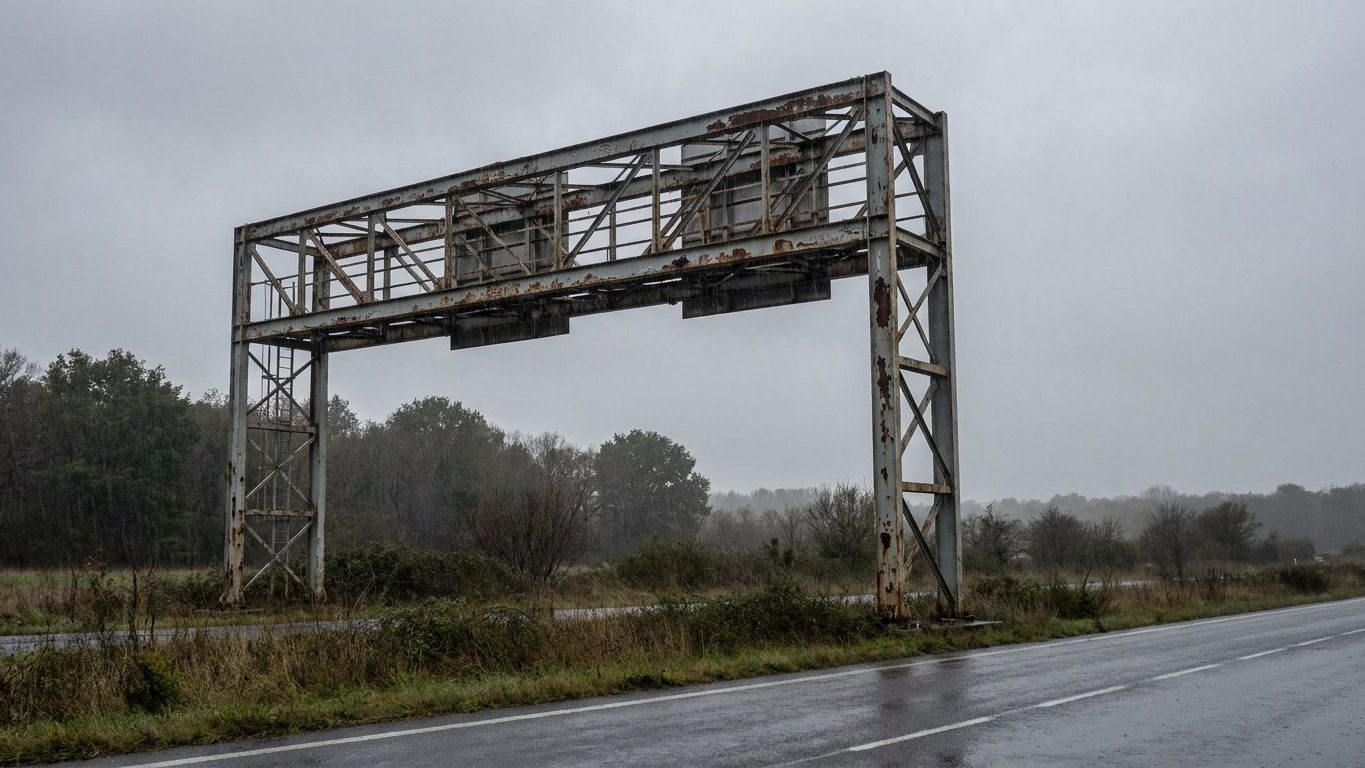
€957.58 million. This is the amount the French state paid to a consortium to abandon the ecotax, which had never yielded a single euro. In 2013, 173 control gantries were erected on national roads to monitor the passage of heavy goods vehicles. Three years later, all that remained of the project was a colossal bill and metal carcasses dismantled one by one.
The story begins in October 2011, when the state signed a thirteen-year partnership with the company Ecomouv’. The objective: to charge trucks over 3.5 tonnes per kilometer traveled on the national network, using a system of onboard GPS devices and control gantries. These gantries, in fact, were not used to bill the tax itself but to verify that heavy goods vehicles were properly equipped, a technical detail often forgotten in public debate.
- The French state paid €957.58 million to Ecomouv’ to abandon the ecotax in 2014 without collecting any revenue.
- The 173 gantries installed in 2013 functioned technically, but the Breton “Red Bonnets” protests forced the scheme’s stop.
- The ironclad contract with Ecomouv’ made the abandonment costly and without a legal basis in the eyes of the Court of Auditors.
A Breton revolt that derailed the machine
The administrative machinery ran for two years. Then autumn 2013 arrived.
Faced with the anger of the Breton “Red Bonnets,” driven by a fragile agri-food sector, Prime Minister Jean-Marc Ayrault suspended the scheme on October 29, 2013. The protest had sparked the “Red Bonnets” movement, which had set Brittany ablaze for three months. A year of fruitless negotiations followed, before the axe fell: the contract with Ecomouv’ was terminated on October 30, 2014.
The final tally can be summed up in one sentence: zero euros in tax revenue collected. Three years of administrative preparation, a few weeks of realexistence on the road, and then nothing.
What really brought it all to a halt
The technology worked. The operating cost, though deemed excessive by some, was not the central problem. What brought the state to capitulate was social and political pressure, and above all the legal robustness of a contract that its own negotiators considered locked. Former State Secretary for Transport Frédéric Cuvillier even described these contracts as “completely armored.” Terminating an agreement so protected for the service provider necessarily came at a price, and that price, the Court of Auditors calculated down to the last euro in its public annual report of February 2017.
The financial judiciary does not mince words. It characterizes the episode as a “public policy failure” and deplores that the decision to abandon was taken “without a legal basis.” A verdict without appeal on five years of government indecision.
The detailed bill from the Court of Auditors
The figure of €957.58 million covers several specific items. It includes a bill of €957.58 million in indemnities to be paid to the Ecomouv’ company and its partners, as well as the costs incurred by the administration to implement and then dismantle the system. The Court adds €70 million in expenses by the administrations handling this dossier, not counting €270 million for potential litigation risks.
The foregone revenue far exceeds this amount. The high court estimates that the foregone revenue over the planned period of operation reached €9.83 billion, a sum that was meant to feed the Agency for Financing of Transport Infrastructure in France. In addition, €795 million in axle tax for the 2009-2024 period, a tax that had been reduced in anticipation of the ecotax’s arrival.
The state also had to record a brutal impairment. The gantries and equipment had been “initially valued at €652 million.” Their resale or dismantling, begun in 2014, was carried out for only a tiny fraction of that value.
A bill charged to motorists
Deprived of this revenue, the government sought a fallback solution. It chose to raise the domestic consumption tax on energy products (TICPE), increasing by 2 euro-cents per liter of diesel, raised to 4 euro-cents for road freight transport. A decision that resolves the short-term budget problem but shifts the burden onto the wrong targets.
The paradox is evident. The Court of Auditors notes that while the ecotax was aimed primarily at foreign trucks in transit, expected to provide 31% of revenue, the compensation tax touches them only at a level of about 2%. It is French transporters, and indirectly motorists who buy their diesel in France, who finance the abandonment of a mechanism meant to make foreign heavy goods vehicles pay.
Socially, the episode also inflicted human costs. The 210 employees of Ecomouv’ were laid off, and the Court notes that “the redeployment envisaged for some of them in public sector establishments did not prosper.” Environment Minister at the time of the abandonment, Ségolène Royal defended her decision by denouncing a system where the state paid €220 million per year in management fees to Ecomouv’, even speaking of “a misappropriation of funds.” She later acknowledged that the government should have pursued the company’s liability rather than indemnifying it so quickly.
Twelve years after the suspension of the scheme, some of the metal structures still stand along the edges of certain French roads, slowly rusting in the rain. The issue resurfaced in 2021 in parliamentary debate around the Climate Citizens’ Convention, with some lawmakers proposing reusing these gantries for a new transit toll. The proposal never materialized, and the vestiges of the ecotax remain, to this day, the symbol of a project buried before it could live.
Sources: portes-essonne-environnement.fr | assemblee-nationale.fr | unionroutiere.fr
