
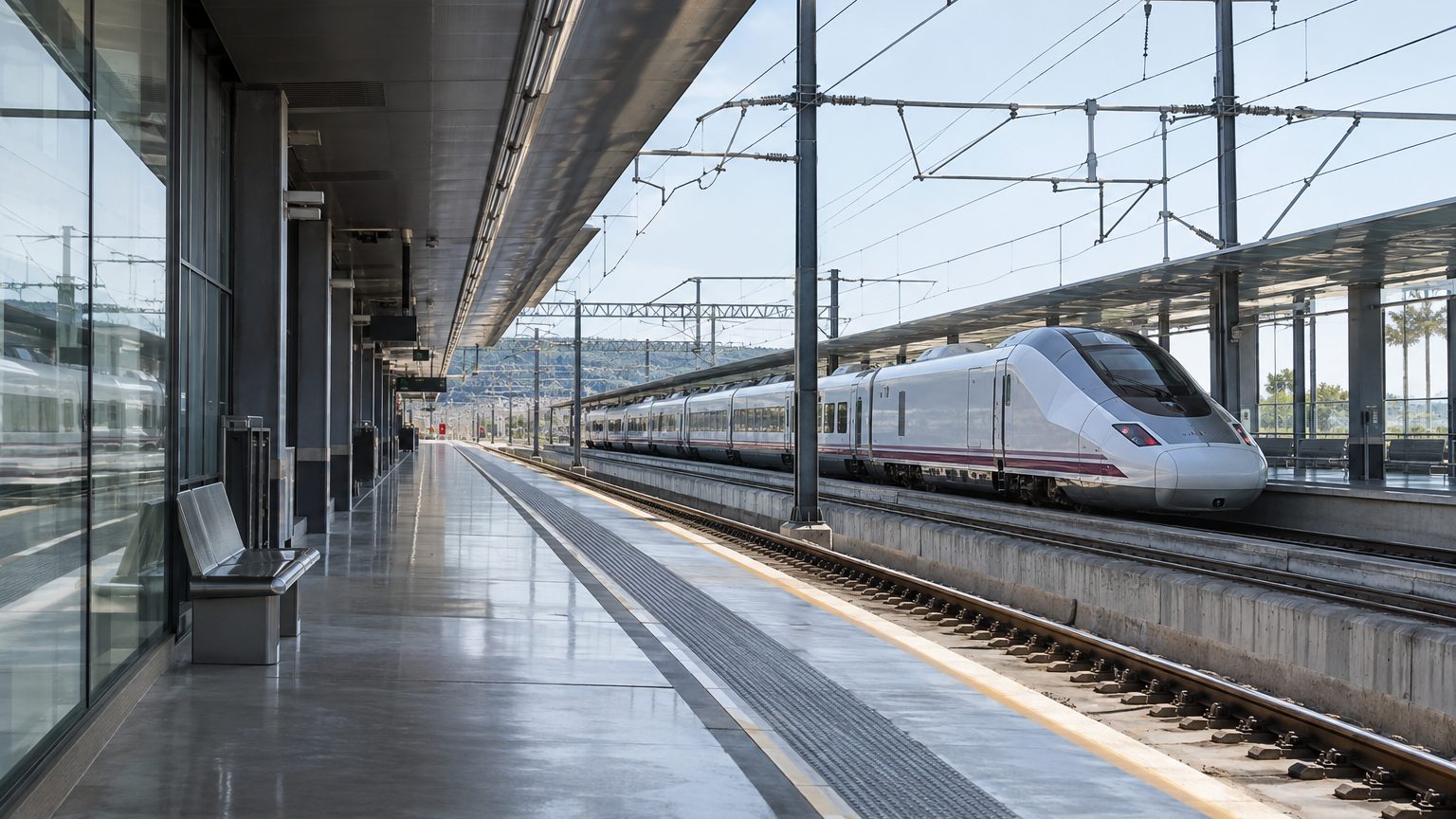
Nine travelers per day. That was the figure that sounded the death knell for a Spanish high-speed line, barely six months after its inauguration.
On December 19, 2010, Renfe launched three daily round trips linking Toledo to Albacete and Cuenca, on the new tracks of the Madrid-Levante corridor. The idea looked appealing on paper: to connect directly these Castile-La Mancha towns without passing through Madrid, relying on an entirely new, high-speed infrastructure. Six months later, Renfe’s Director of Passenger Services, Enrique Urkijo, announced the outright cancellation of the service as of July 1, 2011.
The trains were running almost empty.
- The Toledo-Albacete AVE line carried only nine travelers per day during its six months of operation.
- Operations cost €3.2 million for about 2,796 users in total, i.e., more than the price of a Madrid-New York round-trip ticket per passenger.
- This line represents a symptom of the 2008-2010 Spanish bubble where the country built infrastructure first, without verifying actual demand.
A numerical disaster laid bare
Renfe’s figures released at a press conference on June 28, 2011 tell an unequivocal story. While the Toledo-Madrid AVE line ran at full capacity, the Toledo-Albacete connection registered only nine travelers per day, and the link to Cuenca merely seven, for an overall occupancy rate of 4.7%. A high-speed train, capable of accommodating more than two hundred passengers, thus operated for the equivalent of a minibus’s worth of patrons.
Over the entire period of operation, the service carried roughly 2,796 users in six months, while it cost the company 18,000 euros per day. Do the math: more than 3.2 million euros sunk into transporting fewer than three thousand travelers, a cost that far exceeded the price of a Madrid-New York round-trip airline ticket per passenger carried. The Spanish press did not hesitate to highlight this at the time, with newspapers such as El País and El Mundo portraying this ghost train as a textbook case.
Renfe justified the opening of this service by pointing to real local demand. The route had been created in response to requests from the mayors of the municipalities, who stood to benefit from this infrastructure. The mismatch between political promises and the train’s actual utilization proved fatal.
The symbol of a Spain that overreached
This line did not emerge from a random whim. It fits into a period when Spain, buoyed by years of growth financed through debt, pursued grand-scale infrastructure projects without always verifying their economic viability. The high-speed network in Spain today ranks among the most extensive in Europe, yet some branches were built before demand accompanied them.
The parallel with ghost airports of the same era, such as Ciudad Real, which drew almost no commercial traffic, is striking. In both cases, massive public investments funded infrastructures that nearly no one used on a daily basis. The late-2000s real estate and financial bubble in Spain was also a bubble of concrete and rail, where development came first, usage came later.
The Toledo-Cuenca-Albacete journey illustrates a classic trap of grand-scale infrastructure: building a costly line, but operating it without a customer base costs even more as time goes by.
What replaced the service
Renfe chose to refocus the corridor’s mobility around Madrid and Toledo, replacing the direct AVE service with two new Avant connections offered at cheaper fares. Travelers wishing to continue to Cuenca or Albacete would now have to pass through Madrid. Urkijo asserted at the time that this transfer, typically viewed unfavorably by users, was fully justified in this case and should pose no inconvenience. A combined ticket, cheaper than the initial AVE fare, allowed travelers to chain the connections.
This reorganization reflected a straightforward logic for the public operator. An AVE service must be self-financing through ticket sales, unlike other subsidized public service missions. Lacking a sufficient customer base to cover operating costs, the direct line no longer had economic justification.
Today, the Madrid-Levante corridor remains well served, but through different operating patterns that always pass through the capital. The 2011 episode remains in the Spanish railway memory as the most cited example of a high-speed line killed by a lack of passengers, barely six months after it was launched.
Sources: eldiario.es | eleconomista.es
