
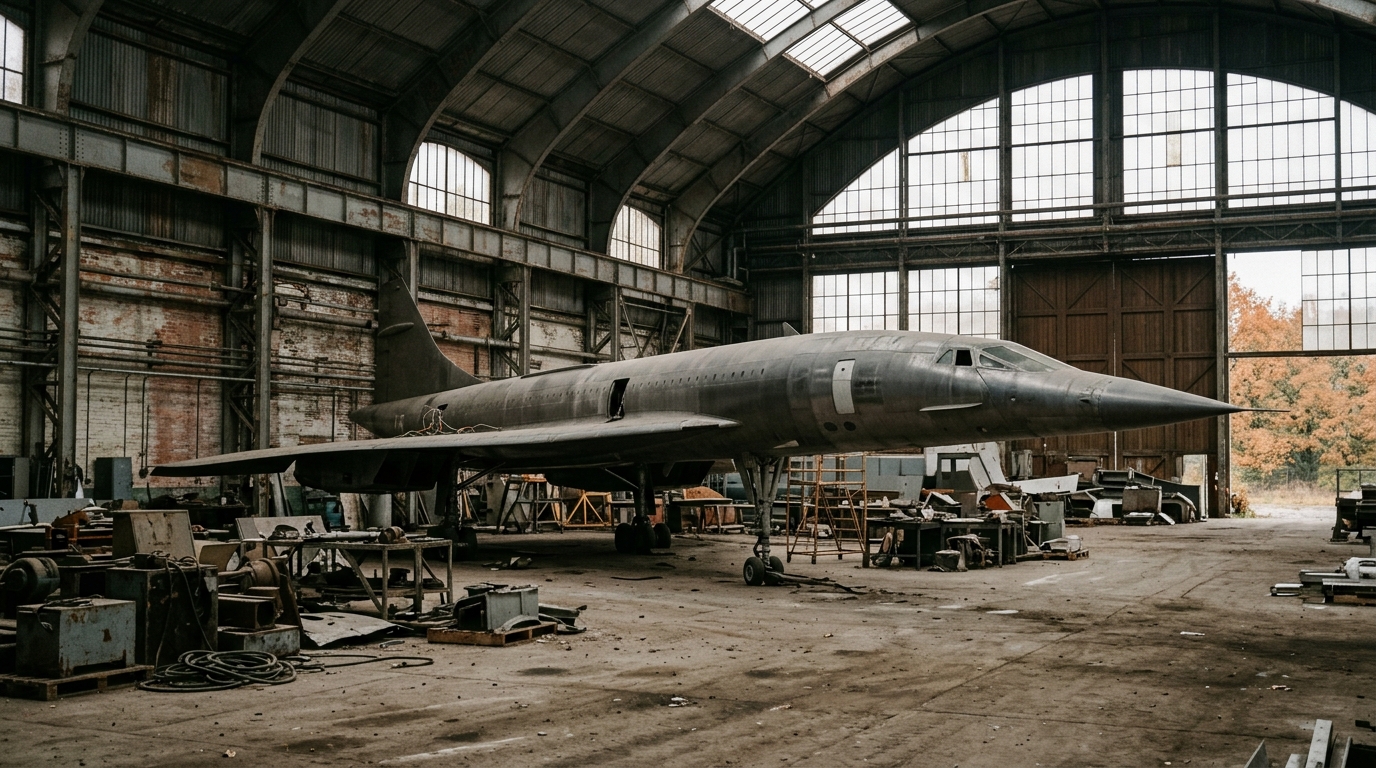
Why would a country capable of building the fastest aircraft of its era choose to stop everything just a few months from the finish line? That question, still puzzling aviation enthusiasts today, is answered by the Miles M.52 story. It is not the tale of a technical failure nor of a project swallowed by runaway costs. It is the story of a political decision, made far from hangars and drafting boards, that cost Britain one of the most symbolic feats of the twentieth century. Let us dive into the behind‑the‑scenes of this secret program, where British ingenuity collided with a wall far more solid than the sonic barrier.
- The Miles M.52, finished to 90%, was cancelled on February 12, 1946 by the Labour government of Attlee for budgetary reasons and skepticism, not technical flaws
- Eighteen months later, American Chuck Yeager broke the sound barrier on the Bell X-1, depriving Britain of the achievement it had pursued since 1943
- In October 1948, a one‑third scale model of the M.52 reached Mach 1.38 in stable flight, proving the British design would have worked
- An engineering masterpiece no one wanted to see fly
- The real obstacle: a deal signed far from the engineers
- When the Americans took the lead thanks to British plans
- What the history of the M.52 reveals about the choices shaping aviation
An aircraft almost ready, a mystery still unsolved. In 1946, a British fighter was 90% complete and promised to break the sound barrier before anyone else. It never flew. What stopped it wasn’t a design flaw, nor a lack of funding.
An Engineering Masterpiece No One Wanted to See Fly
It all began in December 1943, in the thick of World War II. The British government awarded an ultra‑confidential contract, reference E.24/43, to Miles Aircraft. The stated objective sounded almost like science fiction for the era: to build the first piloted jet aircraft capable of reaching 1,000 miles per hour, roughly Mach 1.5. The engine, meanwhile, was entrusted to Frank Whittle, Britain’s pioneer of the turbojet, whose work would feed a large part of modern aviation.
The problem was that, at the time, no one really knew what a supersonic flight would look like. Miles’ engineers had to innovate in the void, lacking any reliable aerodynamic data for objects flying faster than sound. Their only tangible resource, somewhat ironically, came from wind-tunnel tests conducted by the weapons research department, using studies on ammunition and shells. It was by observing ballistic projectiles that the distinctive silhouette of the M.52 emerged: a bulging fuselage, extremely slender wings, and above all a single‑piece tailfin, whose entire horizontal tail surface pivoted as one block. This breakthrough, entirely unprecedented at the time, would later prove crucial for maintaining control of an aircraft as it approached the sound barrier.
Another bold detail: an ejectable forward cone in which the pilot sat inside a pressurized, detachable nose cone in case of emergency. A radical solution, designed for a flight whose unknowns were daunting. And progress was rapid. By early 1946, 90% of the detailed design work was finished, component assembly advanced well, tooling was manufactured, and the first flight was hoped for the following summer. In February of the same year, test pilot Eric Brown was officially confirmed to fly the aircraft, with supersonic tests scheduled for October. Everything seemed aligned for a historic success.
The Real Obstacle: An Agreement Signed Far From the Engineers
And yet, everything was abruptly halted. On February 12, 1946, the order came: Miles Aircraft must immediately stop production of the M.52. There was no major technical flaw, no accident, no scientific dead end to justify the decision. The reason lay elsewhere, and it was squarely political. The new Labour government of Clement Attlee, in power after the war, decided to end the program. Officially, two motives were given: budgetary reasons, at a time when national priority was rebuilding the economy and society, and a certain skepticism among ministry officials about the feasibility, and especially the safety, of piloted supersonic flight.
The government then chose to redirect research toward uncrewed, radio‑controlled scale models, deemed less risky and less expensive than a full prototype with a pilot aboard. A prudent choice on paper, but one that would deprive Britain of an achievement it could have accomplished. The matter remained secret for several more months. It was not until September 1946 that the very existence of the M.52 project was revealed to the public, triggering a wave of criticism and urgent calls for an official explanation of the cancellation as sudden as it was inexplicable.
From a strictly financial standpoint, the budget argument doesn’t quite hold. By some estimates, the project had already swallowed around 75,000 pounds, a substantial sum for the time, but another 250,000 pounds would have been required to bring it to the flight-test stage. A significant additional investment, to be sure, but far from out of reach for a nation that had just financed a colossal war effort for six long years.
When the Americans Took the Lead Using British Plans
Eighteen months later, aviation history swung decisively. It was an American pilot, Chuck Yeager, who became the first human to break the sound barrier, aboard the Bell X-1, a rocket-powered aircraft. The honor Britain had pursued since 1943 thus escaped it forever. A paradox, given that the Bell X-1 had a movable horizontal stabilizer, not the single‑piece tailplane conceived by Miles for the M.52, born from British studies on armaments.
But the story doesn’t completely end there for the M.52. In October 1948, a one‑third scale model of the aircraft, rocket‑powered, was released from a Mosquito bomber flying at over 10,000 meters. This miniature version reached Mach 1.38, about 911 mph, in stable, horizontal flight. This late test delivered a resounding proof: the aerodynamics designed by Miles’ teams were valid, and the M.52 would very likely have breached the sound barrier well before the American aircraft, if the project had not been halted two years earlier.
What the History of the M.52 Reveals About the Choices Shaping Aviation
The fate of the Miles M.52 goes far beyond the tale of an unfinished aircraft. It illustrates how major technological advances depend not only on engineers’ skill or budget strength, but also on the confidence placed by those with decision‑making power. Here, it wasn’t a misresolved aerodynamic equation that doomed the project, but a political climate wary of a technology deemed too uncertain, at a moment when the country also had to heal the wounds of war.
This story still resonates today, in a context where many ambitious programs—whether in aerospace or other cutting‑edge sectors—are sometimes slowed by considerations unrelated to technical feasibility. The M.52 reminds us that an innovation can be ready, brilliant, nearly complete, and yet be sacrificed on the altar of strategic choices made elsewhere, far from wind tunnels and drafting boards.
One question remains that continues to fuel debates among aviation history enthusiasts: how many other equally promising projects disappear into oblivion today, not because they don’t work, but simply because someone, somewhere, decided it was better not to risk believing in them?
