
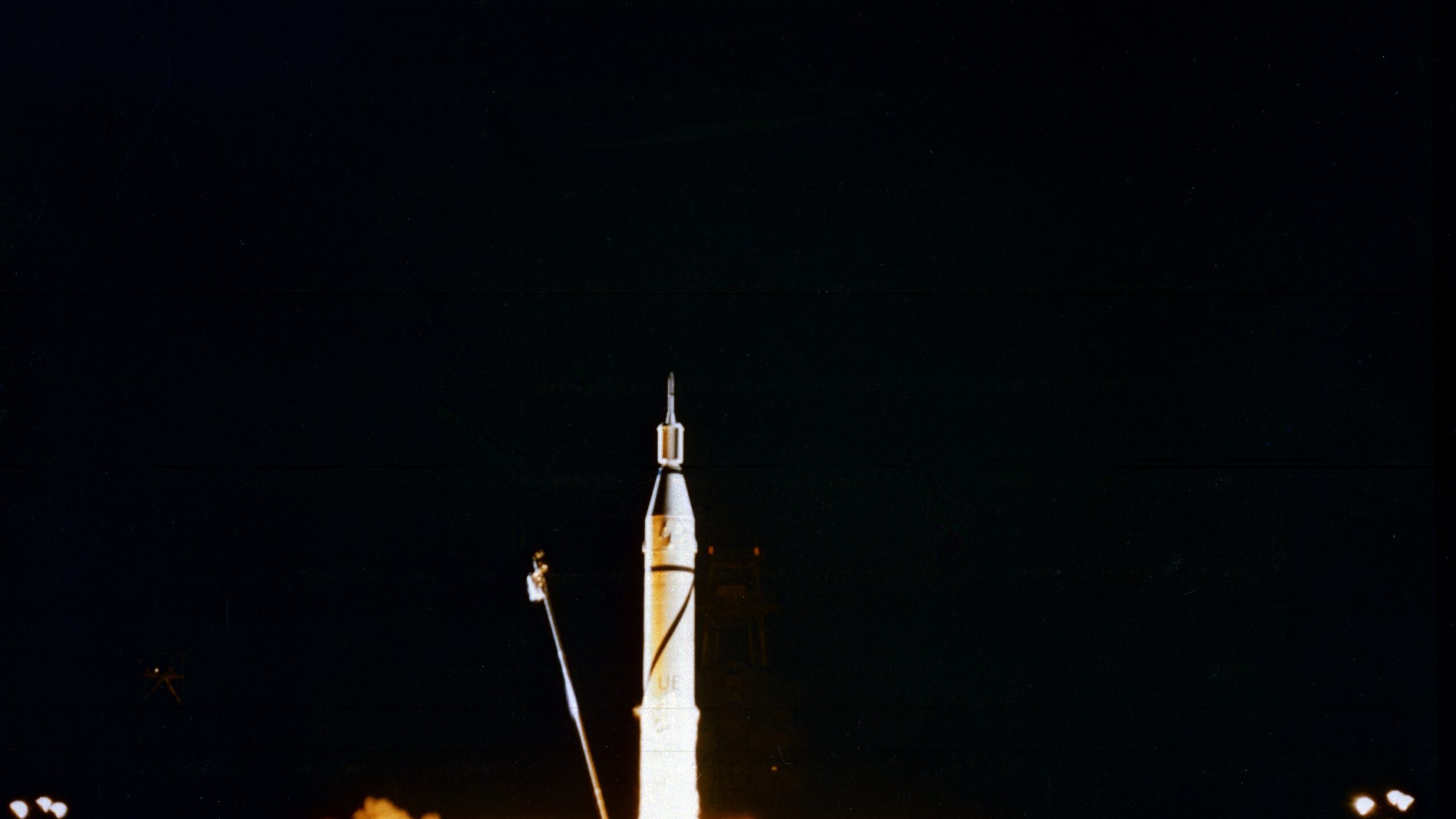
Since May 1964, Vanguard 1 has not received the slightest signal. Yet, this grapefruit-sized metal sphere, in this month of July 2026, continues to complete an orbit around the Earth every 133 minutes. Launched on March 17, 1958 from Cape Canaveral, this object is today the oldest human-made artifact still present in space, a status that even the Soviet pioneers of Sputnik failed to maintain.
The story begins in the rush of the early space race. Two months after Explorer 1, the first American satellite, the Naval Research Laboratory placed in orbit this small device designed originally to test the capabilities of a three-stage launcher. The satellite, with a diameter of only 16.5 centimeters and weighing 1.47 kilograms, was intended to test the launch capacity of a three-stage vehicle, within the framework of the International Geophysical Year scientific efforts. Not a jewel of technology: no camera, no propulsion, no onboard computer. Just two radio transmitters and temperature sensors, powered by two distinct energy sources.
Key takeaways
- A satellite launched before Sputnik that should continue to orbit until the end of the 22nd century
- The first solar-powered cell in space history, born from a failing battery
- A secret mission to bring it back posed dizzying technical challenges
A battery that failed in twenty days, solar cells that lasted seven years
That is where Vanguard 1 enters the pages of technical history. The mercury battery intended to power one transmitter died in record time: the old satellite operated for about seven years thanks to its solar cells, while the conventional batteries powering the other transmitter lasted only 20 days. A technical setback that turned into a scientific triumph: Vanguard 1 effectively became the very first satellite powered by solar energy, opening the way to an entire generation of space vehicles.
That second transmitter, meanwhile, held on for nearly six years. The solar-powered transmitter continued operating until May 1964, when the last signal was received by a tracking station in Quito, Ecuador. Since that day, total radio silence. But the absence of signal does not mean the absence of trace: radar and optical observations allow us to determine the orbit of an object even when no equipment on board is functioning. We know exactly where this metallic phantom is, minute by minute, for more than six decades without it ever uttering a word.
Why it obstinately refuses to fall back
A single number suffices to understand its astonishing longevity: its orbit reaches nearly 4,000 kilometers in altitude. Vanguard 1 occupies an elliptical orbit of 654 x 3,969 kilometers, with an inclination of 34.25 degrees. Unlike its contemporaries launched around the same era, stuck in low Earth orbit and quickly slowed by the outer layers of the atmosphere, this satellite spends most of its time well above that friction zone. The result: the satellite has endured so long thanks to its highly elliptical orbit, unlike the Soviet Sputniks and the American Explorer 1, which fell to Earth within months or a few years.
How much longer will it continue to rotate this way? The answer verges on the absurd given the timescale that exceeds a human life. NASA published an estimated orbital lifetime of about 240 years from launch, which would place reentry toward the end of the 22nd century. This little object, silent since the early days of the Beatles, could thus keep spinning for another century and a half after all of us are gone.
The crazy bet to go retrieve it
That is where the story takes an unexpected turn. A team of engineers from Booz Allen Hamilton, led by space analyst Matt Bille, presented in early 2025 a detailed study outlining practical options to inspect, and potentially retrieve, this Cold War relic of space. A team comprising aerospace engineers, historians and writers proposed retrieving Vanguard 1, a 67-year-old satellite, from its orbit. The stated objective is not merely museum-worthy: it is to study how materials behave after nearly seven decades of exposure to the vacuum of space, micrometeoroids, and radiation. As Bille himself explains, the researchers are interested in the condition of the solar cells, the batteries and the metals, as well as documenting the impacts of micrometeoroids or debris over such a long period.
The planned approach unfolds in two stages. The initial phase would send an inspection vessel to assess Vanguard 1’s condition, estimating any damage from debris and its current structural integrity. Then comes the trickiest part: the actual capture. Two options are on the table, either maneuver Vanguard 1 into a lower orbit for easier access, or bring it back safely to the International Space Station. But the technical challenge is substantial. The antennas, the only visible grabbing points on the object, are considered too fragile to be used as a handle, and the satellite’s body itself lacks any docking mechanism or convenient grasping point. Add to that a spacecraft stabilized by rotation which, after six decades without control, could be spinning chaotically, and one understands why no one has attempted the operation yet.
The authors themselves emphasize that this proposal remains, for now, a thought experiment in technical terms and not an officially funded project. That said: if the mission ever came to fruition, it would make Vanguard 1 the oldest satellite ever placed in orbit. It would also set the record for the oldest object ever returned to Earth, a record with no possible competitor. In the meantime, the small sphere continues its silent circuit, 190 kilometers above the International Space Station at its lowest point, as if nothing were happening.
Sources : spacedaily.com | orbitalradar.com
