
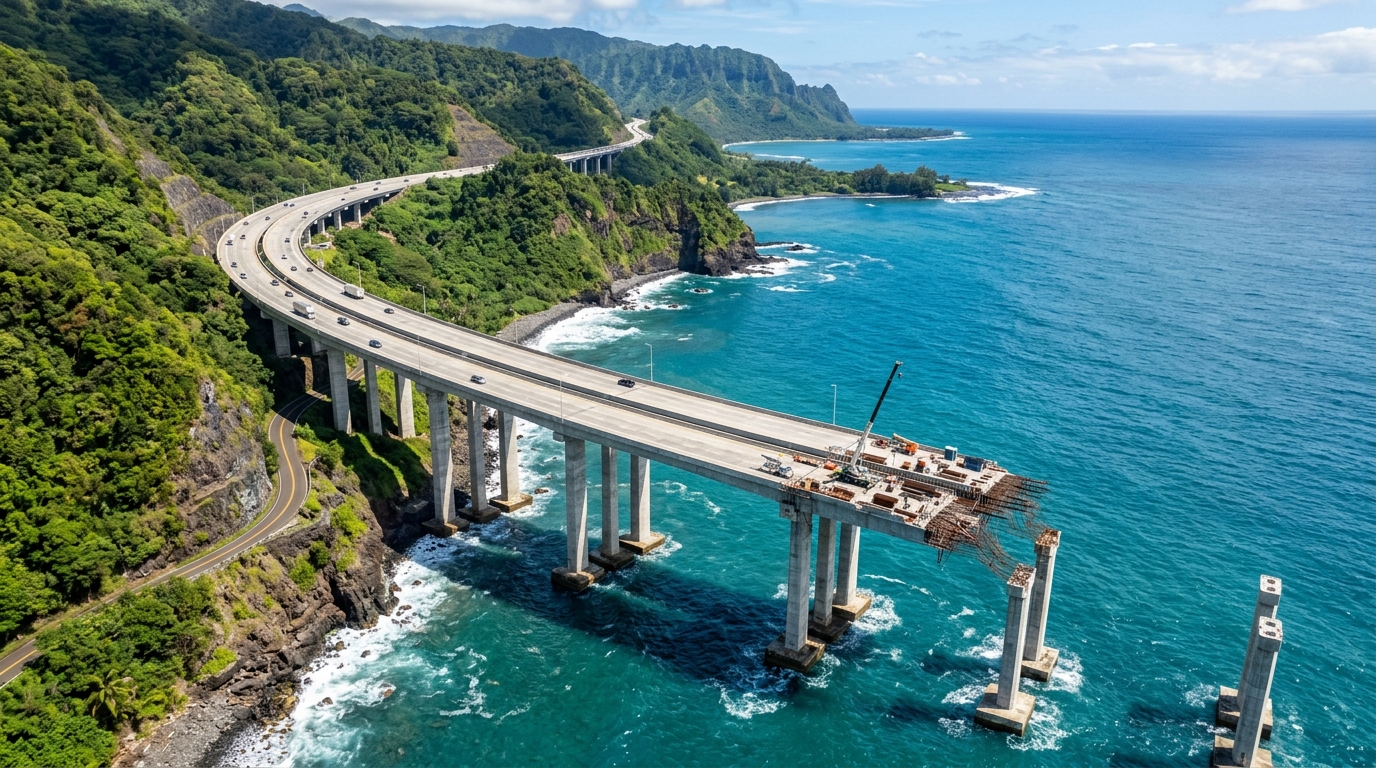
A single figure, on its own, sums up thirteen years of an extraordinary project: 1.6 billion euros. This was the estimate adopted in 2010 by the Matignon II agreements to build one of the most ambitious roads ever constructed in France, with the viaduct works starting in late 2013. Today, as autumn settles in and the final budget approaches 2.5 billion euros, the Nouvelle Route du Littoral remains a sea serpent, in both literal and figurative senses. Between viaducts suspended above the waves and a breakwater that was simply abandoned along the way, a look back at a file that provokes as much as it fascinates.
Key takeaways
- The budget for the Nouvelle Route du Littoral has risen from 1.6 billion euros set in 2010 to around 2.5 billion euros today, i.e., more than 195 million euros per kilometer.
- The lack of a local quarry supplying the rocks needed for the breakwater ultimately forced the Region to abandon it altogether, in favor of a second viaduct whose construction is slated to begin in 2027.
- A 2022 report from the regional chamber of accounts estimated the final cost of the project at 2.5 billion euros, compared with 1.6 billion planned at the start of the 2010 agreements.
Table of contents
- A 1.6‑billion‑euro road that leads nowhere
- Why building here already looked like an impossible challenge
- Viaduct on hold: the breakwater that sank the schedule
- Thirteen years, billions, and a question that remains unanswered
A 1.6‑billion‑euro road that leads nowhere
Decided by the Matignon II accords signed on October 14, 2010, between the State and the Réunion Region, the Nouvelle Route du Littoral (NRL) was meant to embody the definitive solution to a problem that had persisted for decades. The objective, on paper, seemed straightforward: replace a dangerous coastal route, regularly closed due to rockfalls, with a modern and safe infrastructure. The initial budget, fixed at 1.6 billion euros, was supposed to allow completion between 2017 and 2020. The viaduct works, the first tangible section of the project, did not formally begin until the end of December 2013.
Thirteen years later, the reality is quite different. The final cost now approaches 2.5 billion euros according to the regional chamber of accounts, an amount that makes this road one of the most expensive ever built, with a cost exceeding 195 million euros per kilometer. Part of the viaduct did open to traffic in March 2023, but the infrastructure remains, to this day, unfinished.
Why building here already counted as an impossible challenge
To understand the scale of the project, one must look at the island’s peculiar geography. The route, 12.7 kilometers long between Saint-Denis and La Possession, had to move away from an unstable cliff, a real Damocles sword for motorists using the old road, in service since 1976 and responsible for around twenty deaths from rockfalls. The chosen solution: build part of the roadway directly over the sea, between breakwater and viaduct.
But constructing a road on the ocean demands phenomenal quantities of massive rocks, essential for erecting breakwaters capable of withstanding the swell. Yet Réunion has no quarry exploiting this material. This geological paradox significantly slowed progress, to the point where legal challenges led the Council of State to halt the exploitation of the local quarries eyed to supply the project.
Viaduct on hold: the breakwater that sank the schedule
It was precisely this rock-supply problem that derailed the initial schedule — and ultimately brought down the breakwater project itself. After years of gridlock, the Region decided: the stretch of breakwater planned between Grande Chaloupe and La Possession will never see the light of day. It will be entirely replaced by a second viaduct, whose construction is set to begin in 2027.
This new plan pushes the overall completion of the project to 2030, with progressive openings from 2026 onward, according to the Region’s official communication published in December 2025. A ten-year slip compared with the original timetable, which has seen the project change its nature mid-course: what was meant to be a stone wall became, for lack of stone, an additional bridge.
Thirteen years, billions, and a question that remains unanswered
Beyond the financial drift, a report by the Regional Audit Court of Réunion and Mayotte, published in December 2022, raised concerns about another aspect of the dossier: the environment. The document estimated the final cost of the project at 2.5 billion euros, versus 1.6 billion planned at the outset of the 2010 agreements, while pointing to gaps in the environmental compensation measures planned for a route that runs along Réunion’s National Park, a UNESCO World Heritage site.
So, as of this fall 2026, where does this colossal project truly stand? The road exists partially, motorists already use it on certain stretches, but the project as a whole remains a suspended promise — reformulated along the way, a breakwater turned into a viaduct, a ten-year schedule shift, yet still kept.
Sources: Région Réunion — official chantier magazine, December 2025 | IEDOM La Réunion 2020 annual report
