
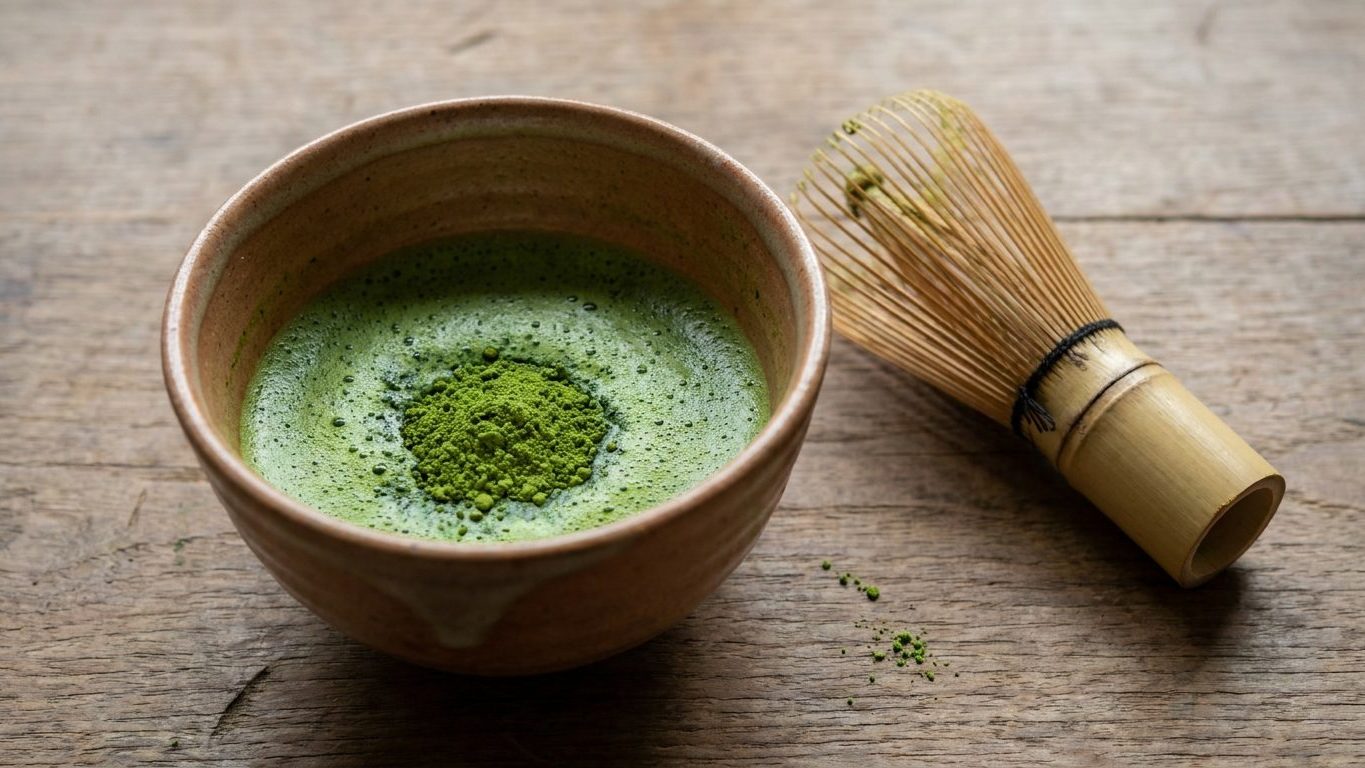
A bright green color, an umami scent, and a reputation as a superfood. Matcha has captured coffee shops and social networks over the past three years. But UFC-Que Choisir has just tarnished this image by revealing, on September 24, 2026, that seven tested matcha references all contain aluminum, and that four of them far exceed the reference value set by Anses, reaching almost four times that threshold in the very first cup of the day.
- Four matchas out of seven exceed four times the French aluminum threshold in the first cup
- Matcha fully absorbs aluminum from the leaves, unlike brewed green tea where the metal stays at the bottom
- No product is illegal because the European Union has not set a maximum limit for aluminum in foods
A test that shakes up the entire category
To verify the legitimacy of its health drink reputation, Que Choisir analyzed seven references at various price points and quality levels, and the results are alarming: all are contaminated with aluminum, and some exceed the recommended thresholds. No brand escapes contamination. The most striking finding is captured in a phrase published by the association: “Almost four times the reference value in a single cup! This shows how some of the matchas tested by Que Choisir are contaminated with aluminum.”
This exceedance is measured against a precise standard. In 2025, Anses set an acceptable daily intake (ADI) of 40 micrograms per kilogram of body weight per day, calculated for a 70-kg person drinking one cup per day. This limit is markedly stricter than the European standard: EFSA, the European Food Safety Authority, has, since 2008, established a toxicological reference value of 143 micrograms of aluminum per kilogram of body weight per day, i.e., 3.5 times more permissive. Compared with the European threshold, the finding would be much less severe: it is indeed the rigor of the French standard that brings the problem to light.
The national figure is even more striking. Yet 39% of adults exceed it, according to the Total Diet Study (EAT) aiming to monitor the population’s exposure to chemical substances present in foods, published in 2026. Anses does not minimize the issue. The agency even mentions “a risk related to this exposure” and calls to “continue efforts to reduce aluminum concentrations.”
Why matcha and not classic green tea
A green tea infusion. No particular concern. This is where the paradox raised by Que Choisir lies. While green tea consumption does not pose a problem, matcha can be problematic because aluminum is a metal naturally found in rocks, particularly abundant in volcanic soils where the tea plant grows, in Japan and China. The tea plant has long been identified by scientific literature as a plant that accumulates this metal in its leaves.
The difference lies in preparation, not in the plant itself. Green tea is brewed. Yet aluminum does not dissolve, or dissolves very little, in hot water. The leaves stay at the bottom of the teapot, carrying their metal load. Matcha follows a radically different path: it is consumed in its entirety, made from finely ground tencha leaves, then mixed with hot water in the traditional recipe, or with milk in the trendy latte version, so that the powdered leaves are fully ingested, unlike an infusion.
This mode of total consumption has a downside. If the antioxidants and stimulants contained in the leaves are absorbed in full, so are the contaminants, particularly aluminum. One swallows both virtue and drawback in the same gulp.
Legal, but not harmless
No tested product is outside the law. Despite the health risk, none of the analyzed products violates regulations, and for good reason, the European Union has not defined a regulatory maximum for aluminum in foods and beverages. A legal vacuum that leaves manufacturers free as long as no numerical ceiling exists for this specific metal.
Aluminum is not a trivial contaminant. It is a neurotoxic metal in case of chronic high exposure, a point Que Choisir emphasizes in its investigation. The danger does not come from a single cup, but from accumulation day after day, week after week, among regular drinkers.
Price does not guarantee anything. The association notes that the cheapest products perform worst on most criteria, and that not all test references are equal. Paying more does not automatically shield against high aluminum content, but entry-level products tend to concentrate the worst results.
A market in full explosive growth
The timing of this alert is not neutral. Matcha has been experiencing explosive growth since 2023. Sales of this famous green blend were multiplied by five between summer 2023 and summer 2024, a period when it began flooding social networks, and the market should rise by as much as 53% by 2029, according to The Economist. More consumers, more daily cups, more cumulative exposure.
Que Choisir does not recommend stopping abruptly. The association instead urges moderation, especially for regular enthusiasts. It would be time for fans to ease off on matcha lattes or matcha cookies. Vigilance should not be limited to the morning cup: biscuits, flavored plant milks, iced teas, and matcha sodas deserve the same attention, as they add their own dose to the daily total without necessarily being on people’s radar.
Bread, biscuits, pastries, and pasta remain the top contributors to overall aluminum exposure in France, according to Anses’ Total Diet Study. Matcha is therefore only one piece of the puzzle, but a new and poorly identified piece that adds to a burden that is by no means negligible for nearly four adults out of ten.
Sources: ncbi.nlm.nih.gov | assemblee-nationale.fr | fr.headtopics.com
