
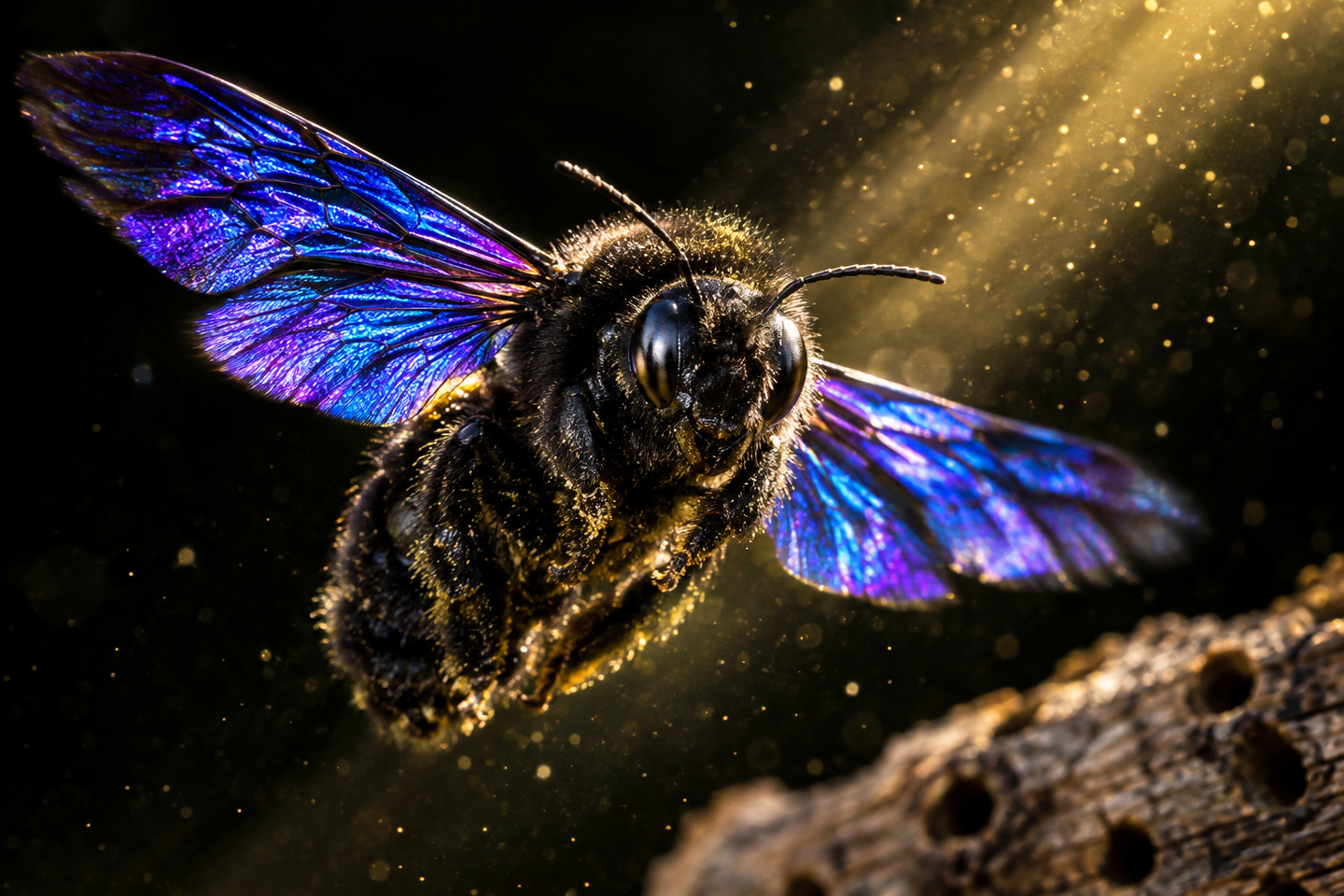
It measures three centimeters in length, bears a deep black coat with a blue-tinged iridescence, and its heavy, noisy flight can startle first-time onlookers. Yet this striking bee that forages in the gardens of Essonne as soon as good weather returns is no threat. Behind its appearance of a giant bumblebee lies a solitary, peaceful creature, and remarkably loyal to its own patch of nature.
- The violet carpenter bee, France’s largest solitary bee (up to 3 cm), defends no colony and only stings when directly provoked.
- It digs galleries in dead wood to rear its larvae, never feeding on the wood itself, and remains lifelong faithful to its birthplace territory.
- Active from spring, it plays an essential pollinator role for garden biodiversity.
- A size that impresses, a behavior that stands out
- Why it never has a colony to defend
- Dead wood, its refuge and pantry
- A discreet but essential pollinator for the garden
- What to remember about this Essonne’s solitary bee
A Size That Impresses, a Behavior That Stands Out
Hard to miss. The violet carpenter bee, scientifically named Xylocopa violacea, holds the title of the largest solitary bee in the French fauna. Its compact, hairy black body can reach 30 millimeters in length, and when it unfolds its dark wings with a bluish sheen, its wingspan can reach 50 millimeters. In other words, at first glance it has plenty to surprise gardeners who spot it whirling around an old stack of wood or a blooming wisteria.
This outsized frame, combined with a buzzing, sometimes erratic flight, has long fed a reputation that is not deserved. Behind the robust appearance of a heavy bumblebee lies a relatively placid insect. Field observations, notably in Île-de-France where it has been photographed in the Yvelines and in several francilian gardens, confirm its non-aggressive behavior. It attends to its activities, indifferent to human presence, unless someone truly attempts to upset it.
Why It Never Has a Colony to Defend
The key to its tranquil temperament is a single word: solitude. Unlike domestic bees that live in structured colonies with a queen to defend at all costs, the violet carpenter bee leads an independent life. Each female builds and manages her own nest, tending her brood on her own, never relying on a collective to defend. And it is precisely this instinct for collective defense that makes some social species quick to sting at the slightest disturbance.
Without a queen or a hive to guard, the carpenter bee simply has no reason to attack. Its sting, though real and painful, is extremely rare and only occurs if directly provoked, such as when you grab it or block its path. It even happens that several females share a single piece of dead wood, each managing her own galleries without ever clashing with neighboring females. A peaceful cohabitation that contrasts with the belligerent image often associated with large flying insects.
Dead Wood, Its Refuge and Pantry
Its name betrays its way of life. Xylocopos, from the Greek xylocopos, literally means “one who cuts wood”. A fitting label since this bee spends much of its energy carving galleries in dead wood—be it an old beam, a stump, or a neglected branch left in a garden corner. Contrary to what one might imagine, it does not feed on the wood itself: the material merely provides the structure for its future larvae.
These galleries, often parallel and interconnected, can reach up to 30 centimeters in length, even though they have a single, discreet entrance. This entrance is closed off by a small ball that resembles a cotton snowflake, a natural seal guarding the brood from the weather and from predators. This detail explains why gardens that retain some dead wood, rather than cleaning everything away, offer a valuable habitat for this bee seeking a stable refuge to raise its offspring.
Notably, this species remains surprisingly attached to its birthplace territory. During its life, a female typically constructs only one to three nests, almost always near where she was born. This fidelity speaks volumes about the importance of preserving dead-wood zones in our gardens, true cradles for several successive generations.
A Discreet but Essential Pollinator for the Garden
Beyond its role as a builder, the violet carpenter bee provides a precious service to local biodiversity. While feeding on nectar and pollen, it actively contributes to the pollination of garden plants, on par with domestic bees and bumblebees. Active from early spring, it capitalizes on every bloom to refuel, moving from flower to flower with a vigor that belies its bulky appearance.
In this autumn period, as Essonne gardens take on gentler hues and insect activity gradually slows, the galleries carved by these bees over the months remain visible in old trunks and forgotten piles of wood. A subtle trace of an entire life cycle that has paced the garden since the return of the sunny days, reminding us that nature continues its quiet work even as summer colors fade.
What to Remember About This Essonne’s Solitary Bee
In short, this black bee with blue-tinged highlights, impressive in size, actually hides a peaceful, solitary lifestyle. Here are the essential points to keep in mind:
- A record size for a French solitary bee, up to 3 centimeters long
- A non-aggressive behavior, with no colony to defend
- Galleries carved in dead wood, never feeding on it
- A rare sting, reserved for direct provocation
- A pollinator role beneficial to garden biodiversity
- A marked fidelity to its birthplace territory
What ultimately strikes about the violet carpenter bee is the gap between the impression it gives and the reality of its behavior. One might instinctively fear it because of its size and buzzing flight, yet it is indeed a discreet ally for our gardens. So, the next time a black, massive silhouette hums near a forgotten heap of wood, perhaps it’s wiser to observe with curiosity rather than fear, remembering that nature often reserves its loveliest surprises for those who take the time to look closer.
