
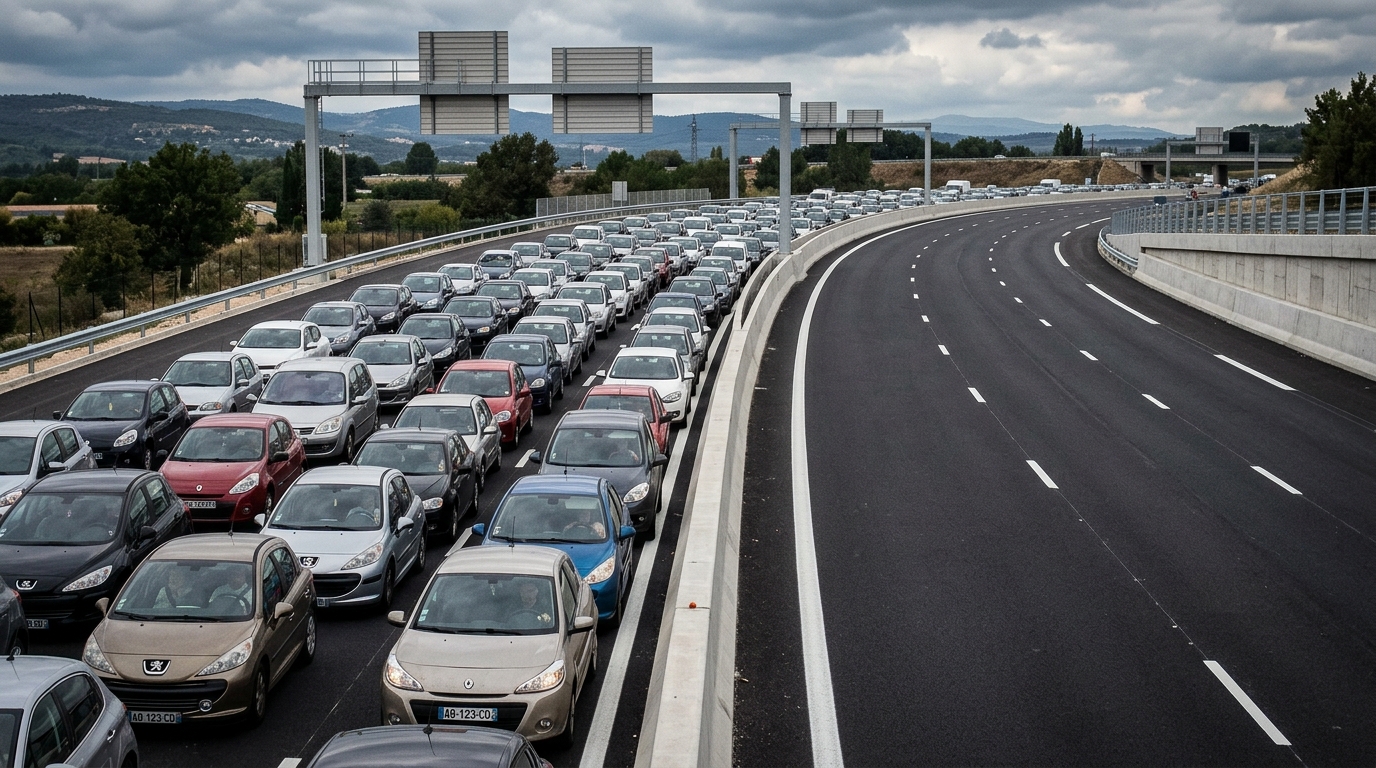
Imagine deciding to build a second entry door at your home to relieve the flow around the living-room door, yet everyone keeps using the old one because it leads straight to the kitchen. That’s a little like the West Bypass of Strasbourg, this brand-new highway supposed to draw in the streams of cars choking the Alsatian urban area for decades. On paper, the plan seemed crystal clear: construct a new main route, trucks and through-traffic would utilize it, and the city would finally breathe. In practice, those who traverse Strasbourg during peak hours know full well that the traffic jams have not exactly vanished into thin air. So, where have these 700 million euros invested in asphalt gone, and why does the promise of smoother traffic today resemble a mirage?
- The A355 (GCO), inaugurated in 2021 for 700 million euros, was meant to divert traffic from the A35 but has reduced only heavy vehicle traffic, roughly 5,000 per day.
- The configuration of the northern interchange, different from the initial project, directly links the A4 to the A355 and has generated induced traffic, with an estimated increase in usage between 16 and 20% since 2023-2024.
- Urban congestion on the old A35 (M35) persists because it is largely due to local or interchange traffic, which the bypass cannot absorb.
- A 700-million-euro bypass intended to save Strasbourg from traffic jams
- The great misunderstanding: why a new highway never emptied the old routes
- The numbers that trouble: what traffic counters reveal since 2021
- Strasbourg is not an isolated case: the phantom promise of road bypasses
- What the failure of the west bypass teaches about mistakes not to repeat
Un contournement à 700 millions d’euros censé sauver Strasbourg des embouteillages
The A355 (GCO), commonly known as the Grand Contournement Ouest, stretches over 24 kilometers from Innenheim in the south to Vendenheim in the north, with a speed limit capped at 110 km/h. Inaugurated in December 2021 after years of legal disputes and on-the-ground mobilization, this infrastructure was meant to mark a turning point for the entire Strasbourg metropolitan area. The idea was simple, almost obvious: divert a substantial share of the traffic that was saturating the old A35, this urban axis crossing the city from north to south and capable of absorbing up to 165,000 vehicles per day before the new route opened.
According to projections released at the time by VINCI Autoroutes, the operator of the project, the bypass was expected to take in between 40 and 50% of the trucks traveling on the A35, with an accompanying anticipated 25% reduction in pollutant emissions such as carbon dioxide, nitrogen oxides, or fine particles. A project marketed as both a road and environmental solution, able to reconcile traffic fluidity with air quality for nearby residents.
Le grand malentendu : pourquoi une autoroute neuve n’a jamais vidé les routes anciennes
The reasoning behind the GCO rested on a common assumption in road planning: create a new route and it will relieve the old one. But this logic neglects a well-identified phenomenon in urban mobility studies, the induced traffic. In plain terms, an additional infrastructure does not simply absorb existing flow; it often generates a new one, making certain trips more attractive or altering travel habits.
In Strasbourg’s case, a technical detail weighed heavily on the final outcome. Contrary to the plan presented during the public inquiry, the configuration of the northern interchange creates a direct continuity between the A4 and the A355. Practically, a motorist coming from Paris is now naturally guided toward the bypass, without even having to think about the route, while to reach the city center, they must take a specific ramp. This seemingly minor detail fostered a much more substantial shift in traffic than anticipated, but not necessarily in the direction hoped to relieve congestion within the city itself.
Les chiffres qui dérangent : ce que révèlent les compteurs de trafic depuis 2021
From the standpoint of international freight transit, the bypass can show a respectable record. About 5,000 trucks now use it daily, which has helped relieve the old A35, renamed M35 and brought back under local management, of a significant portion of its heavy and polluting traffic. On this particular point, the initial objective seems to have been achieved.
But the overall traffic figures are where the problem lies. An article in the Dernières Nouvelles d’Alsace published in January 2024 already noted a 16% traffic increase on the GCO, a figure also given as 20% for 2023 according to counts published at the same time. In other words, the highway did not merely absorb a preexisting flow; it created a new one. Meanwhile, on the M35, traffic studies confirm that the vast majority of the remaining traffic has little to do with long-distance transit. It is mostly local or interchange traffic, home-to-work trips whose origin or final destination lies within Strasbourg itself or its immediate suburbs. For these motorists, the bypass simply does not help, since they will still need to enter the city.
Strasbourg n’est pas un cas isolé : la promesse fantôme des contournements routiers
This scenario is not unique to France or Europe. Many metropolitan areas have bet on a grand highway bypass, hoping to clear their urban arteries of congestion. The result is often the same: a portion of transit traffic does indeed flee to the new infrastructure, but the bulk of urban congestion, driven by daily commuter movements, remains almost unchanged. The reason is structural rather than purely technical: as long as city residents continue to work, study, or shop in the center, they must access it in some way, and no bypass, however well designed, can replace this fundamental need for local movement.
In Strasbourg, the Eurometropolis is aware of this rebound risk. With transit traffic now redirected onto the A355, the M35 could theoretically open up to new, calmer uses. The challenge is precisely to prevent this freed space from attracting new car flows, while promoting alternatives to car-only travel. A delicate balance that requires ambitious mobility policies, far from simply laying down more asphalt.
Ce que l’échec du contournement ouest apprend sur les erreurs à ne plus répéter
The Strasbourg case clearly demonstrates the limits of a purely road-centered approach to territorial planning. Investing 700 million euros in an infrastructure that partially improves environmental conditions by moving polluting trucks away from the city center, while leaving the daily congestion experienced by tens of thousands of residents intact, raises questions about the relevance of mobility-budget priorities.
There are multiple lessons to draw. First, the design of interchanges and ramp connections is never a secondary technical detail; it concretely shapes driving behavior, sometimes in opposition to the objectives stated during public consultations. Second, no road infrastructure can alone solve an urban congestion problem if it is not accompanied by a broader contemplation of public transport, carpooling, or soft mobility. Finally, the phenomenon of induced traffic must be systematically included in projections before launching such projects, rather than being noticed only afterward, once the bulldozers have returned to the shed.
In the end, Strasbourg’s West Bypass did not live up to all its promises. While it did relieve the city of part of its through-traffic of heavy goods vehicles, it never managed to truly unclog the agglomeration, whose daily jams are fed by local trips that the new highway simply cannot absorb. The question remains whether future major French infrastructure projects will draw lessons from this Alsatian experience, or whether other cities are about to invest similarly large sums for a comparable outcome.
