
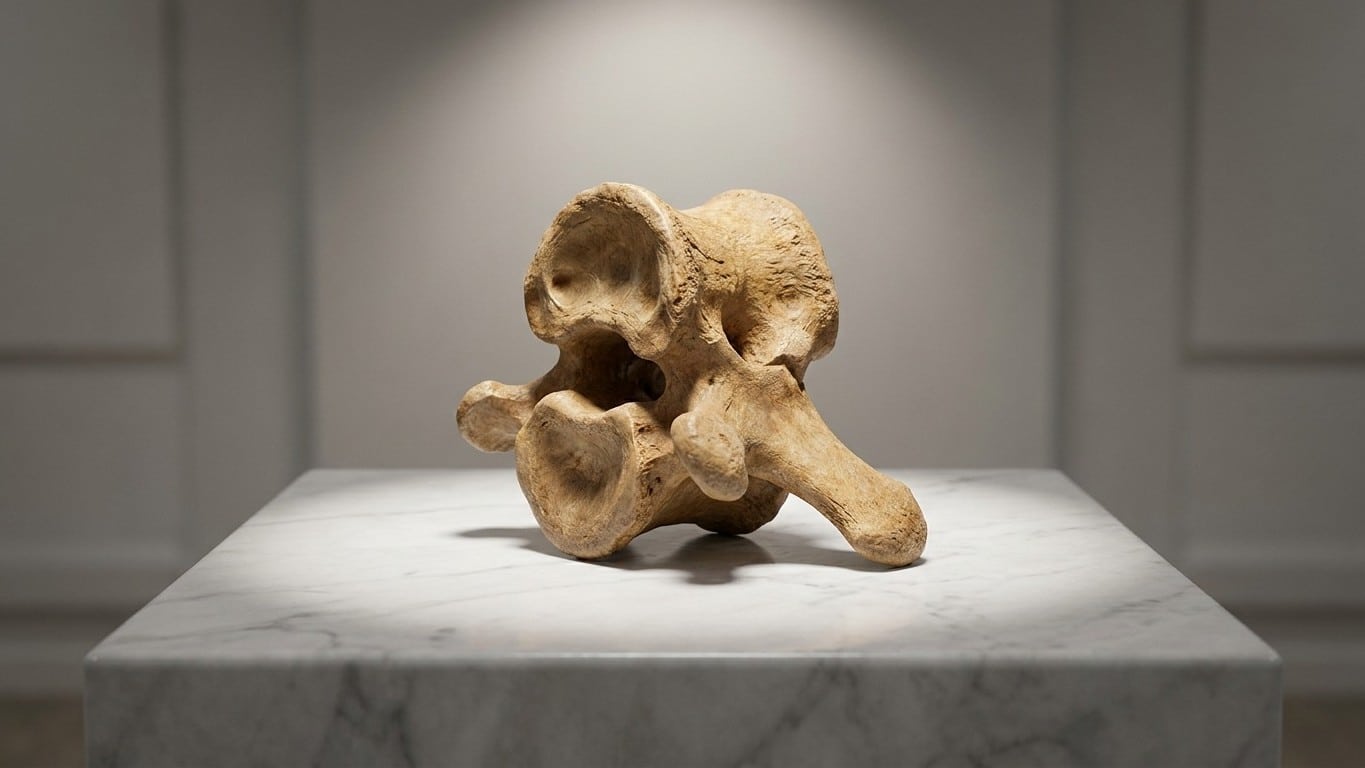
A fragment of a vertebra left in a collection drawer in Cambridge for forty years has just upended what we knew about prehistoric Antarctica. This specimen, a fossilized caudal vertebra aged 82 million years, constitutes the first dinosaur fossil ever found on the southernmost continent, according to a study published on June 29, 2026 in Acta Palaeontologica Polonica. The bone belonged to a titanosaur, one of the most impressive giant herbivores to roam the Earth. Under the eternal ice, millions of years ago, multi-ton creatures wandered peacefully.
Key takeaways
- A bone forgotten for four decades in a museum hides an extraordinary secret about prehistory
- Scientists uncover troubling clues about the movement of giant dinosaurs between continents
- This vertebra completely rewrites the official chronology of Antarctic discoveries
A bone mislabeled from day one
Back in 1985. Two geologists braved the cold of the Antarctic Peninsula to map rock layers on James Ross Island. Over the course of a long summer, British geologist Michael Thomson and German geologist-paleontologist Reinhard Förster explored the rock strata on that island off Antarctica. As they carried out their surveys, they uncovered several fossil traces: invertebrates, plant remains, bony fish scales, and a bone larger than the others. This fossil was unearthed on December 9, 1985 by the two men, though they did not grasp its full significance at the time.
Thomson noted the anomaly in his field notebook, but without particular conviction. He recorded it as the “vertebra of a large reptile,” before it slipped into oblivion for decades. At the time, no one imagined that a dinosaur could have lived on that icy outcrop. The fossil joined the shelves of the British Antarctic Survey, catalogued among thousands of other specimens brought back from polar expeditions. It would stay there, silent, for nearly four decades.
A fresh look, four decades later
The story could have ended there if a paleontologist hadn’t shown the curiosity to reopen old drawers. Mark Evans, who oversees the geological collections at the British Antarctic Survey, recalls that upon spotting this bone in the collections a few years ago, he suspected it was a dinosaur, and after examining it more closely, he thought it was probably a titanosaur caudal vertebra. A simple look, and decades of certainties collapsed.
To confirm his hunch, Evans dug back into the original archives. Consulting Mike Thomson’s field notebooks, he discovered that the geologist already knew it was a large reptile, which makes the subsequent confirmation, forty years on, all the more remarkable. The matter was then handed to Paul Barrett, a senior researcher at the Natural History Museum in London, whose analyses decisively settled the question. According to him, this fossil, which seems banal at first glance, actually holds an important place in the history of Antarctic exploration as the first dinosaur fossil found on the continent.
The anatomical features do not mislead. The researchers were able to place the animal in the dinosaur family tree based on the bone’s distinctive shape, with a concave notch on one side and a corresponding convex surface on the other, classifying it as a lithostrotian titanosaur. The size estimate remains prudent: the sauropod to which the vertebra belonged would have measured between 6 and 7 meters in length, and it is not possible to determine whether it was a juvenile or an adult from a single bone sample. An intriguing detail even links this fossil to a South American cousin: it shows strong similarities to a dinosaur called Muyelensaurus, though it cannot be asserted whether they are the same species or a close relative.
A green Antarctica, connected to the rest of Gondwana
The place of discovery tells its own distinct story. The vertebra originates from the Santa Marta Formation, a marine-derived sediment layer dating to the Late Cretaceous, about 82 million years ago, and it remains the only Antarctic dinosaur fossil recovered from this formation. A titanosaur, a terrestrial animal, found in marine sediments: this is no coincidence. Scientists believe the animal likely drifted at sea after death before being buried and fossilized on the seabed. Dying far from shore, it ultimately yielded, a century later, evidence that its species indeed inhabited this continent.
This fossil not only ends forty years of anonymity; it also reshapes the official chronology. BAS D.8621.25 is not merely the first dinosaur bone ever collected in Antarctica; it predates Antarctopelta oliveroi, the armored ankylosaur found in 1986 and long credited as the continent’s first discovery.
The question that captivates paleontologists remains: how did these giants travel between the southern continents? Paul Barrett sees this as a missing piece of a larger puzzle. According to him, this discovery sheds light on how dinosaurs spread across the southern continents: to date, no titanosaur has been found in Australia and evidence of their presence in New Zealand remains limited, but confirming their presence in Antarctica suggests they journeyed to these regions when they were connected. The picture becomes clearer: while no titanosaur fossil has been identified in Australia and only a few have been recovered in New Zealand, South America is rich in them.
This small bone fragment is not an isolated case. Since 1985, researchers have uncovered other dinosaur specimens on the Antarctic continent, identifying fossils belonging to twelve named species, not to mention bones whose species remain unknown. A reminder that a museum is never just a dusty warehouse: it is a repository of discoveries waiting, sometimes for four decades, for a curious eye to finally examine them properly.
Sources: especes-menacees.fr | gdtimag.com
